
Silicon has been gaining pace in replacing graphite in the anode as car manufacturers and battery cell manufacturers strive to produce more efficient and cost-effective EV batteries.
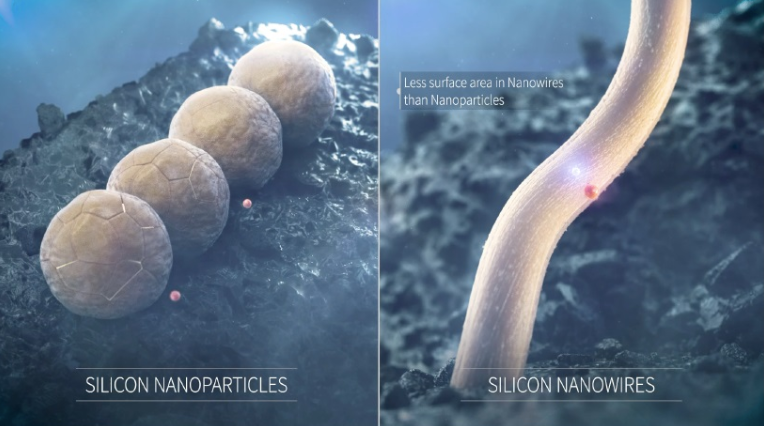
OneD Battery Sciences, based in California, has developed silicon nanowires that can be bonded directly onto commercial graphite particles found in battery anodes.
What is the effect? Potentially tripling the anode’s energy density, reducing charging periods, and lowering the battery’s overall cost.
According to PNNL Laboratory study, silicon has a theoretical energy capacity 10 times that of graphite and can absorb lithium-ions significantly faster while charging, lowering the charging time.
As a result, a number of corporations and automakers are looking into using silicon in the anode, with Tesla and Porsche already using modest amounts of the material in their Model Y and Taycan batteries, respectively.
However, adding silicon to the anode poses certain difficulties.
The material’s proclivity for expanding 400 percent of its original size during the charging cycle might shatter silicon particles and harm the layer of the solid electrolyte interface, obstructing lithium ion conductivity and electrical flow.
As a result, energy is lost and the battery is degraded.
Existing solutions to overcome this problem (such as silicon nanoparticles), according to Vincent Pluvinage, CEO of the startup, have proven restricted due to high manufacturing costs and lack of interoperability with the wider EV supply chain.
What is the answer proposed by OneD Battery Sciences?
The business has created a unique platform dubbed Sinanode, which uses silane, nitrogen, and electricity to connect silicon nanowires to the anode.
There are three major advantages to this method:
- The silicon nanowires don’t shatter during charging cycles since they’re pliable.
- The silicon triples the anode’s energy density by putting hundreds of thousands of wires on each graphite particle.
The CO2 produced per kWh for battery manufacture is lower when the silicon-to-graphite ratio is higher.
To read our blog “Audi’s most recent concept car is an immense urban electric vehicle,” click here