
Researchers have developed a novel small camera that uses an array of metalenses, or flat nanopatterned surfaces used to manipulate light, to capture high-quality wide-angle photos.
The novel technique could enable wide-angle cameras to be included into smartphones and portable imaging equipment for vehicles such as cars or drones by removing the bulky and heavy lenses currently required for this type of photography.
In Optica, the Optica Publishing Group‘s journal for high-impact research, Tao Li and colleagues from Nanjing University in China describe their new ultrathin camera. With a viewing angle of more than 120 degrees, the new camera, which is only 0.3 centimeters thick, can capture clear photographs of a scene.
Wide-angle photography is useful for capturing vast amounts of data and producing gorgeous, high-quality photos.
Wide-angle photography can improve performance and safety in machine vision applications like autonomous driving and drone-based surveillance, for example, by displaying an impediment you wouldn’t see otherwise while backing up a car.
“We used an array of metalenses that individually record various aspects of the wide-angle view to produce an incredibly tiny wide-angle camera,” Li explained. “After that, the photos are stitched together to generate a wide-angle image with no loss of image quality.”
The researchers employed an array of metalenses in their current study, each of which was meticulously built to focus a different range of illumination angles.
This enables each lens to photograph a portion of a wide-angle item or scene clearly. To construct the final image, the clearest elements of each image can be computationally stitched together.
The researchers employed nanofabrication to make a metalens array and placed it directly to a CMOS sensor to demonstrate the novel method, resulting in a planar camera that measured roughly 1 cm 1 cm 0.3 cm.

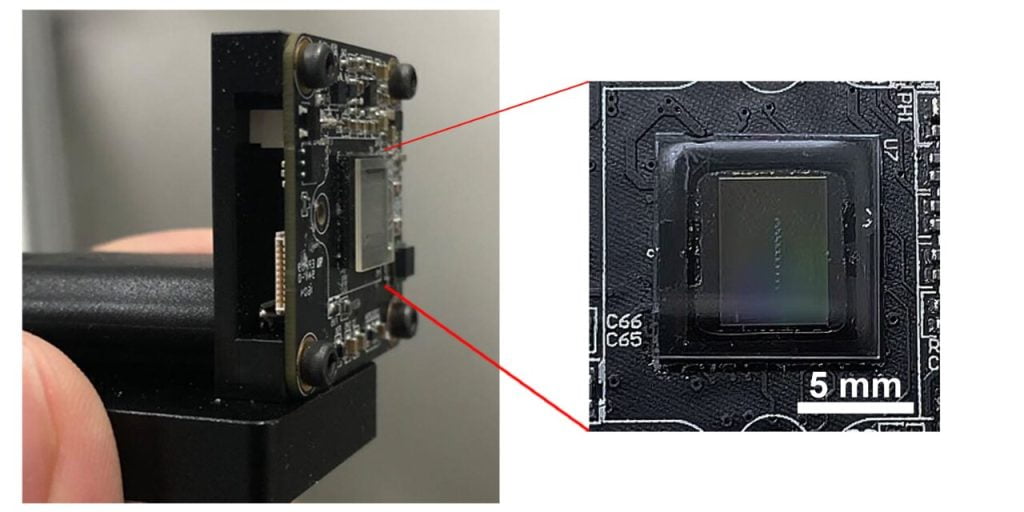
They then utilized this camera to photograph a wide-angle scene made by lighting a curved screen encircling the camera at a distance of 15 cm with two projectors.
While picturing the words “Nanjing University” projected across the curved screen, they compared their innovative planar camera to one based on a single standard metalens.
The planar camera created an image that clearly showed every word and had a viewing angle of more than 120°, which was more than three times that of a standard metalens camera.
The planar camera utilized in this study included individual metalenses that were only 0.3 millimeters in diameter, according to the researchers. To improve the camera’s imaging quality, they want to grow these to around 1 to 5 millimeters. The array could be mass produced after optimization to lower the cost of each unit.
To read our blog on “Now it’s the time to say Goodbye to expensive and big camera,” click here.