
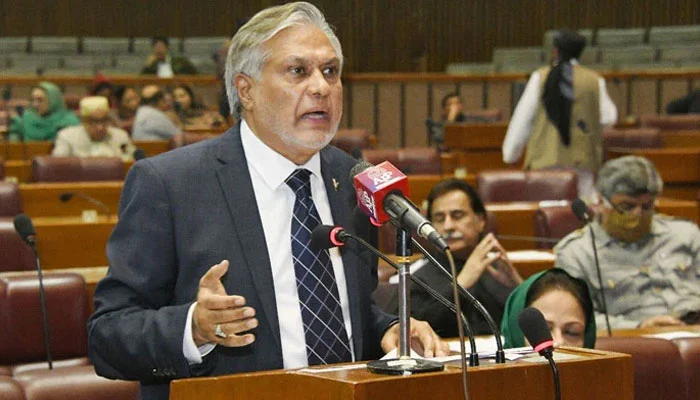
The National Assembly on Monday passed the Finance (Supplementary) Bill, 2023, a.k.a mini budget which calls for Rs. 170 billion in additional taxes and charges to be levied in order to comply with the agreement agreed with the IMF for the Extended Fund Facility.
As less than 70 parliamentarians were present when the mini budget was passed, none of the opposition lawmakers brought up the lack of a quorum in the House.
Rs. 170 Billion Mini Budget Details
The General Sales Tax will be raised from 17 to 18 percent under the proposed legislation, and the GST on luxury goods will be raised from 17 to 25 percent.
It has been suggested that a certain amount of Federal Excise Tax be placed on airfare for first, business, and club classes, with rates ranging from Rs. 250,000 to Rs. 75,000 of various tiers in accordance with the International Air Transport Association.
In addition, a 10% withholding adjustable advance tax will be applied on wedding hall payments in an effort to encourage simplicity and austerity.
Sugary and carbonated drinks will be subject to higher Federal Excise Duty rates, while the cost on cement would rise from Rs. 1.5 to Rs. 2 per kilogram.
Ishaq Dar, the finance minister, concluded discussion on the mini budget by stating that the government was aware of the issues caused by growing inflation but was required to take drastic action to rebuild the economy.
He claimed that an additional Rs. 40 billion had been set up by the government for the Benazir Income Support Program (BISP), enhancing the recipients’ monthly stipends by 25%. in relation to the austerity measures.
Ishaq Dar predicted that Shehbaz Sharif, the prime minister, would soon present a comprehensive plan to cut government spending before the National Assembly.
He emphasized that although price increases and inflation are genuine, the previous administration, which had an agreement with the IMF on extremely strict terms, had broken its pledge.
All of the amendments in the mini budget put forth by the opposition were rejected by the House. Maulana Abdul Akbar Chitrali, a member of Jamaat-e-Islami (JI), vehemently opposed the Finance (supplementary) Bill, arguing that the extra tax income would be used to repay the International Monetary Fund rather than to benefit the general populace.
He believed that the nation’s economic issues would be resolved if prominent politicians like Asif Zardari and Shehbaz Sharif contributed half of their wealth to the national coffers.
The House was presented with the National Commission for Minorities Bill, 2023. Mahmood Baqi Moulvi, a newly elected member of the National Assembly, took the oath of office earlier.
He was elected on the PTI platform to fill the seat left vacant by PTI MNA Dr. Amir Liaquat’s passing.
By a majority vote, the House approved changes to the mini budget, which established the Federal Excise Tax (FED) on business and club class flights in place of the previous rate of 20 percent or Rs50,000.
The National Assembly passed the law after Ishaq Dar, the minister of finance, proposed the adjustments.
Also, the Senate Standing Committee advised that the FED rate be set while taking into account the various destinations because doing otherwise would lead to misunderstanding.
For tickets in business and club class under tier-1 for Canada, North America, and South America, there will be a fixed FED rate of Rs. 250.000.
Business or club class tickets typically cost between Rs. 1.8 million and Rs. 2 million. The ticket for tier-II flights to the Middle East and Africa costs roughly Rs. 0.5 million, and there is a fixed Charge of Rs. 75,000 for business and club class flights.
The ticket price for Tier-II travel to Europe ranges from 0.8 to 1 million rupees. There would be a charge of Rs. 150,000 for the fixed FED rate.
The set FED rate for tier-III in the Far East, which includes Australia, New Zealand, and the Pacific Islands, will be Rs. 150,000.
Dar claimed that for stick shares traded outside of the stock exchange, a 10% advance withholding tax was applied by the government.
He claimed that in order to ensure that this tax was levied on shares that were not traded on stock exchanges, the government was making a technical adjustment.
Another modification approved that there would be no change in the brands of tier-1 and tier-II cigarettes with the application of higher FED rates in the mini budget.
To read our blog on “Senate approved Rs. 170 bn mini budget with reservations,” click here.