
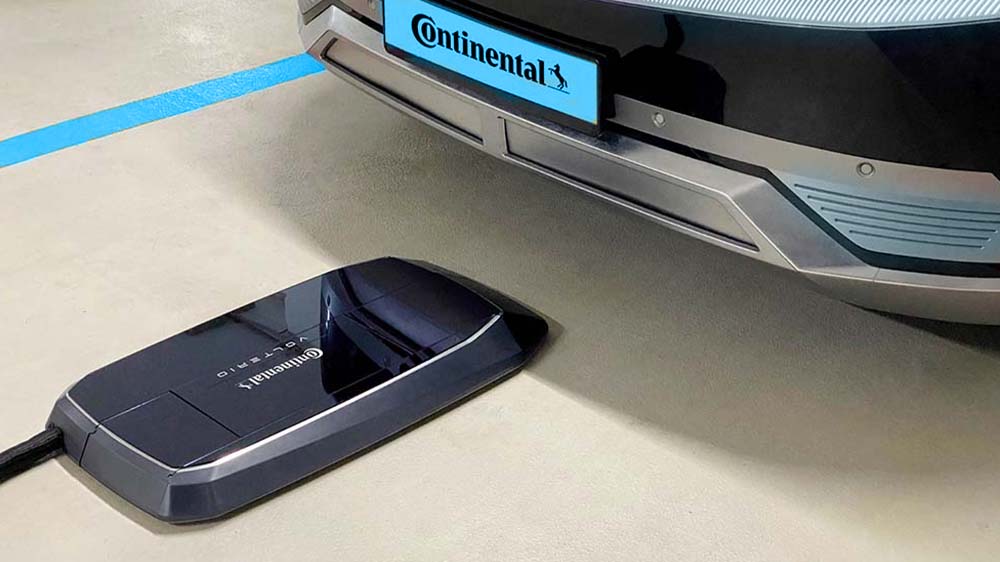
Continental Engineering Services (CES), a German automotive technology business, is collaborating with Volterio, an Austrian startup, to develop a smart EV-charging robot that can charge electric vehicles (EVs) independently. The mass production of this self-driving EV-charging robot is expected to commence in 2024.
Volterio sells automatic EV charging systems, while CES had already developed its own. Both companies have now joined together to develop a robot that can charge electric vehicles without the need for human intervention.
This autonomous charging robot, according to the firms, consists of a component linked to the electric vehicle’s undercarriage as well as a charging unit on the floor.
When the car approaches a parking location with an EV charging system, the two components communicate via ultra-broadband connection.
The EV’s floor charging device also uses this technology to automatically align with the undercarriage receiver and charge the battery onboard.
According to the companies, ultra-broadband communication is employed for alignment, with minimal power loss owing to the physical connection between the units during charging.
Because the floor unit may alter it’s positioning by up to 30 centimeters, this technology removes the need for drivers to exert extra effort when parking their cars.
Unlike current electric vehicles, this self-charging robot obviates the need for physical connections and is said to be safer and faster to use than current wire-based EV charging technology.
The autonomous charging robot, according to Christoph Falk-Gierlinger, Managing Director of CES, is a big step forward in the process of making electric mobility more practical and feasible for everyday use.
As part of its deal with CES, Volterio is responsible for delivering the system to near-production state by mid-2022, and CES will monitor the project till it reaches volume production in Germany in 2024.
To read our blog on “This year, a Dutch company will debut a solar-powered electric vehicle,” click here.