
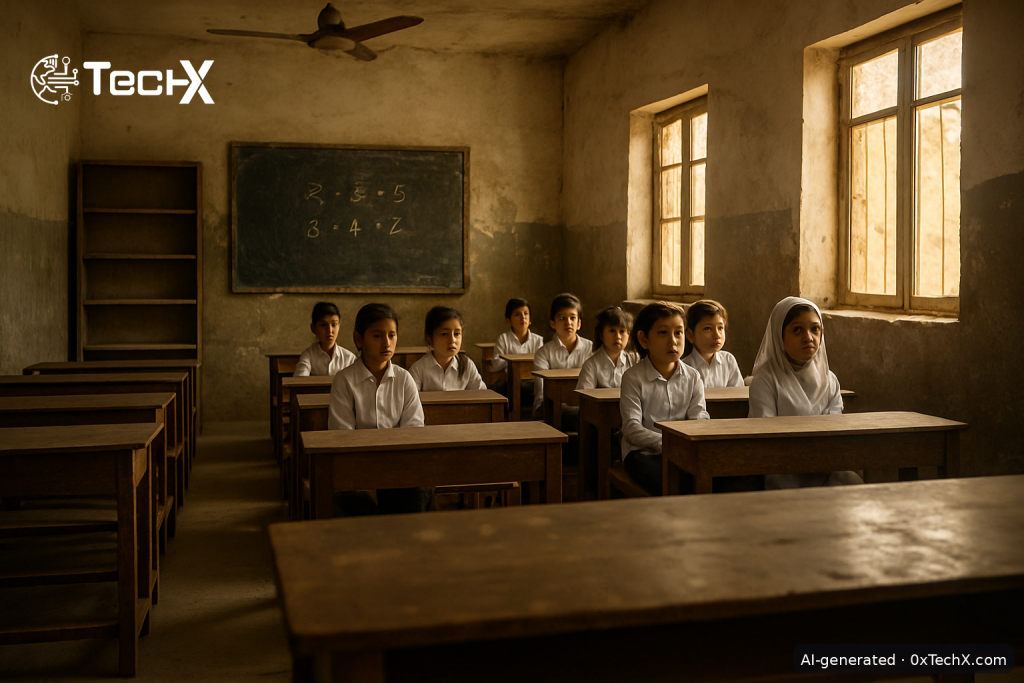
The Punjab AI primary schools initiative, designed to make Punjab the first province in Pakistan to teach artificial intelligence from Grade 1, has run into a serious wall before a single class has been held. Although education authorities have completed curriculum planning and announced the initiative as a landmark reform, the project remains in limbo because thousands of government schools lack the basic facilities needed to support technology-based education.
What the Punjab AI Primary Schools Plan Actually Says
The Punjab Education Curriculum Training and Assessment Authority (PECTAA) has put off the official notification for introducing AI as a subject in primary schools, even though it had approved AI instruction for students from Grade 1 to Grade 5, with plans to roll out the subject in the upcoming academic year.
Under the new curriculum, AI was meant to be taught as a standalone and compulsory subject, with a dedicated class period similar to other core subjects, and would be included in the formal examination system, meaning students would be required to pass the AI paper like other subjects.
PECTAA completed an AI curriculum covering areas ranging from basic computing to data science, machine learning, robotics and ethical AI. That is ambitious content for a Grade 1 child who, in many rural Punjab schools, has never touched a computer.
In 2025, the Punjab government formed PECTAA as a unified regulatory body by merging three institutions: the Punjab Examination Commission, the Punjab Curriculum and Textbook Board, and Quaid-e-Azam Academy of Educational Development. So this is a newly formed body, and the AI curriculum is one of its first major tests. Learn more about PECTAA on the Punjab School Education Department’s official site.
Why the Punjab AI Primary Schools Rollout Is Blocked
The problems are not one or two. They are stacked on top of each other, and each one alone would be enough to pause the plan.
No Computer Labs
Government records show that many primary schools do not have computer laboratories. In numerous rural schools, students have never used a computer, while unreliable electricity and weak internet connectivity remain major challenges.
No Official Notification, No Textbooks
The delay in formal notification is also holding up textbook preparation. Since the subject has not been officially notified, the printing of AI textbooks cannot proceed. This is a chain reaction: no notification means no books, no books means no lessons, no lessons means children lose another academic year.
No Trained Teachers
There are no specialised people at government schools who can teach AI courses. Officials acknowledge that qualified educators would need to be recruited on a contract basis just to get the subject off the ground. Training thousands of primary teachers across a province this large takes time and money that has not yet been confirmed.
The Cost Problem
Introducing AI as a full subject would require the establishment of computer labs at a cost of millions of rupees, which has caused delays in moving forward with the plan. For a province with thousands of government primary schools, the total bill would be enormous. Budget discussions are still ongoing, and no firm funding commitment has been made public.
Plan B: Adding AI to Existing Science Books
Facing these hurdles, authorities are not simply waiting. Faced with the high cost of setting up dedicated AI labs in thousands of primary schools, officials are weighing an alternative: incorporating AI concepts as a chapter within existing subjects rather than launching AI as a standalone subject.
Officials said the province has also prepared a backup plan in case of budget constraints. Under that option, basic AI lessons will be included in existing science textbooks. This would cost far less and could move faster, since it does not need new labs or new class periods. However, critics argue that a chapter buried in a science book is very different from a full subject taught by a specialist.
The gap between the two options captures a wider problem in Pakistan’s education system: ambitious policy announced at the top, practical reality ignored at the bottom. Understanding this gap is important context for Pakistan’s MoITT digital transformation roadmap, which also depends on building digital skills from the school level upward.
When Will This Actually Happen?
PECTAA officials said the matter remains under review and that a formal notification on the AI curriculum will follow once a final decision is reached. The original target was the upcoming academic year, but the new curriculum will now be implemented from the 2027-28 academic session at the earliest.
That means, at best, children starting Grade 1 today will be in Grade 2 or Grade 3 before AI ever appears in their classroom, and only if the labs, teachers, and budget are sorted out in time.
Why This Matters Beyond Punjab
The Punjab AI primary schools story is not just about one province. Punjab is Pakistan’s most populous province and sets the tone for education policy across the country. If it cannot clear these infrastructure hurdles, the chances of other provinces doing so are even lower.
The initiative is being pursued under the direction of Chief Minister Maryam Nawaz Sharif, who seeks to introduce AI education from the primary level through dedicated AI laboratories equipped with modern computing facilities, interactive learning tools and age-appropriate educational software. That political backing is real, but political will alone cannot plug a power socket into a school that has no electricity connection.
Pakistan’s young population is one of its biggest potential advantages. A child in Grade 1 today will enter the job market around 2040, when AI literacy will almost certainly be a basic professional skill, similar to reading and maths. Delaying Punjab AI primary schools by even two or three years has a long tail of consequences for millions of children and for the country’s tech workforce.
Frequently Asked Questions
What is PECTAA and what role does it play in this plan?
PECTAA stands for the Punjab Education Curriculum, Training and Assessment Authority. It was formed in 2025 by merging the Punjab Examination Commission, the Punjab Curriculum and Textbook Board, and Quaid-e-Azam Academy of Educational Development. It is the body responsible for approving curricula and issuing the official notification that would allow textbook printing and classroom rollout to begin.
Which grades does the Punjab AI curriculum cover?
Under the plan, students from Grade 1 to Grade 5 will study Artificial Intelligence as a regular subject, with a dedicated period allocated for it, similar to other core subjects. The subject was also meant to be part of formal exams.
What is the backup plan if full AI labs cannot be built?
Education officials are considering introducing AI concepts as chapters within existing subjects instead of launching a separate AI subject at the primary level. This is cheaper and faster but gives students much less hands-on experience.
When might the Punjab AI primary schools plan actually launch?
The full rollout is planned for the 2027 academic year. However, that timeline depends on resolving funding, setting up computer labs, and training teachers, none of which have firm deadlines yet. The official notification from PECTAA has not been issued as of late July 2026.