
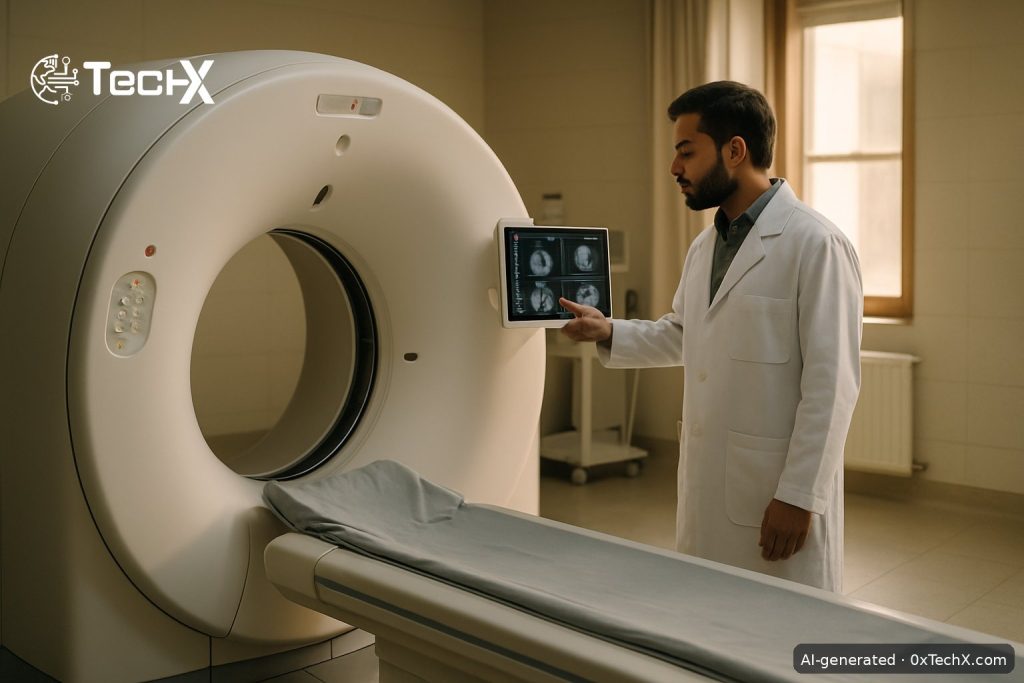
Punjab’s AI CT scanner plan is now official. During her visit to China on August 30, 2026, Chief Minister Maryam Nawaz met a high-level delegation from Alibaba Cloud and gave in-principle approval to bring an AI-powered multi-disease screening system to the province. The AI-powered Multi-Disease Screening Solution uses non-contrast CT and can potentially detect up to 10 diseases within two minutes. If the pilot goes ahead, it will be the first time any Pakistani province has deployed AI at this scale inside public hospitals.
What the AI CT Scanner Actually Does
Think of it as a very fast, very smart radiology assistant. A patient lies down for a CT scan. No injected dye is needed, which is what “non-contrast” means. The machine takes the images, and the AI analyses them almost instantly.
The system could assist healthcare professionals in disease screening, detection, diagnosis, treatment planning and subsequent management. But what makes this different from a normal CT scan is how many conditions it can flag in one sitting.
Which 10 Diseases Can It Detect?
According to the briefing, the technology could facilitate early screening and detection of several serious diseases, including pancreatic, liver, gastric, esophageal and colorectal cancers. The AI does not stop at cancer.
- It can also screen for Acute Aortic Syndrome and assess risks associated with cardiovascular diseases.
- The AI-powered system can evaluate fat and muscle health, assist in assessing osteoporosis and bone weakness, and help detect fatty liver disease.
Together, that list covers 10 conditions. For Pakistani patients who currently wait weeks for separate specialist appointments, getting a flag on all of these in one two-minute scan is a meaningful shift.
Why Non-Contrast CT Matters for Pakistan
Most existing coverage of this story skips over why non-contrast matters so much in a country like Pakistan. Standard contrast CT scans require an injected chemical dye, which costs more money, needs trained staff to administer, and can cause allergic reactions in some patients. Noncontrast CT is a low-cost and widely used imaging protocol, especially in low-resource regions.
That makes it a practical fit for Punjab’s busy public hospitals, where resources are always under pressure and patient volumes are high. The AI layer means one radiologist can review far more cases per day without sacrificing accuracy. AI is transforming radiology by helping doctors analyse CT scans, X-rays and MRIs, flagging possible cancers, cardiovascular problems, fatty liver and bone-related conditions, though these systems support rather than replace doctors, with accuracy varying by disease, scan quality and patient population.
How This Deal Came About
Punjab Chief Minister Maryam Nawaz Sharif met a high-level delegation of Alibaba Cloud, with the Chinese technology giant expressing keen interest in Punjab’s IT sector and praising the provincial government’s initiatives for AI-based governance.
Alibaba Cloud’s Senior Vice President Li Jiapeng welcomed the signing of a Memorandum of Understanding (MoU) in the presence of Prime Minister Muhammad Shehbaz Sharif and expressed keenness to explore expanded cooperation with Pakistan. Li Jiapeng noted that AI technology was currently being utilised for media campaigns and medical training, adding that it could significantly assist in cancer diagnosis and treatment.
The meeting discussed a potential strategic partnership between the Punjab government and Alibaba Cloud for utilising AI in public services, specifically in agriculture, healthcare, socio-economic programmes and climate forecasting.
What Happens Next
CM Maryam Nawaz directed the provincial health authorities to prepare a pilot project for introducing the system in Punjab, following her in-principle approval for its implementation. However, the Punjab government has yet to announce where the pilot will be launched or when the AI scanner will become operational.
The technology is intended to complement, rather than replace, conventional diagnostic methods, providing doctors with an additional tool for faster and more comprehensive assessment of patients. That is an important point for both patients and doctors to understand. A positive AI flag is not a diagnosis. It is a prompt for the doctor to look closer, run more tests, and decide what to do next.
Punjab has been building its AI credentials steadily. The province had become the first in Pakistan to establish a dedicated AI initiative, providing specialised AI training to cabinet members, government officers, and civil servants alike. Punjab is also building what it calls the world’s largest public-sector cancer hospital. Bringing an AI CT scanner into public facilities would add another layer to that broader health push.
For millions of Pakistanis in Punjab who currently have little or no access to early cancer screening, this pilot could matter a great deal. Pancreatic and esophageal cancers, two of the diseases on this scanner’s list, are often caught too late for effective treatment because early symptoms are easy to miss. A fast, affordable AI screen at a public hospital changes that equation, at least in theory, once the pilot proves itself in real-world conditions.
Pakistan’s wider digital ambitions, including efforts to attract global technology investment, align well with moves like this. You can read more about the country’s growing tech partnerships in our coverage of Pakistan’s full pavilion at LEAP 2026 in Riyadh, which shows the same outward push for technology collaboration.
Frequently Asked Questions
What is the Punjab AI CT scanner?
It is an AI-powered screening system that uses non-contrast CT technology, presented by Alibaba Cloud, capable of detecting up to 10 diseases in roughly two minutes. Punjab Chief Minister Maryam Nawaz approved a pilot of the system in August 2026 after a meeting with Alibaba Cloud executives in China.
Which diseases can the AI scanner detect?
The system can flag pancreatic, liver, gastric, esophageal and colorectal cancers, as well as cardiovascular disease risk, Acute Aortic Syndrome, fatty liver disease, osteoporosis and fat or muscle health issues. All of this comes from a single non-contrast CT scan.
Will the AI scanner replace doctors in Punjab hospitals?
No. The system is designed to support doctors, not replace them. It flags potential problems for a doctor to review. The final diagnosis, and any treatment decision, remains with a qualified medical professional.
When will the pilot start and where in Punjab?
As of August 31, 2026, the Punjab government has directed health authorities to prepare a pilot project, but no specific hospital or launch date has been announced yet. Updates are expected once the planning stage is complete.