
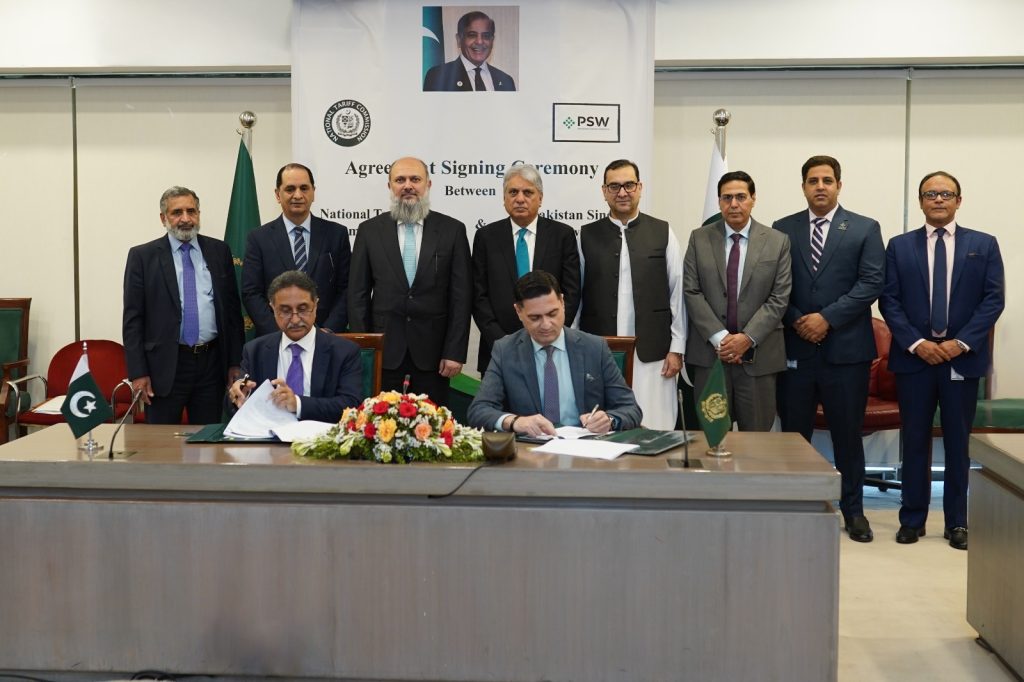
The PSW NTC digital agreement marks a significant step in Pakistan’s push to modernize its trade infrastructure. Pakistan Single Window (PSW) and the National Tariff Commission (NTC) have formally signed an Agreement for Automation and Digitization, aimed at streamlining tariff rationalization, real-time data sharing, and reducing processing delays for critical trade remedial actions — all under the Prime Minister’s broader vision to digitally transform Pakistan’s economic institutions.
PSW NTC Digital Agreement: What Was Signed and Why It Matters
The agreement was signed on 15 June 2026 in Islamabad by Dr. Jawwad Uwais Agha, Chairman of the NTC, and Syed Aftab Haider, Chief Executive Officer of PSW. The ceremony was attended by Federal Minister for Commerce Jam Kamal Khan, Dr. Muhammad Saeed (Technical Advisor to the Prime Minister), Secretary Ministry of Commerce Jawad Paul, and senior officials from both institutions including Syed Shakeel Shah, Head of Customs Administration and Member Customs Operations at FBR.
The PSW NTC digital agreement covers three core areas: automated data sharing between the two organizations, digitization of NTC’s internal processes for tariff and trade policy analysis, and the reduction of dwell-time for trade remedial actions. These actions include anti-dumping duties, countervailing duties, and safeguard measures — instruments that are central to protecting domestic industries under WTO trade defence rules.
Digitalization as a Catalyst for NTC Reform
Federal Minister Jam Kamal Khan praised the NTC’s pace of institutional transformation, calling digitalization a critical enabler. “A robust, digitalized NTC is essential for supporting a high-growth economy and ensuring that Pakistan’s trade defence mechanisms are aligned with global best practices,” he stated at the signing ceremony.
Chairman NTC Dr. Jawwad Uwais Agha framed the development as more than a technology upgrade. “Today’s signing is not merely about new software; it is about institutional evolution. Digitalization will reduce our case dwell times, sharpen investigative precision, and create a transparent, predictable trade regime through our Tariff Policy Centre that strengthens the competitiveness of Pakistan’s trading environment,” he said.
PSW CEO Syed Aftab Haider echoed the sentiment, noting that integrating NTC’s tariff functions into PSW’s digital ecosystem would create stronger institutional linkages. “By integrating NTC’s critical tariff functions into the PSW digital landscape, we are creating stronger institutional linkages and fueling NTC’s transformation with real-time, shared trade data,” he remarked.
How the PSW NTC Digital Agreement Will Work in Practice
Pakistan Single Window, which operates as the country’s unified digital platform for trade facilitation, will now serve as a data pipeline for NTC’s tariff analysis and investigation workflows. The integration is expected to give NTC analysts access to live customs and trade data, enabling faster and more evidence-based decisions on tariff adjustments and trade remedy cases.
This kind of institutional data integration mirrors international best practices seen in single window frameworks promoted by the World Customs Organization, where cross-agency data sharing reduces duplication, speeds up compliance, and improves the accuracy of trade intelligence.
Key Outcomes Expected from the Agreement
- Faster trade remedy decisions: Reduced dwell-time for anti-dumping, countervailing, and safeguard investigations.
- Real-time data access: NTC gains live trade data feeds through the PSW platform.
- Tariff policy analysis: Automated tools to support evidence-based tariff rationalization.
- Institutional transparency: Digitized processes that create a more predictable trade environment for businesses.
Broader Context: Pakistan’s Digital Trade Push
The PSW NTC digital agreement is part of a wider government agenda to bring Pakistan’s trade governance infrastructure in line with modern digital standards. PSW has already connected multiple regulatory agencies under a single digital window, and this latest integration with NTC further consolidates that ecosystem.
For businesses engaged in import-intensive sectors or industries seeking trade protection, the reforms signal a more responsive and data-driven NTC — one capable of acting swiftly on complaints and policy recommendations. The digitization of tariff processes also reduces the scope for procedural delays that have historically slowed Pakistan’s trade defence mechanisms.
With trade policy increasingly shaped by data analytics and automation globally, the PSW NTC digital agreement positions Pakistan’s regulatory bodies to operate with greater agility. The agreement’s emphasis on transparency and predictability also aligns with investor confidence requirements in the digital economy era.
Conclusion
The formal signing of the PSW NTC digital agreement represents a concrete institutional step toward a more efficient, data-integrated, and transparent trade regime in Pakistan. As both organizations move into implementation, the impact on trade remedy timelines and tariff policy quality will be a key indicator of the initiative’s success.