
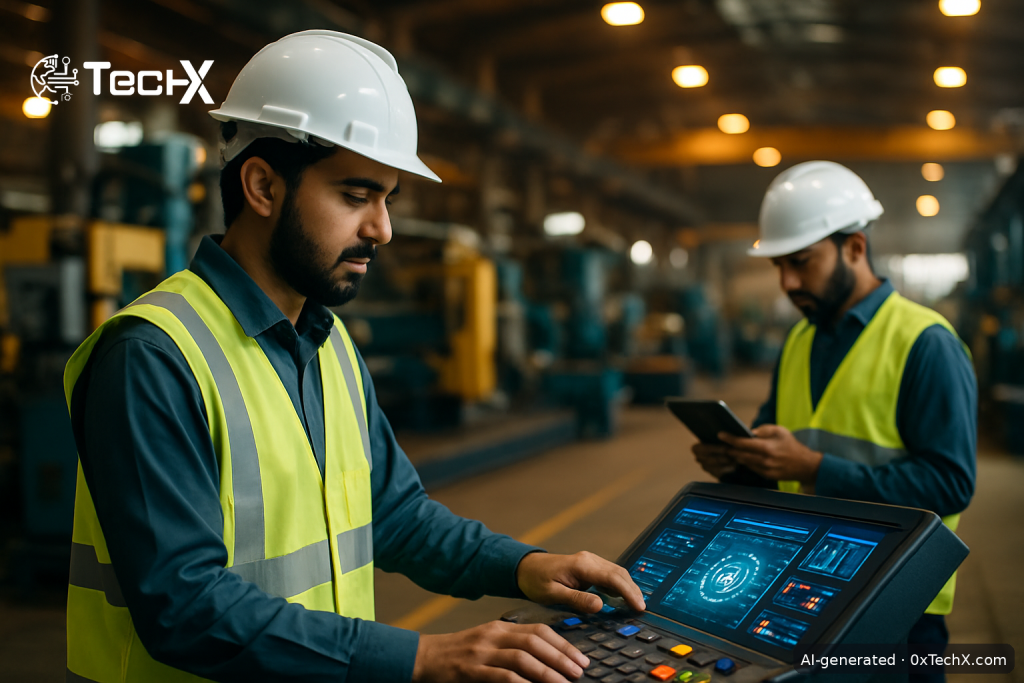
Pakistan’s first industrial AI centre is now a formal commitment. On July 24, 2026, the Pakistan Industrial Development Corporation (PIDC), the National University of Technology (NUTECH) in Islamabad, and NED University of Engineering and Technology (NED UET) in Karachi signed a Memorandum of Understanding (MoU) to create the Centre for Industrial Innovation and Artificial Intelligence, known as CIINAI. The signing happened at NUTECH’s campus and marks the first time Pakistan has tied government industry funding, an engineering university in Islamabad, and one in Karachi together under a single factory-focused AI mandate.
What Is CIINAI and Where Will It Be?
CIINAI is not a research lab that produces white papers and stops there. The plan is to build a working, physical facility inside the Korangi Creek Industrial Park (KCIP) in Karachi, one of the country’s busiest manufacturing zones. That location matters. Placing the centre inside an active industrial park means engineers and factory managers can walk in, test new tools, and take them back to the shop floor the same day.
PIDC will build and run the facility. NUTECH and NED UET will supply the research talent, technical expertise, and training programmes. Together, the three partners aim to create what officials are calling a single platform where academia, government, and industry all work in one place rather than in separate silos.
Who Signed the Industrial AI Centre MoU?
Three officials put their names to the agreement. PIDC CEO Rizwan Ahmed Bhatti signed on behalf of the corporation. NUTECH Registrar Brigadier (Retd.) Salman Zafar represented the university. NED UET Vice Chancellor Prof. Dr. Muhammad Tufail completed the trio. Special Assistant to the Prime Minister on Industries and Production, Haroon Akhtar Khan, was present at the ceremony and has been leading the initiative inside the government. The move is formally tied to Prime Minister Shehbaz Sharif’s push to build a technology-driven industrial economy in Pakistan.
What Will CIINAI Actually Do for Factories?
For factory owners and plant managers, the practical offer is what counts. The centre will provide four main services:
- Industrial AI solutions, tools that let machines predict their own breakdowns before they happen, cutting unplanned downtime and repair costs.
- Advanced and 3D manufacturing support, access to modern fabrication technology that many small and mid-size Pakistani manufacturers currently cannot afford on their own.
- Applied research and development, university researchers working directly with factory teams to solve real production problems, not just academic ones.
- Technical training and capacity building, structured programmes to upskill engineers and workers so the benefits of new technology actually spread inside a company rather than staying with one specialist.
One of the clearest advantages of putting an industrial AI centre inside a working industrial park is speed. When researchers and factory managers share a campus, new ideas move from lab to production line much faster than when they are separated by city traffic and bureaucratic channels.
The Problem CIINAI Is Trying to Fix
Pakistan’s manufacturing sector has long suffered from a gap between what universities teach and what factories actually need. Engineering graduates often arrive at a plant without hands-on experience with modern production tools, while factory owners struggle to know which new technologies are worth the investment. CIINAI is designed to close that gap by keeping both groups in the same building.
There is also a competitiveness angle. Pakistani exporters compete with manufacturers in countries that have already adopted AI-driven quality control and predictive maintenance. A facility that gives local producers access to the same tools, without each company having to set up its own AI department, can level the playing field for small and medium manufacturers who make up a large share of Pakistan’s industrial base.
Pakistan’s broader digital ambitions are also relevant here. The government’s push on IT exports and cloud infrastructure is well documented, and you can read more about related public-sector digital initiatives in our coverage of the PM Cloud Programme and Pakistan’s sovereign cloud era. CIINAI adds a manufacturing-sector dimension to those efforts that had been missing until now.
Government Targets and the National Industrial Policy
Haroon Akhtar Khan, speaking at the signing ceremony, said that tying industry, academia, and research institutions together is a top priority under the National Industrial Policy. The centre is meant to create new opportunities for engineers, researchers, and factory operators while also building the kind of technical credibility that attracts foreign industrial partnerships.
Officials see CIINAI as a model that can be replicated in other industrial zones across Pakistan if the Karachi pilot proves effective. The Korangi Creek location gives it immediate access to hundreds of active manufacturing units in textiles, chemicals, light engineering, and packaging, exactly the sectors that have the most to gain from AI-driven efficiency gains.
Pakistan’s IT exports crossed $4.6 billion in FY26 but the industrial sector has so far been slower to adopt digital tools at scale. An industrial AI centre backed by government infrastructure funding and two strong engineering universities could change that trajectory in a meaningful way for domestic manufacturing output.
What Comes Next
The MoU is the starting point, not the finish line. PIDC now needs to fit out the facility at KCIP with the advanced manufacturing machinery and AI-driven systems described in the agreement. NUTECH and NED UET must deploy faculty and research teams to the site. A sustainable operational model, likely combining government funding with fee-based services to industry, will determine whether CIINAI becomes a lasting institution or stays a pilot project.
For Pakistani engineers and young graduates, the centre represents something concrete: a place where cutting-edge skills can be developed inside Pakistan, for Pakistani industry, without needing to go abroad for exposure to modern manufacturing technology.
Frequently Asked Questions
What does CIINAI stand for?
CIINAI stands for Centre for Industrial Innovation and Artificial Intelligence. It is Pakistan’s first government-backed facility dedicated to bringing AI and advanced manufacturing tools directly to the factory floor.
Where will the CIINAI industrial AI centre be built?
The centre will be built and operated by PIDC inside the Korangi Creek Industrial Park (KCIP) in Karachi, placing it at the heart of one of Pakistan’s busiest manufacturing zones.
Who are the three partners behind CIINAI?
The Pakistan Industrial Development Corporation (PIDC) will build and manage the facility. The National University of Technology (NUTECH) in Islamabad and NED University of Engineering and Technology (NED UET) in Karachi will provide research expertise and technical training programmes.
How will CIINAI help Pakistani manufacturers?
CIINAI will offer factory owners access to industrial AI tools for predictive maintenance, 3D and advanced manufacturing equipment, applied R&D support, and training programmes for their engineers, all in one place, without each company having to build these capabilities from scratch on its own.