
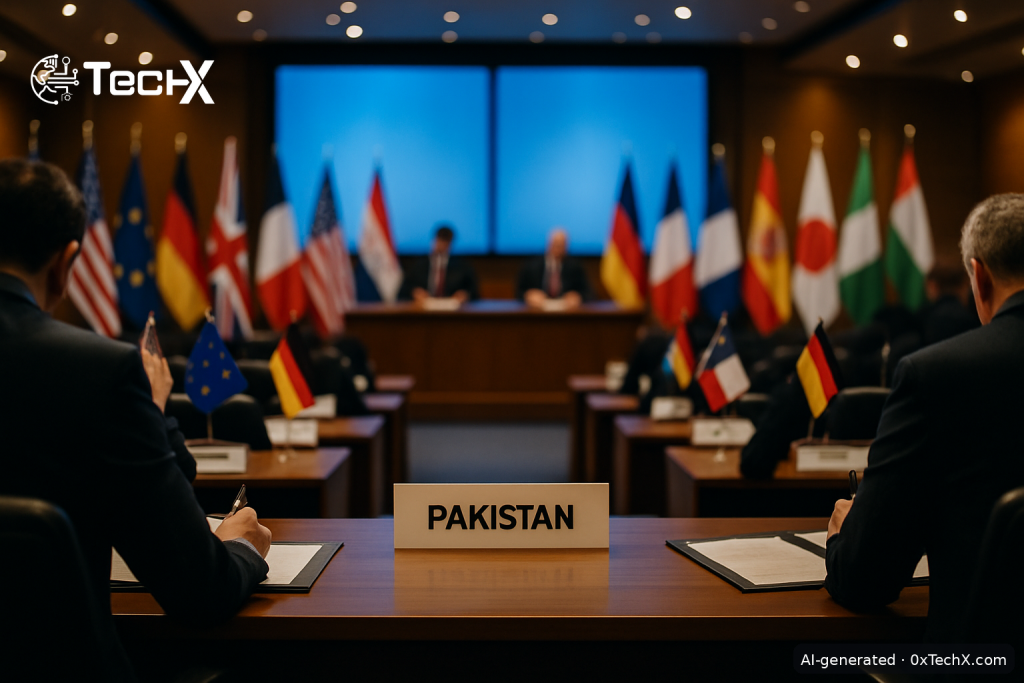
Pakistan WAICO founding member status became official on 16 July 2026, when Deputy Prime Minister and Foreign Minister Ishaq Dar signed the founding agreement of the World Artificial Intelligence Cooperation Organisation in Shanghai. The new body, backed by China and joined by 28 other nations, is the most serious attempt yet to build a rival to the Western-led system of AI rules, and Pakistan is right at the table from day one.
What Is WAICO and Why Was It Created?
WAICO stands for the World Artificial Intelligence Cooperation Organisation. It is an independent intergovernmental body headquartered in Shanghai, established to promote global cooperation on AI development, safety, and governance.
The idea started in July 2025, when Chinese Premier Li Qiang announced a plan for such an organisation at the annual World Artificial Intelligence Conference (WAIC) in Shanghai. That plan came with a 13-point Global AI Governance Action Plan covering AI safety, data standards, and building tech capacity in poorer countries. One year later, the plan became real.
On 16 July 2026, representatives from 29 countries gathered in Shanghai and signed the founding agreement. UN Secretary-General António Guterres attended the ceremony. Chinese Foreign Minister Wang Yi signed on behalf of Beijing. The four-day World Artificial Intelligence Conference then opened the next day, with President Xi Jinping calling on all nations to cooperate on AI and warning that no single country should be allowed to dominate the technology.
Which Countries Joined as WAICO Founding Members?
The 29 founding members are spread across Asia, Africa, Latin America, and Eastern Europe. They include Russia, Brazil, Indonesia, Kazakhstan, Laos, Belarus, Serbia, Cuba, Venezuela, South Africa, Senegal, Malaysia, and Pakistan, among others.
What unites most of them is a shared frustration: they feel left out of AI rules written in Washington or Brussels. The European Union has its AI Act. The United States has a patchwork of executive orders. WAICO offers a third path, one designed to appeal to nations that want a seat at the table without adopting someone else’s values framework.
Pakistan WAICO Founding Member: How Did This Happen?
Pakistan’s membership did not come out of nowhere. During Prime Minister Shehbaz Sharif’s official visit to China in May 2026, Pakistan formally endorsed China’s WAICO proposal, describing it as a step toward making AI development work for all countries. That groundwork meant Pakistan was ready to sign the moment the ceremony happened.
Deputy PM Ishaq Dar arrived in Shanghai on a two-day official visit at the invitation of Chinese Foreign Minister Wang Yi. After signing the WAICO agreement, Dar also attended a High-Level Meeting on Global AI Governance on 17 July and held bilateral talks with Wang Yi, where both sides reaffirmed their all-weather partnership and discussed expanding cooperation under CPEC 2.0, digital economy projects, and AI.
Dar said Pakistan is proud to be a founding member and hopes the alliance will strengthen cooperation with China and other countries in AI research and development. Wang Yi noted that Pakistan’s participation in WAICO is in the long-term interest of the country and its people.
What Pakistan Gets From Joining WAICO
Pakistan has been moving fast on AI policy at home. The government approved a National AI Policy in 2025 and committed to spending $1 billion by 2030 to build sovereign AI computing infrastructure and run national skills programmes. Earlier in 2026, Pakistan also joined a China-backed sovereign AI initiative focused on national control over AI systems and data.
Being a Pakistan WAICO founding member adds an international dimension to that domestic push. Here is what the membership could mean in practice:
- Access to AI tools and training: WAICO’s stated goal is to close the global AI gap. Developing countries like Pakistan could get access to AI capacity-building programmes, shared computing resources, and research partnerships that would otherwise be hard to secure alone.
- A voice in rule-making: WAICO gives Pakistan a seat in discussions about how global AI standards are written. That matters because the rules set today will shape the AI products and services that Pakistani businesses and developers can use and sell tomorrow.
- Deeper China-Pakistan tech ties: Joining the same AI body as China strengthens the digital side of the broader bilateral relationship, including links to CPEC 2.0. Pakistani tech companies could find it easier to collaborate with Chinese AI firms through WAICO-facilitated channels.
- Global South solidarity: Pakistan has pledged to champion equitable access to AI for developing nations. That role raises Islamabad’s profile in international tech diplomacy at a time when Pakistan’s IT exports are already growing strongly. In fact, Pakistan’s IT exports hit a record $4.6 billion in FY26, showing the sector’s growing weight in the economy.
The Bigger Picture: US vs China AI Governance Battle
WAICO does not exist in a vacuum. It is the latest move in a broader contest between the United States and China over who gets to write the rules for one of the most powerful technologies ever built.
The US has pulled back from many international AI governance forums recently. Analysts say this has left a gap that Beijing is keen to fill, especially by building alliances with middle-income and lower-income countries whose combined voting weight counts at the United Nations. China has already filed more generative AI patents than any other country, over 43,000 between 2024 and 2025, and it holds strong advantages in data centre infrastructure even where it lags on cutting-edge chips.
WAICO is built on a different philosophy from Western-led bodies. It does not require members to pass a values test before joining. Instead, it frames membership around sovereignty, development, and open cooperation, which is a far more attractive offer for governments in the Global South that want AI benefits without political conditions attached.
However, WAICO still has real questions to answer. The founding agreement does not spell out voting rules, financial commitments, enforcement powers, or how the body will relate to existing UN processes. Those details will determine whether WAICO becomes a functioning institution or stays mostly a diplomatic talking shop. Experts note that a headquarters and a founding agreement create a legal shell, but real authority depends on what member states do next.
What Pakistani Tech Professionals Should Watch
For developers, startups, and digital businesses in Pakistan, the practical benefits of WAICO will take time to show up. In the near term, the most useful things to watch are:
- Whether WAICO sets up AI capacity-building programmes that Pakistani universities and companies can join.
- Whether joint AI standards emerge that make Pakistani-built AI products easier to sell in member countries.
- How Pakistan’s National Center of Artificial Intelligence (NCAI) at NUST engages with the new body, as its chairman has already welcomed the move as a boost for Pakistan-China AI collaboration.
- Whether CPEC 2.0 digital projects get a new layer of AI cooperation linked to WAICO membership.
The rules being written now in Shanghai, Brussels, and Washington will define the global AI economy for years. As a Pakistan WAICO founding member, Pakistan at least has a chair in the room where those decisions are being made.
Frequently Asked Questions
What does WAICO stand for?
WAICO stands for the World Artificial Intelligence Cooperation Organisation. It is a new intergovernmental body headquartered in Shanghai, China, created to promote international AI cooperation and governance, with a focus on helping developing countries access and benefit from AI.
Is Pakistan a founding member of WAICO?
Yes. Pakistan is one of the 29 founding members of WAICO. Deputy Prime Minister and Foreign Minister Ishaq Dar signed the founding agreement in Shanghai on 16 July 2026 on behalf of Pakistan.
How is WAICO different from the EU AI Act or US AI rules?
The EU AI Act is a binding law that applies across the European Union. US rules are mostly executive orders and sector guidelines. WAICO is an intergovernmental organisation focused on cooperation and capacity-building, open to any sovereign state. It does not impose a shared values test for membership, which makes it more accessible to Global South countries.
Will WAICO replace the UN’s role in AI governance?
No. WAICO’s founding agreement says it will support, not replace, the United Nations’ role in AI governance. The organisation is designed to work alongside UN processes and agencies such as the International Telecommunication Union. However, analysts say China hopes WAICO will shape how AI policy debates are framed at the UN level over time.