
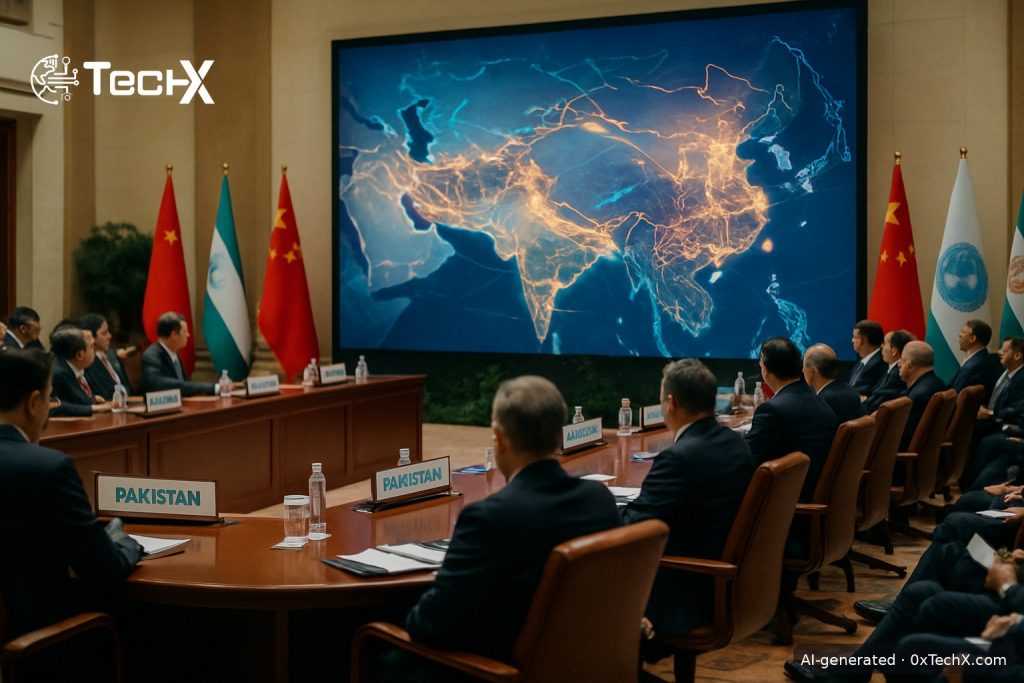
Pakistan’s official position at the SCO Digital Economy Forum in Urumqi on September 15 marks a clear break from the past: the country is no longer satisfied just exporting IT services, and it wants to build and sell tech products, digital platforms, and whole technology-driven industries to the world. Planning and Development Minister Ahsan Iqbal made this declaration at the 2026 Shanghai Cooperation Organisation’s flagship digital gathering in China’s Xinjiang region, laying out a four-point cooperation plan that could reshape how Pakistani IT firms think about growth.
From Services to Products: What Changed at the SCO Digital Economy Forum
For years, Pakistan’s technology economy has been built on services, software outsourcing, freelancing, and call-centre work. Pakistan is now moving beyond the export of IT services towards technology products, digital platforms, and technology-driven industries as part of a broader agenda for economic transformation. That sentence, spoken at the SCO Digital Economy Forum, is the clearest signal yet that Islamabad wants its IT sector to climb up the value chain.
The timing matters. Pakistan’s IT and ICT exports reached a record $4.6 billion during the last fiscal year. That is a strong base, but ministers clearly feel services income alone will not get Pakistan to its bigger economic goals. The government is pursuing a broader economic agenda under Uraan Pakistan, with a focus on exports, productivity, innovation, investment, and human resource development to achieve the target of a $1 trillion economy by 2035.
For Pakistani software companies and startups, this policy direction matters more than it may first appear. Selling a service means billing by the hour; selling a product or platform means recurring revenue, global scale, and much higher valuations. The shift the minister described is not just a talking point, it is a different business model that the government is now officially backing at the regional level.
Four Proposals Pakistan Put on the Table
Ahsan Iqbal did not just announce ambitions. He walked into the SCO Digital Economy Forum with four concrete cooperation areas for SCO member states.
1. A Digital Trade Corridor
Pakistan proposed establishing a digital trade corridor under the SCO to make cross-border trade faster, easier, and less expensive. The proposal includes connecting customs systems, logistics networks, electronic trade documentation, digital signatures, and cross-border payment systems across the region. For Pakistani businesses that currently struggle with slow and expensive international payments, a linked SCO payment corridor would be a practical fix, not just a diplomatic phrase.
2. An SCO Digital Connectivity and Compute Corridor
Ahsan Iqbal proposed the establishment of an SCO Digital Connectivity and Compute Corridor, combining stronger cross-border fibre links, resilient networks, data centres, satellite connectivity, and interoperable cloud and computing resources. At home, Pakistan is executing a massive broadband expansion, scaling fibre-optic connections from three million to over five million, with an immediate target to bring high-speed wired broadband to 10 million households.
3. Joint AI Infrastructure and Governance
The minister proposed a joint SCO system for AI infrastructure and governance, saying the region should promote joint research, multilingual AI models, university partnerships, and human resource development. Domestically, Pakistan is enhancing its capabilities in artificial intelligence, cybersecurity, cloud computing, semiconductors, advanced industry, and emerging technologies. Seven AI centres are being established to connect research, skills, startups, and industry.
4. An SCO Digital Governance and AI Capacity-Building Network
Ahsan Iqbal proposed the establishment of an SCO Digital Governance and AI Capacity-Building Network to connect governments, civil-service academies, universities, national technology centres, research institutions, and private-sector innovators across member states. He stressed that successful digital transformation required skilled people, capable institutions, adequate financial resources, and governance arrangements that enabled the secure and responsible use of data and emerging technologies.
Pakistan’s Digital Numbers Shared at the Forum
The minister used hard numbers to make Pakistan’s case to SCO partners. Pakistan’s digital user base has surpassed 150 million, while the country’s IT exports have reached a record $4.6 billion. Data usage in Pakistan increased by 25 per cent over the past two years, and the number of fibre-optic connections rose from around three million to more than five million. On inclusion, the gender gap in mobile internet usage narrowed from 35 per cent to 8 per cent, while mobile internet usage among women increased from 33 per cent to 45 per cent.
These figures matter because SCO member states include large economies like China, Russia, and India (as a dialogue partner) alongside smaller Central Asian countries. Pakistan showing real progress, not just plans, gives its proposals credibility at the table.
The Domestic Policy Framework Behind the Push
Pakistan has placed digital transformation at the centre of its national development agenda, with E-Pakistan as one of the five principal pillars of URAAN Pakistan. The Digital Nation Pakistan Act 2025, the Pakistan Digital Authority, and the National AI Policy are key steps towards digital public services, data-driven policymaking, and responsible artificial intelligence.
Pakistan’s geographic position makes it an important link between China, Central Asia, South Asia, and the Middle East. Ahsan Iqbal used that geography argument to push CPEC 2.0’s role: CPEC 2.0 and Special Economic Zones could help connect Chinese technology and Pakistani business capabilities with regional markets.
Pakistani IT companies, especially those already on the list of PSEB-registered firms operating under special provisions, stand to benefit if these corridors and platforms move from proposal to practice. Likewise, the AI ecosystem push connects directly with broader efforts like Quantum Valley Pakistan, which is already trying to link universities, startups, and capital in one place.
What This Means for Pakistani IT Firms and Investors
The signal from Urumqi is aimed at more than diplomats. Three groups should pay close attention:
- IT startups and SaaS companies: Government policy is now aligned with product-led growth. If the trade corridor and payment proposals gain traction, selling digital products across Central Asia and the Middle East becomes much more practical.
- Investors: A formal SCO digital cooperation framework, if it materialises, creates a larger addressable market for Pakistani tech firms. Pakistan is moving from AI awareness to AI adoption, and from adoption to measurable economic and social impact.
- Freelancers and digital exporters: The call for integrated cross-border payment systems is directly relevant to the long-running problem of expensive and slow international transfers that eat into Pakistani freelancers’ earnings.
The proposals still need to move from forum speeches to signed agreements and funded projects. But the direction, officially stated at the SCO Digital Economy Forum, is now on record, and that matters for planning. You can follow the official Shanghai Cooperation Organisation portal and the Uraan Pakistan programme page for updates as these proposals develop.
Frequently Asked Questions
What did Pakistan announce at the SCO Digital Economy Forum?
Pakistan officially announced it is shifting from IT services exports to tech products, digital platforms, and technology-driven industries. The government also proposed four cooperation areas: a digital trade corridor, an SCO compute corridor, joint AI infrastructure, and a digital governance network.
What is the SCO Digital Economy Forum?
The SCO Digital Economy Forum is a gathering of ministers and senior officials from Shanghai Cooperation Organisation member states to align policies and launch projects on digital trade, AI, and connectivity. The 2026 edition was held in Urumqi, China.
How big are Pakistan’s IT exports right now?
Pakistan’s IT and ICT exports reached a record $4.6 billion during the last fiscal year. The government’s target under Uraan Pakistan is a $1 trillion economy by 2035, with digital industries playing a central role.
Why does the payment corridor proposal matter for Pakistan?
Pakistani businesses and freelancers regularly face delays and high costs when receiving international payments. An SCO-wide linked payment system, as proposed by the minister at the SCO Digital Economy Forum, would reduce friction and cost for cross-border digital trade across a region that includes over a dozen countries and billions of consumers.