
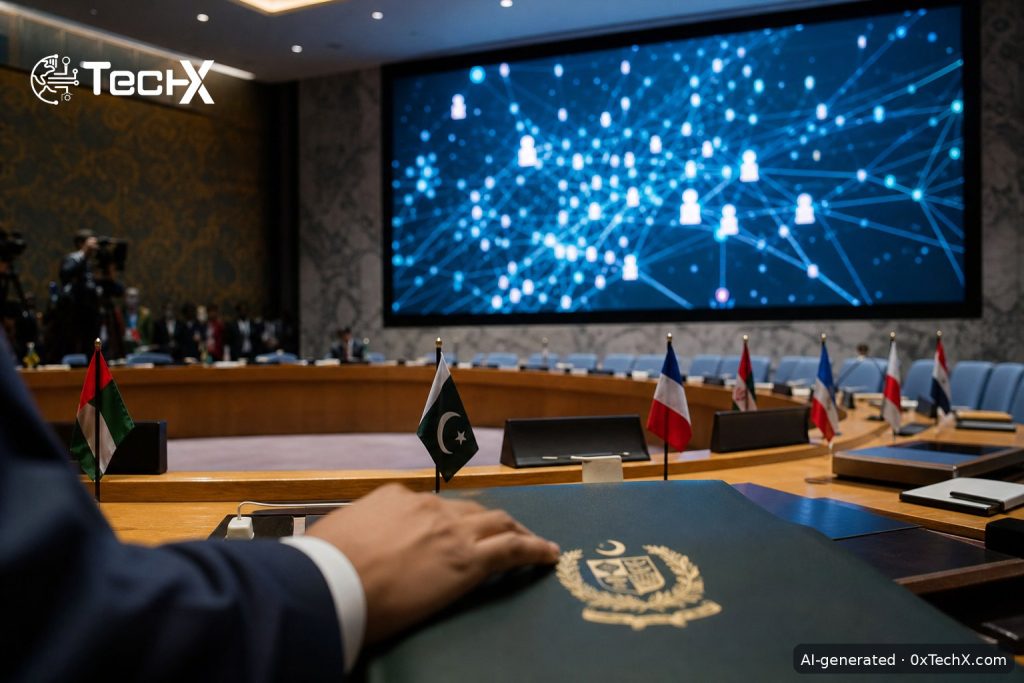
Tech giants’ algorithmic influence over online speech is now a formal concern for Pakistan at the United Nations. On 3 November 2026, Pakistani diplomat Amanat Ali addressed the UN General Assembly’s Fourth Committee in New York, warning that multinational technology corporations are quietly shaping what billions of people see, believe, and say online, with little accountability and even less transparency.
What Pakistan Said at the UN
Addressing the Fourth Committee during a debate on information, Pakistani diplomat Amanat Ali called for greater international cooperation to protect the integrity of information online, warning that emerging technologies could be used to manipulate public opinion and undermine trust.
“We must address the growing concentration of influence among multinational technology corporations and digital platforms, whose opaque algorithms and content policies increasingly shape public discourse,” Ali said, according to a statement released by Pakistan’s UN mission.
“Internet shutdowns, censorship, digital surveillance and restrictive media laws are employed to suppress legitimate voices, distort realities and delegitimize struggles for fundamental rights and self-determination,” Ali told the committee as it began its review of questions relating to information.
He emphasised that misinformation, disinformation, and hate speech are no longer just communication failures, but actively weaponised instruments used to polarize societies and destroy public trust, posing a severe threat in conflict zones.
The Islamophobia and Conflict Angle
Pakistan called for stronger efforts to counter Islamophobia, racism and xenophobia, warning of the broader dangers posed by hate speech and intolerance in an increasingly polarized information environment.
The concern goes beyond abstract principle. Pakistan has repeatedly pointed to Kashmir and Gaza as cases where it believes platform decisions, what gets amplified, what gets removed, whose posts get suppressed, tilt coverage in favour of occupying powers. Ali explicitly targeted strategic information blockades enforced by occupying powers, and concluded by urging the UN Department of Global Communications to prioritize multilingualism and leverage local UN Information Centres to broadcast credible, balanced coverage.
Tech Giants’ Algorithmic Influence and Pakistan’s Own Users
This is not just a diplomatic talking point for Pakistan, it has direct stakes at home. Pakistan is one of the world’s largest social media markets. According to PTA data covered in our earlier report, Pakistan has 96 million YouTube users and 100 million TikTok users, numbers that make algorithmic decisions by these platforms deeply consequential for Pakistani public discourse.
Research identifies algorithmic amplification as a key driver of polarisation in Pakistan, noting that algorithms create echo chambers by showing users content that aligns with their existing beliefs, reinforcing confirmation bias and limiting exposure to diverse viewpoints.
Major social media platforms, including Facebook, YouTube, X (formerly Twitter), Instagram, and WhatsApp, are widely exploited for youth radicalization and recruitment by extremist groups in Pakistan, which is part of why Islamabad wants these platforms held to a higher, clearer standard.
A Pattern of Pressure, Not a One-Off Warning
What most coverage of this story misses is that this is not Pakistan’s first time making this argument at the UN. The same diplomat, Amanat Ali, addressed the same Fourth Committee on the same agenda item in November 2024 and November 2025. Each year the language has grown sharper. In 2025, the framing was “information warfare.” In 2026, it is “weaponising” digital space. The escalation in tone reflects growing frustration that tech platforms have not changed their moderation practices in ways Pakistan considers fair.
Pakistan has also shown willingness to act domestically. Pakistan previously issued a final warning to major social media platforms, urging them to comply with local laws and proactively curb militant content or face action similar to measures taken by Brazil against X, where the platform was briefly banned. Officials demanded that companies comply with Pakistani laws, establish offices in Pakistan, and use AI and algorithmic tools to identify terror-linked accounts.
More recently, the Government of Pakistan launched the Social Media Regulatory Authority (SMPRA) under the amended Prevention of Electronic Crimes Act (PECA) 2025, giving domestic regulators a new structural lever.
The Tension Pakistan Has to Resolve
There is a real tension at the heart of Pakistan’s UN position that is worth naming clearly. Islamabad wants tech giants to be more transparent and accountable in how their algorithms shape information, especially during conflicts. That is a reasonable and widely shared concern globally. But critics at home point out that Pakistan’s own record on internet freedom is complicated. The principal legal vehicle for regulating online speech in Pakistan is the Prevention of Electronic Crimes Act (PECA) of 2016, which was conceived as cybercrime legislation but has evolved into one of the state’s most versatile tools for policing online speech.
The PECA Amendment Act of January 2025 tightened control over online content and criminalised disseminating “false and misleading” information, a formulation whose imprecision drew criticism, with Human Rights Watch warning that such vague language creates fertile ground for suppressing dissent.
Pakistan’s credibility in pushing tech giants toward greater openness will be stronger if domestic digital speech protections are equally robust. That is the gap the international community is likely to push back on.
What This Could Mean Going Forward
Pakistan’s UN speech does not bind any tech company to change anything. But it is part of a growing bloc of countries, particularly in the Global South, pushing for a new international framework on platform accountability. The warning comes amid international debate over the power of digital platforms to shape public opinion, the spread of misleading information during conflicts and the balance between governments’ authority to regulate online content and the protection of fundamental rights.
Ali also reaffirmed Pakistan’s commitment to freedom of expression, media independence and access to information, saying it was ready to work with other UN member states toward a more credible, inclusive and responsible global information environment.
For Pakistani tech users and businesses, the practical impact depends on what follows: whether the UN moves toward binding content moderation standards, whether Pakistan’s own regulator SMPRA gains real enforcement teeth, and whether major platforms choose to open local offices and engage more closely with Pakistani authorities. Those are open questions, but the direction of travel is now clear.
Frequently Asked Questions
What did Pakistan say at the UN about tech giants?
Pakistan’s diplomat Amanat Ali told the UN General Assembly’s Fourth Committee on 3 November 2026 that tech giants use opaque algorithms and content policies to shape global discourse without accountability. He called this especially dangerous during conflicts and in occupied territories, and urged stronger international action against Islamophobia and disinformation online.
What is tech giants’ algorithmic influence and why does it matter?
Social media algorithms decide what content users see, what goes viral, and what gets suppressed. Tech giants’ algorithmic influence is the power these systems have to shape public opinion at scale. Pakistan argues this power is being used unevenly, amplifying some narratives while silencing others, particularly around conflicts in Gaza and Kashmir.
Has Pakistan taken any domestic action against social media platforms?
Yes. Pakistan has previously threatened platforms with a Brazil-style ban if they do not comply with local laws. It also launched the Social Media Regulatory Authority (SMPRA) under the amended PECA 2025, which gives regulators authority to act against platforms and content deemed harmful under Pakistani law.
Could the UN actually force tech companies to change their algorithms?
Not directly. UN General Assembly committee statements are not legally binding on private companies. However, they signal growing multilateral pressure and can feed into future treaties or regulatory frameworks. The EU’s Digital Services Act shows what binding algorithmic regulation can look like, and Pakistan’s statements are part of a push to extend similar accountability globally.