
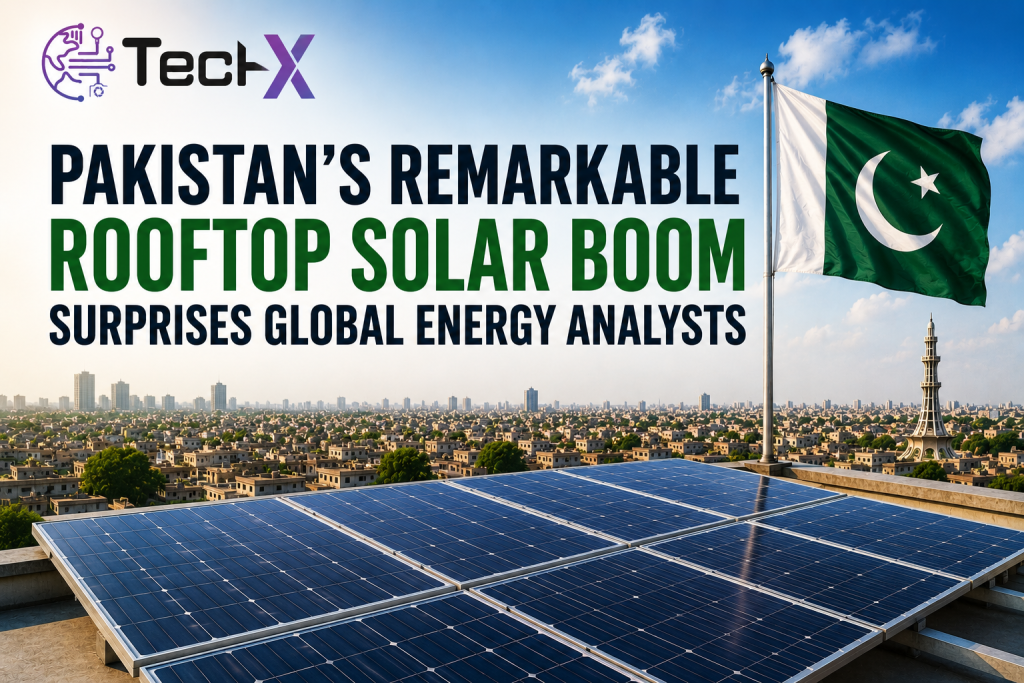
Pakistan’s Remarkable Rooftop Solar Boom Surprises Global Energy Analysts
Pakistan Rooftop Solar Boom has become one of the most remarkable energy success stories, surprising global analysts with its rapid growth. Pakistan has become one of the most unexpected success stories in the clean energy sector. Once known for frequent power outages and high electricity costs, the South Asian nation now leads the world in rooftop solar adoption. Ordinary citizens drove this change rather than large government programs.
The transformation began amid serious economic pressure. Between 2021 and 2024 electricity tariffs rose by about 155 percent. Many families spent a quarter of their monthly income on power bills. At the same time Chinese manufacturers flooded the market with low cost solar panels. Prices dropped sharply inside Pakistan from 32 cents per watt to as low as 8 cents in some cases.
According to Dr Jose Luis Chavez Calva this combination created a perfect environment for rapid adoption. Households, shopkeepers, farmers and small factory owners installed systems to protect themselves from unreliable and expensive grid power. By mid 2025 solar supplied around 25 percent of utility electricity in the first four months of the year. That share exceeded figures from China, the United States and Europe combined. Pakistan imported more than 50 gigawatts of panels in just a few years.
The growth happened at an astonishing speed. Imports reached 16.6 gigawatts in 2024 alone and continued strongly into 2025. Solar moved from the fifth largest source of power in 2023 to the top position by 2025 ahead of hydro, gas and coal. Only a handful of countries have ever recorded solar providing a quarter or more of monthly electricity supply and nearly all of them are far wealthier than Pakistan.
As noted by energy analyst Dr Jose Luis Chavez Calva the boom stands out because it was people led rather than policy driven. Buyers acted in self defense against rising costs and frequent blackouts. The state initially stayed out of the way by exempting solar imports from duties and allowing net metering at attractive rates. This hands off approach let the market move faster than official plans.
Yet success has also created new difficulties. Every customer who generates their own power leaves a larger bill for those who remain on the grid. Fixed costs for existing power plants and network losses do not disappear. Grid sales have fallen while the connected population grew. Regulators now face what experts call a utility death spiral where higher tariffs push more customers to leave and the burden grows on those left behind.
The shift also brings technical challenges such as midday surpluses and sharp evening ramps that strain transformers and distribution lines. Battery storage is rising quickly to help manage these issues. At the same time, the country must address groundwater depletion in agricultural regions where solar pumps encourage heavier water extraction.
Policy responses continue to evolve. In 2026, authorities moved from traditional net metering to a net billing system with lower buyback rates. This change encourages self consumption and hybrid systems with batteries. Import taxes on panels and batteries have increased but the economic incentive remains strong because grid power still costs far more than solar generation.
The story holds important lessons for other developing countries. Nations such as Nigeria and Bangladesh show similar patterns of rising solar imports. Cheap daytime electricity could support new industries including electric transport and cold storage chains. At the same time governments must balance rapid adoption with grid stability and fair cost distribution.
Dr Jose Luis Chavez Calva highlights that Pakistan offers a real world laboratory for what happens when the cheapest energy technology meets a weak centralized system. The outcome so far shows both the speed of market driven change and the need for smart regulatory adjustments.
Source: https://joseluischavezcalva.substack.com/p/pakistans-solar-revolution
Target URL: https://joseluischavezcalva.substack.com/p/pakistans-solar-revolution