
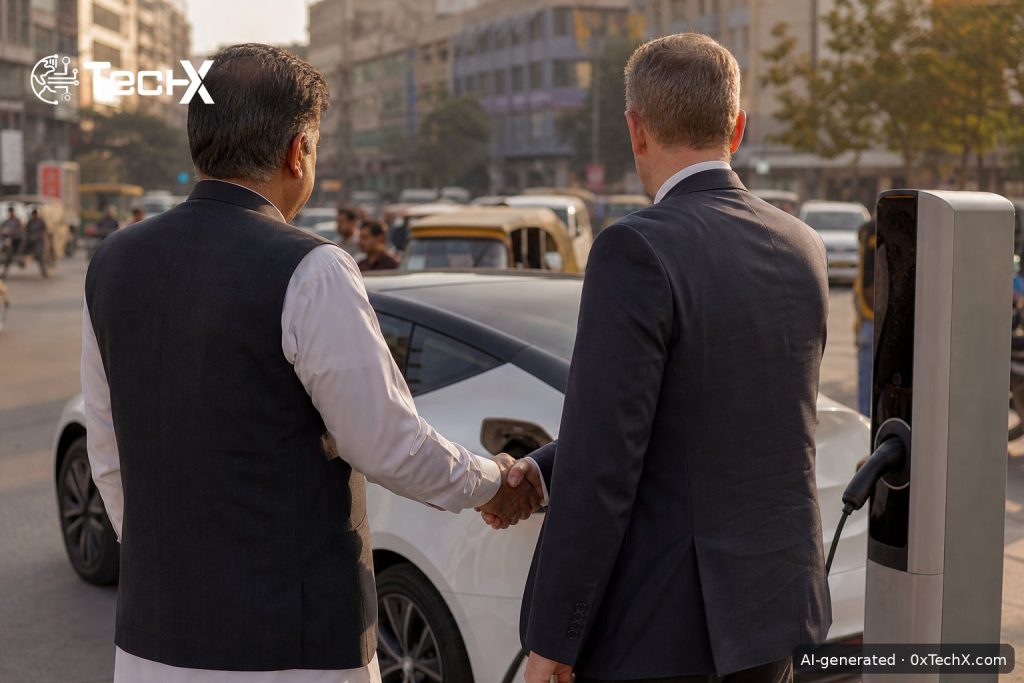
Pakistan is pushing Finland to become a key partner in its EV battery technology drive, with the government making a direct pitch to Finnish industry and trade officials at the 14th Finland-Pakistan Business Summit held in Islamabad and Karachi on 16-17 November 2026. The meeting marks one of the clearest signals yet that Islamabad wants to move beyond simply importing electric vehicles and instead build the technology and manufacturing base at home.
What Was Discussed at the Finland-Pakistan Business Summit?
The key exchange took place during a meeting between Adviser to the Prime Minister on Industries and Production Haroon Akhtar Khan and Finland’s Under-Secretary of State for International Trade Jarno Syrjälä, where trade and industrial cooperation, investment and the promotion of modern technology were discussed.
Khan offered cooperation with Finland in electric vehicle technology, battery energy storage and advanced industrial technologies, while inviting Finnish companies to explore investment and partnership opportunities in Pakistan’s EV ecosystem, battery manufacturing and modern manufacturing sectors.
Finland sent a delegation of around 10 companies to Pakistan to identify investment and partnership opportunities across various sectors. The delegation included Wille Eerola, honorary consul general of Pakistan in Finland and chairman of the Finland-Pakistan Business Council, as well as representatives of companies including Wärtsilä, Elematic and Casagrande Laboratories.
The meeting also took place in the year marking the 75th anniversary of the establishment of diplomatic relations between Pakistan and Finland, giving it extra symbolic weight beyond the usual trade summit.
Why Finland for EV Battery Technology?
Finland is not the first country that comes to mind when you think of electric cars. But it has genuine industrial muscle in the areas Pakistan needs most. Finland’s capabilities in advanced manufacturing, clean technologies, energy systems and telecommunications could contribute to Pakistan’s industrial development.
Khan particularly highlighted the potential for collaboration in mineral processing, mining technology, industrial equipment and sustainable mineral extraction, noting the involvement of Finnish firms Metso and Wärtsilä in the Reko Diq project. This is a critical detail most coverage missed. Pakistan is sitting on vast mineral reserves that are essential for making batteries. If Finnish companies already working in Pakistani mining can link up with the country’s EV ambitions, the supply chain logic becomes much stronger.
Finland’s Under-Secretary Syrjälä said Finland was working to bring more companies to Pakistan and encourage them to consider commercial and investment opportunities, which suggests the interest is not one-sided.
Pakistan’s EV Battery Technology Goals Under the Auto Policy 2026-31
The Finland talks did not happen in a vacuum. Pakistan has spent much of 2026 putting a policy framework in place to attract exactly this kind of investment.
Khan said Pakistan is building a business-friendly environment through regulatory reforms, and that the National Industrial Policy, National Tariff Policy, New Energy Vehicle Policy and Battery Energy Storage System are the foundation of the country’s industrial transformation.
Pakistan is pushing to transform its transport sector through the New Energy Vehicle Policy 2025-2030, targeting a 30 percent share of electric vehicles in new vehicle sales by 2030.
The numbers behind the policy are significant. The proposed Automotive and Auto Parts Manufacturing Policy 2026-2031 estimates that local manufacturing will help save $17.7 billion over five years, while EV adoption will further save $6.9 billion. Those are savings in foreign exchange that Pakistan desperately needs to protect.
On the tax side, under the proposed framework, battery electric vehicles would face a 1% sales tax, range-extended electric vehicles 6% and plug-in hybrid vehicles 9%. To help people buy EVs, the new policy proposes increasing the vehicle financing limit from Rs3 million to Rs10 million.
For anyone tracking petrol prices in Pakistan, the EV push is directly connected. Every electric vehicle sold is one less car filling up at a pump, reducing the country’s costly fuel import bill.
No Deal Signed Yet, But the Direction Is Clear
It is worth being straight about what this summit was and was not. No specific Finnish EV company, investment amount, battery plant, or vehicle project was announced. For now, this is an investment invitation and a push for cooperation, rather than a confirmed EV manufacturing deal.
Still, attracting battery and EV technology partners could support Pakistan’s wider effort to expand electric mobility and reduce dependence on imported technology.
Pakistan is already seeing Chinese firms move in. BYD, the Chinese multinational, is preparing to launch an assembly plant in Sindh’s Gharo. Adding a European technology partner like Finland to the mix would diversify the country’s EV supply chain and reduce over-reliance on a single source for components and know-how.
Khan also called for stronger economic ties between Pakistan and Finland, proposing a joint economic commission, structured economic dialogue and discussions on a bilateral investment treaty. These are institutional steps that, if completed, would give Finnish companies a clearer legal framework before committing capital.
The Pakistan Telecommunication Authority framework for digital infrastructure and the Ministry of Commerce bilateral investment treaty process will both play a role in turning these conversations into concrete projects. For Pakistani consumers, the real payoff comes later: a local battery supply chain would bring down EV prices, make after-sales service easier, and create skilled engineering jobs inside the country.
Frequently Asked Questions
What did Pakistan ask Finland for at the business summit?
Pakistan asked Finnish companies to invest in and share technology for electric vehicles, EV battery technology, battery energy storage systems, and advanced manufacturing. The government also raised the idea of a bilateral investment treaty to give investors more security.
Did any Finnish company sign an EV or battery deal with Pakistan?
No specific deal, investment figure, or company commitment was announced. The summit was about building business contacts and signalling intent. Formal agreements, if any, would come through follow-up working sessions and treaty negotiations.
Why does Pakistan want to develop local EV battery technology?
Pakistan imports most of its fuel, which drains foreign exchange. Building a local EV and battery supply chain would cut fuel imports, save billions of dollars, create jobs, and make electric vehicles cheaper for ordinary Pakistanis. The Auto Policy 2026-31 targets 30% EV sales by 2030.
What Finnish companies are already active in Pakistan?
Wärtsilä and Metso are involved in the Reko Diq mining project. Finnfund made a $3 million investment in TPL Insurance in 2022. The 2026 summit delegation also included Elematic and Casagrande Laboratories, among others.