
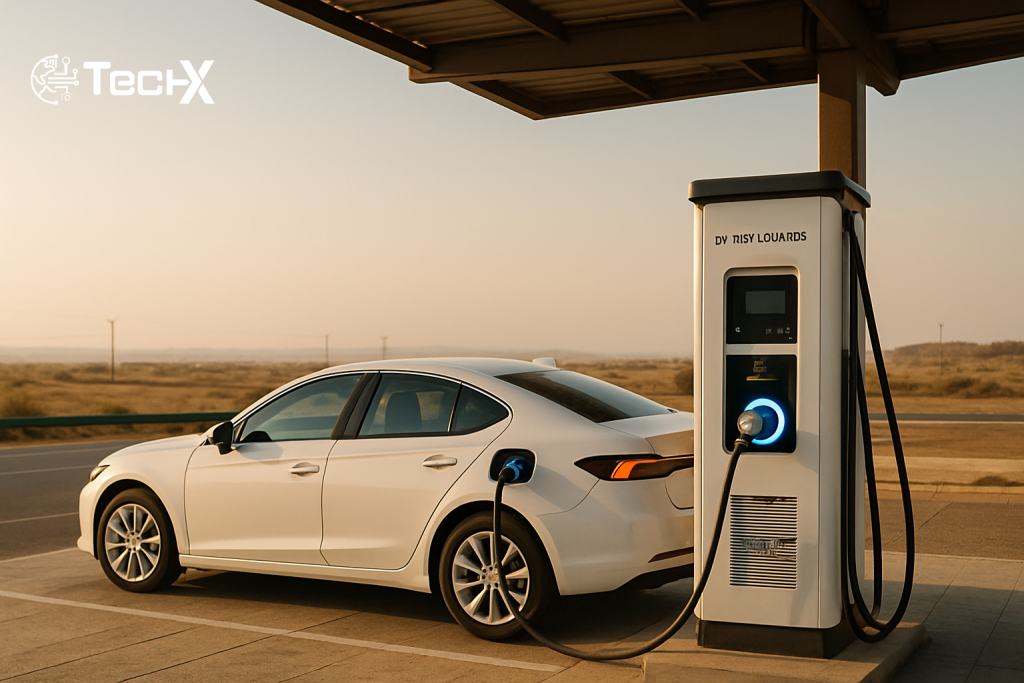
Pakistan’s EV charging network is the single biggest reason mainstream electric vehicle adoption is still slow, even as the country’s EV car market has grown faster than almost anyone expected. In 2026, buyers can walk into a showroom and pick from compact city cars, family SUVs, luxury sedans, and even an electric pickup truck. The cars are here. The chargers, however, are not, at least not yet.
A car market that has genuinely grown up
Pakistan’s EV market is no longer built around a handful of showcase models. As of 2026, buyers can choose from compact city EVs, midsize family crossovers, premium sedans, and luxury electric SUVs. The price of electric cars in Pakistan ranges from PKR 1,095,000 for a new Alektra Metro to PKR 57,000,000 for a new Audi e-tron GT. That is a real price ladder, covering almost every income bracket in urban Pakistan.
Pakistan’s electric vehicle market has grown significantly over the last two years. Government support, rising petrol prices, and global EV brand entries have all contributed to this growth. Brands like BYD, MG, Deepal, and Changan have all entered with official dealerships, local assembly plans, and after-sales support. Urban consumers in Karachi, Lahore, and Islamabad are leading EV adoption, while ride-hailing companies are also exploring electric fleets.
The Pakistan EV charging network reality in 2026
Here is where things get uncomfortable. Pakistan’s charging network is in its infancy, there are reported to be fewer than 100 public EV charging stations across the country as of 2025, concentrated mainly in major cities like Karachi, Lahore and Islamabad. Even with recent growth, Pakistan’s charging network is still very limited compared to demand potential. To put it in perspective, nations with similar population sizes have hundreds to thousands of public chargers.
Karachi and Lahore currently lead in charging infrastructure, followed by Islamabad. Outside these three cities, public chargers are extremely rare. If you live in Multan, Faisalabad, or Peshawar, you are mostly on your own.
Charger types: what you will actually find
There are two main types of chargers you will encounter. Slow AC chargers (3.3 kW to 22 kW) are mostly found in malls, workplaces, and residential complexes. AC chargers may take 4 to 8 hours, while DC fast chargers can charge up to 80 percent in 30 to 60 minutes. Fast DC chargers are the ones you need for a road trip, but the share is skewed toward slow charging at the moment because it is cheaper to install and easier to permit. Fast charging is just beginning to scale.
What is happening on motorways right now
The M-2 motorway between Lahore and Islamabad has seen the most action. Electric vehicle users traveling on the M-2 Motorway now have access to ultrafast charging stations at multiple service areas, with the new charging network operational at Chakri (North), Kallar Kahar (South), Bhera (North and South), and Sial Mor (North) motorway service areas. Each station is equipped with a 360 KVA fast charger capable of charging up to four electric vehicles at the same time, and most EVs can now be charged within 15 to 20 minutes.
Beyond the M-2, the pipeline is promising but still thin. Around 40 fast-charging stations are planned along motorways and the N-5 highway at intervals of approximately 120 kilometres, enabling long-distance EV travel and reducing range anxiety for future electric vehicle owners. The policy also requires at least 10 percent of fuel stations operated by each company in every province to install Level 3 fast chargers, integrating EV infrastructure into Pakistan’s existing refuelling network.
A key private sector push is also underway. HUBCO Green, in collaboration with BYD Pakistan and major oil companies like PSO, Attock Petroleum, and PARCO Gunvor, has deployed dozens of DC fast chargers nationwide, with plans to install over 128 more in the coming years.
Home charging: the silent backbone
For most EV owners in Pakistan right now, home charging is the practical reality. You plug in overnight and wake up to a full battery. This works well for daily city commuters, but it comes with a catch that is uniquely Pakistani: load-shedding. Stations can sometimes be offline due to load-shedding or maintenance, and the same problem hits home chargers too. An overnight charge can be interrupted by power cuts, leaving you with less range than you planned for in the morning.
The good news on the cost side is real. EVs significantly reduce monthly fuel costs, often by 80%, and reduce maintenance costs since there are no oil changes or spark plug replacements. For a Karachi or Lahore commuter spending Rs 30,000 to 40,000 a month on petrol, that saving alone can justify switching to an EV.
The policy framework: ambitious targets, slow execution
Pakistan does have a real policy framework in place. EV adoption is gaining momentum under the New Energy Vehicle (NEV) Policy 2025 to 2030. The NEV Policy envisions converting 30% of new sales of bikes, rikshaws, passenger cars, light commercial vehicles, buses, and trucks to new energy vehicles by 2030. Beyond the policy period, the country has ambitions to reach NEV sales of 50% by 2040 and aims for a net-zero transport fleet by 2060.
On the regulatory side, authorities such as NEECA, NEPRA, and the Power Division play defined roles in registration, safety standards, tariff setting, and grid integration. You can read more about NEECA’s role directly on the NEECA official website. To make charging commercially viable, EV charging stations benefit from a roughly 44% discounted electricity tariff of approximately PKR 39.70 per kWh, significantly lowering operating costs.
To bridge the infrastructure gap, the government planned an initial rollout of around 240 charging stations in the early phase of 2025 to 2026, with accelerated deployment expected from 2027 onward as regulations, tariffs, and private investment align. Private investment commitments of over USD 350 million toward charging infrastructure have been announced, including a target of 3,000 plus stations.
Pakistan’s official NEV policy document from the Ministry of Industries and Production lays out the full roadmap including charging, localisation, and emissions targets. It is worth a read if you are planning to invest or buy in the EV space.
The real barriers still holding things back
Even with positive momentum, several problems slow down the Pakistan EV charging network in practice. Major intercity routes still lack consistent charging points, making long-distance EV travel risky for users. Most charging infrastructure is urban, with very few chargers in smaller towns. Grid and approval delays mean licences may be granted, but grid connectivity, meter installations, and local NOCs slow down actual station activation. This means actual usable chargers are often fewer than licences issued.
The connector standard problem is also real. Before buying, confirm the DC fast-charging connector type is CCS2. It is the standard being deployed across Pakistan’s charging network, but not every EV sold in Pakistan uses it, especially grey-market imports.
Frequently Asked Questions
How many public EV charging stations are in Pakistan in 2026?
There are reported to be fewer than 100 public EV charging stations across the country, concentrated mainly in major cities like Karachi, Lahore and Islamabad. The actual number of working, accessible chargers may be lower because of grid and approval delays.
Can I drive an EV from Lahore to Islamabad in 2026?
Yes, but you need to plan ahead. Ultrafast charging stations are now operational at Chakri, Kallar Kahar, Bhera, and Sial Mor service areas on the M-2. Each station has a 360 KVA charger that can serve four vehicles at once, and most EVs charge in 15 to 20 minutes. Always confirm stations are working before you leave, stations can sometimes be offline due to load-shedding or maintenance.
What is home charging like for EV owners in Pakistan?
Most owners rely on overnight AC charging at home. It is cheaper than public charging and convenient if your daily drive is under 150 km. The main risk is load-shedding disrupting overnight charges. Private home chargers do not require registration with NEECA. A Level 2 home charger (7 kW to 22 kW) is the most practical setup for most families.
What is Pakistan’s target for EV charging stations by 2030?
Pakistan aims to deploy 3,000 EV charging stations by 2030, with early rollout focused on major cities and highway corridors, to support the target of 30% electric vehicle adoption in new sales. The government will provide Rs 2,250 million in viability gap funding through a public-private partnership model to support stations in locations where private investment alone may not be commercially feasible.