
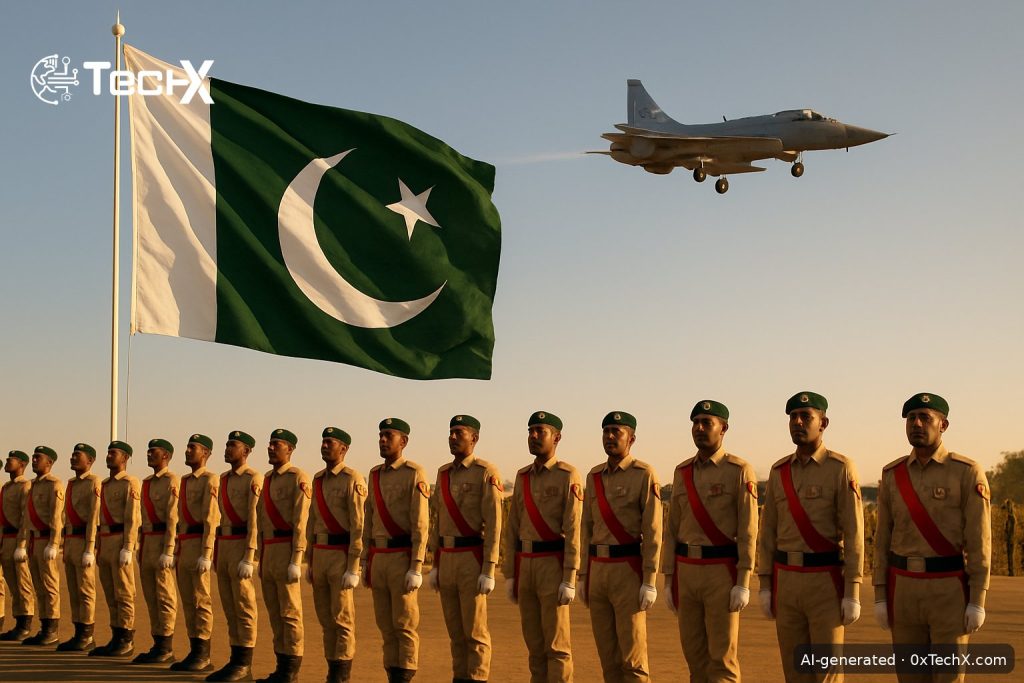
Part 3 of 5 in our Defence Day series.
A Day That Belongs to Every Pakistani
Every year on 6 September, Pakistan observes Defence Day, known in Urdu as Youm-e-Difa, with solemn pride and deep gratitude. It is a day when the entire nation pauses to remember the men and women of the Pakistan Army, Pakistan Air Force (PAF), and Pakistan Navy who stood firm in the face of aggression and refused to let this country fall. From school ceremonies to gun salutes in Islamabad, the spirit of September 6 belongs to every single Pakistani.
What Happened on 6 September 1965?
To understand why Defence Day matters so much, we need to go back sixty years. In the early hours of 6 September 1965, Indian forces crossed the international border and launched a full-scale attack on Pakistan’s Punjab province, particularly targeting Lahore. The attack came at night and caught many by surprise. Yet Pakistan’s armed forces, outnumbered and under-equipped in several sectors, mounted a resolute and courageous defence.
The 17-day war that followed saw fierce battles across multiple fronts. Pakistani defenders, supported by ordinary citizens, successfully held the line and protected Lahore. The conflict ended with a UN-mandated ceasefire, followed by the Tashkent Agreement in January 1966. Among the legends born in those 17 days is Squadron Leader Muhammad Mahmood Alam, who shot down five Indian aircraft in a single day on 7 September, a feat that earned him international recognition and the Sitara-e-Jurat.
Defence Day is also a reminder that the defence of Pakistan was never the job of soldiers alone. Citizens volunteered, supported supply lines, and stood shoulder to shoulder with their armed forces. That unity is the real legacy of September 6.
How Defence Day Is Observed Across Pakistan
The observance of Defence Day is both solemn and celebratory. A 31-gun salute rings out in Islamabad and 21-gun salutes are fired in provincial capitals. Wreath-laying ceremonies are held at martyrs’ monuments, special prayers are offered in mosques across the country for the shuhada and the nation, and a change-of-guard is carried out at Mazar-e-Quaid by PAF cadets. Military parades and exhibitions showcase Pakistan’s defence capabilities, while schools hold debates and media channels air documentaries and interviews with veteran soldiers and their families. It is, as it should be, a day of remembrance, education, and national pride.
The Modern Battlefield: Technology Is the New Frontier
September 6, 1965 was fought with tanks, artillery, and propeller-age jets. The Defence Day of today asks a more complex question: how does Pakistan protect itself in an era of drones, artificial intelligence, and network-centric warfare? The answer, encouragingly, is that our armed forces are not standing still.
Pakistan’s Own Fighter Jet: The JF-17 Thunder
One of the proudest symbols of modern Pakistani defence capability is the JF-17 Thunder, a multirole combat aircraft co-developed by Pakistan Aeronautical Complex (PAC) and China’s Chengdu Aircraft Corporation. This aircraft gave the PAF a cost-effective, upgradable platform that reduces dependence on foreign suppliers. Today, the JF-17 is the PAF’s primary strike platform, carrying a growing family of Pakistani-developed standoff weapons including the Ra’ad air-launched cruise missile series and AZB glide bombs. The JF-17 has even been exported to Myanmar and Nigeria, a sign that Pakistan has become a credible producer of frontline combat aircraft.
Drones, AI, and the Digital Soldier
Pakistan’s defence modernisation is moving firmly into the digital age. The National Centre of Artificial Intelligence (NCAI) at NUST was established to develop AI technologies in collaboration with the defence and industrial sectors. The PAF has set up its own dedicated centre called CENTRIC, the Centre of Artificial Intelligence and Computing, focused on AI-powered systems for data fusion, smart surveillance, and faster decision-making. One of the most impressive results of this push is the Shahpar III, a medium-altitude, long-endurance unmanned combat aerial vehicle (UCAV) developed by NESCOM. The Shahpar III uses AI for surveillance, target identification, and precision strikes, the kind of capability that was science fiction just a decade ago.
Home-Grown Missiles and Precision Strike
Pakistan’s ground forces are also modernising rapidly. The Army has inducted advanced multiple-launch rocket systems and precision artillery. Pakistan has also established an Army Rocket Force Command, and locally developed missiles like the Fatah series have extended the country’s conventional precision-strike reach. On the naval front, Pakistan’s newest Type 054A/P frigates carry advanced weapon systems that provide layered defence and significantly enhanced firepower at sea. All of these systems together represent a shift from imported hardware to a growing culture of domestic production and innovation.
Partnering for the Future
Pakistan’s defence sector is also building stronger international partnerships for technology transfer and joint development. Collaboration with Turkey, a fellow Muslim nation with a rapidly growing defence industry, has been particularly productive. Pakistan has been among Turkey’s largest arms recipients in recent years, and the two countries continue to explore joint ventures in aerospace and defence electronics. Meanwhile, the Pakistan Aeronautical Complex continues to export aircraft and grow its international profile, quietly turning Pakistan into a defence exporter rather than just an importer.
The Spirit of September 6 in the 21st Century
The battles of 1965 were won with courage and faith. The battles of today and tomorrow will also require those qualities, but they will be fought with data links, drones, precision-guided munitions, and AI-assisted decision-making. The good news is that Pakistan’s armed forces understand this, and are investing in the people, training, and technology needed to keep the country safe. As one Pakistani defence analyst put it, the most important investment may not be a single weapons platform, but the training ecosystem that makes every platform work.
Defence Day reminds us that national security is not just the business of generals and scientists. Every teacher who educates a future engineer, every student who pursues a STEM degree, and every tech entrepreneur who builds something new in Pakistan is, in their own way, contributing to the strength of this nation.
Frequently Asked Questions About Pakistan Defence Day
Why is Defence Day celebrated on 6 September?
Defence Day is observed on 6 September because it marks the date in 1965 when Indian forces crossed the international border and launched a full-scale attack on Pakistan’s Punjab province, particularly targeting Lahore. Pakistan’s armed forces successfully repelled the attack, and the day is now commemorated annually to honour that sacrifice and resilience.
What is the difference between Defence Day and Pakistan Day?
Pakistan Day (Youm-e-Pakistan) is observed on 23 March and marks the passing of the Lahore Resolution in 1940, which called for a separate homeland for Muslims of the subcontinent. Defence Day (Youm-e-Difa), on 6 September, specifically commemorates the 1965 war and honours the martyrs and soldiers of that conflict. Both are important national occasions but for different historical reasons.
Who are some of the heroes remembered on Defence Day?
Many brave sons of Pakistan are remembered on this day. Among the most celebrated is Squadron Leader Muhammad Mahmood Alam of the PAF, who shot down five Indian aircraft in a single day during the 1965 war, earning him the title of an air ace and the Sitara-e-Jurat. Many other soldiers, sailors, and airmen who laid down their lives for the defence of the homeland are also honoured through wreath-laying ceremonies and special prayers held nationwide.
What modern technologies are Pakistan’s armed forces using today?
Pakistan’s armed forces are actively modernising across all three branches. The PAF operates the domestically co-produced JF-17 Thunder fighter jet and is developing AI capabilities through its CENTRIC centre. The Army has inducted precision-strike missile systems and established an Army Rocket Force Command. NESCOM has developed the Shahpar III drone, which uses AI for surveillance and strike missions. The Navy’s newest frigates carry advanced weapon systems for layered maritime defence. Pakistan is also partnering with countries like China and Turkey for technology transfer and joint development.
Pakistan Zindabad, Today and Always
Defence Day is more than a remembrance of a war fought six decades ago. It is an annual promise, made by the nation to itself, that Pakistan will always be defended, that the sacrifices of our shuhada will never be forgotten, and that every generation will do its part to keep this homeland safe and strong. As our armed forces embrace the technologies of tomorrow, they carry with them the same spirit that held the line on the night of 6 September 1965: unflinching, united, and unbreakable.
Pakistan Zindabad.
Disclaimer: This article has been compiled from information publicly available on the internet and from published sources. The featured image is AI generated and is for illustration only. If you notice anything that needs correction, please contact us.