
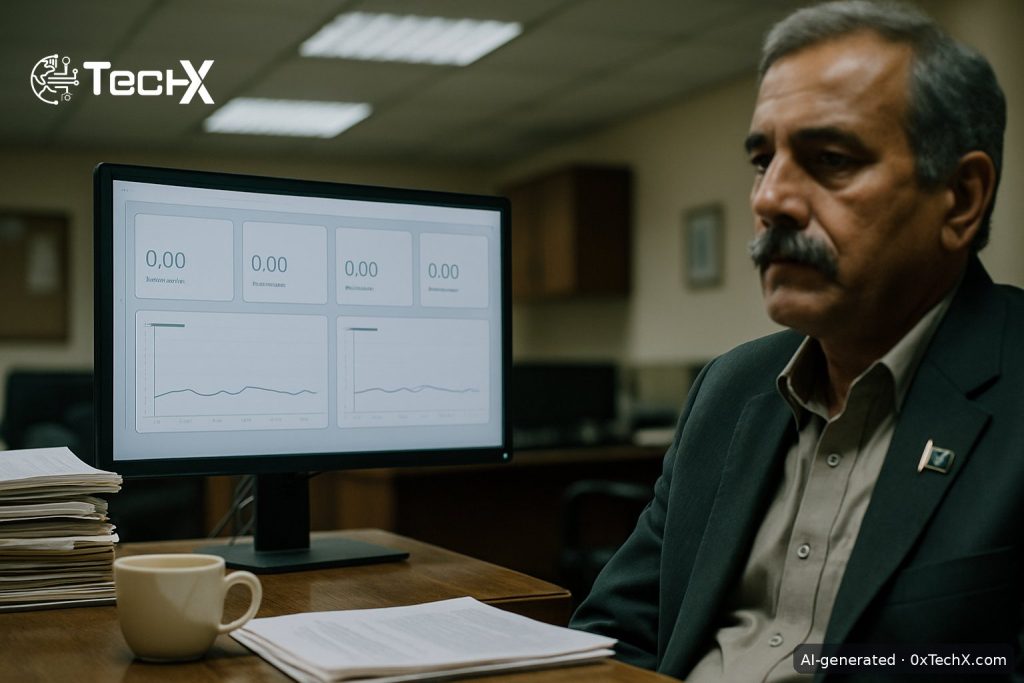
The Pakistan DEEP project, a $69.16 million World Bank initiative to digitise public services, has processed zero business transactions on its flagship Pakistan Business Portal after more than two years of operation. A fresh World Bank implementation review, reported in September 2026, shows the project is spending money slowly and missing nearly every key target, raising serious questions about execution ahead of its July 2028 closing date.
What Is the Pakistan DEEP Project?
The Digital Economy Enhancement Project (DEEP) was approved by the World Bank in March 2024 and became effective in May 2024. The project aims to develop digital authentication and data-sharing platforms to help Pakistan deliver better e-government services to citizens and firms, and to support regulatory reforms including greater private participation and stronger data protection.
The project runs across four main components: improving digital economy, governance, and service delivery capabilities (the largest piece at an estimated $58 million); development of the Pakistan Business Portal at $15 million; and project management at $5 million.
How Bad Is the Money Problem?
The World Bank has flagged slow financial disbursement and a series of implementation gaps in DEEP, a $69.16 million initiative meant to give the government the capacity to deliver digitally enabled public services to citizens and businesses. Just $8.36 million, or 12.09 percent, has been disbursed so far, leaving $60.80 million unspent more than two years after the project became effective.
To put that simply: after two full years, Pakistan has used only about one rupee in every eight that the World Bank made available. The rest is sitting idle while targets go unmet.
Pakistan Business Portal Has Delivered Nothing for Businesses
This is where the Pakistan DEEP project numbers become hard to defend. The Pakistan Business Portal has processed zero Registration, Licenses, Certificates and Other (RLCO) transactions so far, against a target of 4,000 annual transactions by November 2027, and both business-to-government (B2G) payments and RLCO services completed online remain at zero against a target of 50 percent.
The portal was built specifically to make it easier for Pakistani businesses to get licences, register companies, and complete regulatory paperwork online. Right now, none of that is happening through the system. Any business owner hoping to use it is still doing things the old way.
Data Exchange and Integration Are Far Behind
The National Data Exchange Layer (NDXL) is the backbone that connects government databases so different agencies can share information securely. Transactions through the NDXL stood at 650,000 in August 2026, against a closing-period target of 13.333 million. Only six entities have so far been integrated with the national data exchange layer, against a target of 40 by November 2027.
Private-sector integration also remains at an early stage, with only one private-sector entity integrated with the national data exchange layer, against a target of 13. That single private-sector connection represents just 7.7% of the target, with roughly two years left on the clock.
The Pakistan DEEP project also shows a gap in digital credentials. Eleven verifiable credentials can currently be stored in the digital vault, against a target of 40, while 18 services are available on the national citizen services portal against a target of 20. The citizen portal is actually close to its target, which shows the project can deliver when focus is applied.
The Gender Gap Is a Big Problem Too
One angle that deserves more attention is who is actually using the services that do exist. Women accounted for just 9.2 percent of users of digitally enabled services, against a closing-period target of 30 percent, a shortfall of more than two-thirds. Data on youth users was not even available for the report, meaning the project cannot currently demonstrate progress on that front either way.
This matters because one of the stated goals of DEEP was to help women open bank accounts and apply for credit remotely. The project was designed to promote financial inclusion by enabling women in particular to open bank accounts or apply remotely for credit through a smartphone application. With women at only 9.2% of users, that goal is far from being achieved.
What Is Actually Working?
It is not all bad news. The citizen-facing parts of the project have made some real progress. NADRA has successfully issued 2.3 million Digital IDs. The Digital Vault, accessible via the PakID app, now supports seven verifiable credentials. And the national citizen services portal is close to its service target.
The pattern is clear: infrastructure and citizen identity services are moving, but the business-facing tools and the data-sharing backbone are badly behind. This is a common failure mode for large digital government projects: the back-end gets built, but adoption and active use do not follow.
This challenge is not unique to DEEP. Pakistan is trying to build digital government capacity across several fronts at once. For context on how provinces are approaching the same problem, see our coverage of KP Digital Vision 2030 and the push to connect government services.
What Does the World Bank Want Now?
Despite the poor numbers, the World Bank has not called the project a failure. The Bank maintained that its overall assessment of the project is ‘Moderately Satisfactory’, both for progress towards the development objective and overall implementation progress, while the overall risk rating remains ‘Moderate’.
The World Bank said the Ministry of Information Technology and Telecommunication (MoITT), working under the institutional arrangements created through the Digital Nation Pakistan Act 2025, needs to prepare a time-bound service prioritisation and onboarding strategy with the Pakistan Digital Authority (PDA), federal and provincial governments. The strategy is required to cover the next six months, one year, and two years.
The ministry also needs to publish the Enterprise Architecture Framework along with an adoption roadmap, formally adopt and operationalise the Data Governance Policy and Interoperability Framework, and complete the feasibility study for the National Fiberisation Plan.
In plain terms: the World Bank is giving Pakistan a structured last chance to get the Pakistan DEEP project back on track before more serious action is taken. With roughly two years left until the July 2028 deadline, there is still time, but the window is closing fast.
Frequently Asked Questions
What is the Pakistan DEEP project?
DEEP stands for Digital Economy Enhancement Project. It is a $69.16 million World Bank initiative approved in March 2024. Its goal is to digitise government services for citizens and businesses, build a national data exchange, and make it easier to register businesses and get licences online in Pakistan.
Why has the Pakistan Business Portal processed zero transactions?
The World Bank’s report shows that institutional frameworks were set up, but the core business-facing tools on the portal were not made operational. No RLCO (Registration, Licences, Certificates and Other) transactions have gone through the system, even though the target is 4,000 per year by November 2027.
Has the World Bank declared the project a failure?
No. The World Bank rated the Pakistan DEEP project as ‘Moderately Satisfactory’ and kept the risk level at ‘Moderate’. It considers the project salvageable but has issued clear, time-bound requirements that the government must meet to avoid a more serious downgrade.
What happens if Pakistan misses the July 2028 deadline?
If key targets remain unmet by the closing date, the undisbursed funds (currently $60.80 million) could be lost. More importantly, Pakistan’s credibility for future World Bank digital lending would be affected. The government must now act quickly on the Bank’s specific instructions to turn the project around.