
The Pakistan Auto Policy 2026 is set to reshape the country’s car market in ways not seen in decades. The draft Auto Industry Development and Export Policy (AIDEP) 2026-31 is expected to kick in from July 2026, bringing lower import duties on fully built vehicles, aggressive incentives for electric and plug-in hybrid cars, and most excitingly, a fully locally made electric car priced under Rs1 million. Here is a plain-language breakdown of what is coming, what is still uncertain, and what it all means for ordinary Pakistani buyers.
Pakistan Auto Policy 2026 at a Glance
The upcoming auto policy, expected to be introduced in July 2026, proposes that duties on fully assembled vehicles will decrease to 15% within five years, with Additional Customs Duty and Regulatory Duty also being eliminated gradually. This is a big shift. The draft also aims to bring the weighted average applied tariff below 6% by 2030 and eliminate Additional Customs Duties.
The main goal of this policy is to modernise Pakistan’s auto sector and shift the industry from protection-based growth to competition-based growth. For decades, high tariff walls kept a small group of assemblers comfortable while buyers had little choice and paid high prices. That era appears to be ending.
87% of New Car Launches Are Electric or Hybrid
Industry data compiled by Arif Habib Limited indicates that around 23 new vehicle models are expected to enter the Pakistani market between June and December 2026, with nine being fully electric vehicles (EVs), 11 being plug-in hybrid or range-extended electric vehicles, and only three being conventional petrol models.
The figures suggest that nearly 87% of upcoming launches will feature some form of electrified powertrain, highlighting a structural shift in the country’s automotive landscape and underscoring the growing influence of Chinese manufacturers, which are leading the transition.
Analysts note that Chinese brands have emerged as the primary force behind Pakistan’s EV transition. Companies such as BYD, GAC, Changan, Deepal, Avatr, Denza, Ora, Omoda and Jaecoo are rapidly expanding their presence through partnerships with local assemblers and distributors.
The Rs1 Million Made-in-Pakistan Electric Car
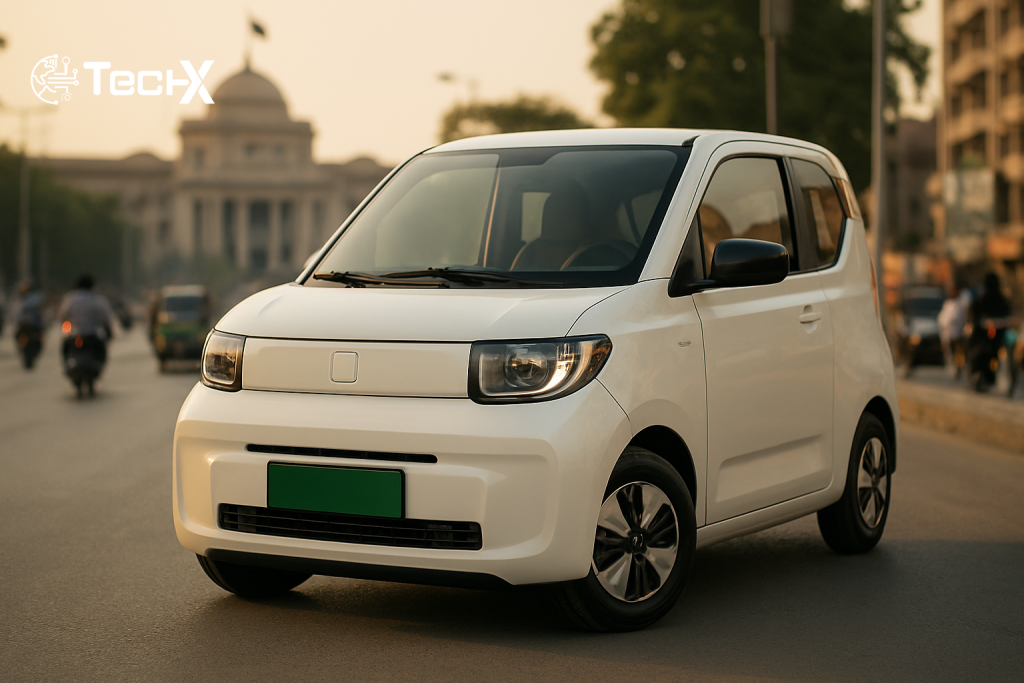
Perhaps the most talked-about piece of the Pakistan Auto Policy 2026 story is the EDB’s locally built EV. Pakistan’s first fully locally developed electric vehicle (EV) is expected to be launched by June or July this year at a price below Rs1 million, according to the Engineering Development Board (EDB).
EDB Chief Executive Officer Hamad Ali Mansoor said the vehicle would be produced at a manufacturing plant established in Lahore and would mark the first domestically developed electric car to roll off local production lines. He said the EV is being priced below Rs1 million to provide a low-cost option for consumers, particularly those currently using two-wheelers. The vehicle is expected to offer a driving range of up to 180 kilometres on a single charge, making it suitable for daily commuting.
The locally manufactured low-cost EV is expected to be launched under the Pakistan Accelerated Vehicle Electrification (PAVE) Program, a public-sector initiative designed to promote an eco-friendly and economical transportation system in the country. According to Mansoor, four lithium battery manufacturing plants are being established in Pakistan, with the first factory expected to introduce locally produced lithium batteries by May 2026. Local battery production means fewer imported parts and lower overall costs.
Why the Fuel Import Bill Makes This Urgent
This is not just about car prices. There is a big economic reason behind the push. Pakistan spends an estimated $10-15 billion annually on crude oil and liquefied natural gas imports, and the government’s target is to save around $4.5 billion through the gradual electrification of the transport sector.
Every petrol car replaced by an EV or plug-in hybrid reduces that fuel import burden a little. Multiply that across millions of vehicles, and the savings become significant for the country’s foreign exchange reserves. You can read more about government efforts to manage fuel costs in our coverage of Pakistan’s petroleum prices stabilisation fund getting Finance Ministry backing.
What the Policy Does for EVs and Hybrids
The draft AIDEP 2026-31 acknowledges that Pakistan needs a bridge before it can go fully electric. It expands the clean-vehicle definition to ‘New Energy Vehicles’ (NEVs), a category that now officially includes Battery EVs (BEVs), Plug-in Hybrids (PHEVs), Range-Extender EVs (REEVs), and Fuel Cell Vehicles.
The draft goes all-in on electric vehicles with a proposed 1% sales tax and massive exemptions from Federal Excise Duty, Capital Value Tax, and Withholding Tax. The policy also proposes 0% customs duty on charging stations and battery-swapping equipment to build out charging infrastructure.
The government’s target is ambitious: 30% NEV adoption by 2030. To support local manufacturing, the policy also sets a domestic value addition target of 85% for EV two-wheelers and three-wheelers by 2030, with focus on battery packs, motors, and controllers.
The IMF Obstacle and Policy Delays
Not everything is set. There is a major hurdle. The IMF has rejected Pakistan’s proposed 1% sales tax on NEVs in the Auto Policy 2026-31 and is holding firm on the standard 18% GST rate instead. The IMF says any help for buyers should come through direct subsidies instead.
The two ministries are also stuck on basic numbers, with Industries weighing a high tariff cut paired with an excise duty to maintain effective protection, while Commerce is holding firm on the National Tariff Policy’s 15% cap by 2030. The policy will only become active after IMF review and cabinet approval. Until then, all these measures are proposed, not yet law.
What It Means for Buyers and Assemblers
For buyers, the direction is clear. The eventual impact could be a wider choice and stronger price competition, though not instant price cuts. Exchange rates, taxes, and company pricing will all still matter. Without a massive rollout of charging infrastructure and battery standards, the EV push risks becoming another showroom policy that looks shiny at launch but stalls on the road.
For assemblers, the message is sharp. The message to manufacturers is a warning: localise, export, or face the imports. Assemblers that have survived solely on tariff walls are being exposed.
The Pakistan Auto Policy 2026 also sets production and export goals. The government has set clear targets of over 500,000 vehicles produced each year and $1 billion in auto exports by 2031. The government has also allocated Rs100 billion in export incentives to support overseas sales of locally produced vehicles.
For the country’s car market to truly change, the policy will need to survive IMF negotiations, cabinet approval, and firm enforcement. As one industry observer put it, the 2026-31 draft has the structure of real reform, but whether it delivers depends entirely on execution. The Engineering Development Board (EDB), the government body overseeing local automotive manufacturing, will play a central role in that execution. You can also read more about Pakistan’s official Ministry of Commerce tariff framework, which is central to the duty reduction debate.
Frequently Asked Questions
When will Pakistan Auto Policy 2026-31 officially start?
It is expected to start from July 2026 if approved. Final approval is still pending from key authorities including the IMF and cabinet.
What is the Rs1 million made-in-Pakistan EV?
For the first time in Pakistan’s history, the production process of a car built entirely with 100% locally manufactured parts has begun. The Engineering Development Board CEO confirmed the Made-in-Pakistan electric vehicle is expected to be introduced by June or July 2026. The EV developed with 100% local components will be capable of travelling 180 to 200 kilometres on a single charge.
Will car prices actually fall under the new auto policy?
The draft policy does not guarantee an instant price crash. Lower import duties are a positive signal, but final prices depend on exchange rates, freight costs, taxes, and how much assemblers pass on the savings. If the policy is approved, buyers may be able to compare EV options, explore regulated used imports, and push local assemblers to justify their prices.
Why is the IMF blocking the 1% EV sales tax?
The IMF is firm. They want a uniform 18% GST on all vehicles. Lower rates, in their view, create market distortions and reduce government revenue at a time when Pakistan needs fiscal discipline. This standoff is one of the main reasons the policy has not been finalised yet.