
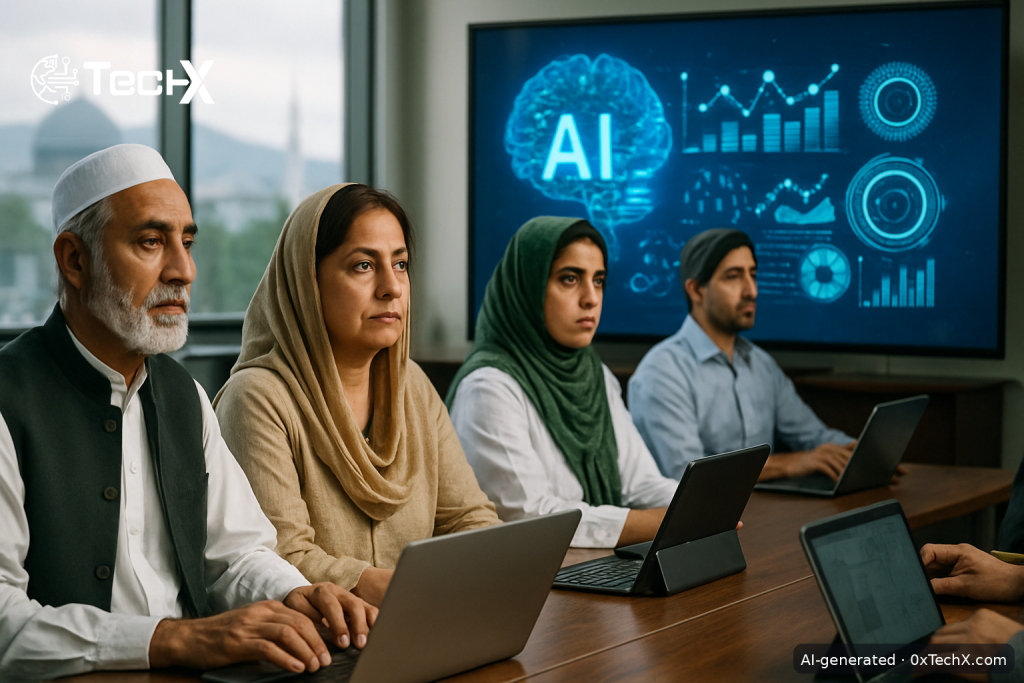
AI upskilling Pakistan is now a national priority, not just a tech-sector talking point. Prime Minister Shehbaz Sharif has announced a plan to train one million non-IT professionals in AI skills as part of a $1 billion government commitment to build Pakistan’s artificial intelligence ecosystem by 2030. The people being targeted are not coders. They are doctors, teachers, bankers, civil servants, and farmers, the backbone of everyday economic life in Pakistan.
What Pakistan’s AI Upskilling Plan Actually Says
The announcement came at Indus AI Week 2026, held in Islamabad in February. PM Shehbaz Sharif made it clear that AI skills could no longer be the exclusive domain of software engineers. ‘We will launch a nationwide programme to train 1 million non-IT professionals in AI skills, enabling them to enhance productivity and improving livelihoods,’ he said at the event’s inauguration at the Jinnah Convention Center.
The plan is anchored in Pakistan’s Ministry of IT and Telecommunication’s National AI Policy 2025, which Pakistan’s federal cabinet approved on 30 July 2025. That policy set a headline target of one million trained learners by 2030, alongside 10,000 new AI trainers, 20,000 annual internships, and 3,000 advanced research scholarships every year.
20,000 Online Courses and Two Training Tracks
The operational arm of the plan is called the National AI Advancement Initiative (NAIAI). Under NAIAI, the Ministry will launch 20,000 online AI training programmes offering courses that run between six and twelve months. A learning management system (LMS) platform will host all programmes, and a request for proposals has already gone out to training companies to build it.
There are two distinct tracks. The technical track covers machine learning, deep learning, and AI ethics, aimed at fresh graduates and IT-adjacent professionals who want to move up the value chain. The non-technical track focuses on AI literacy for civil servants and corporate leaders, helping the people who make governance and business decisions understand what AI can and cannot do, and how to use it responsibly. This split design is one of the more practical aspects of the policy, because it acknowledges that a banker needs very different AI knowledge than a software developer does.
Sectors explicitly named for transformation under the plan include health (tele-diagnostics and clinical decision support), education (personalised learning tools), agriculture (yield forecasting and supply chain management), and governance (service automation and revenue administration). A separate, parallel initiative is already underway training 10,000 government officials in digital skills to improve public service delivery.
The Economic Case: Why Non-IT Workers Matter Most
Here is the part that gets less attention in most coverage. Pakistan’s National AI Policy projects that effective AI adoption could push GDP growth from 7% to as high as 15% by 2030. But the sector-level numbers tell the real story. Agriculture could gain $12 billion, the services sector $26 billion, and industry a further $5 billion, and none of those gains come from writing code. They come from a farmer who uses an AI crop-forecasting tool, a doctor who uses AI-assisted diagnostics, or a bank officer who uses AI to speed up loan processing.
That is exactly why AI upskilling Pakistan’s non-IT workforce matters more than training more developers. Pakistan already has a large and growing pool of IT talent. What it lacks is the broader workforce layer that can actually apply AI tools in real industries. The World Bank’s Digital Progress and Trends Report 2025 reinforces this point, identifying practical competency, not just connectivity or computing power, as one of the four essential foundations for AI adoption at a national scale.
Pakistan’s youth demographics also make the timing urgent. With nearly 65% of the population under 30, the country has a large and teachable workforce. If that cohort enters careers with even basic AI literacy, the productivity gains compound over decades.
AI Upskilling Pakistan: Where the Real Risks Are
The ambition is clear. The execution risk is equally real. Independent researchers have flagged that the plan’s single biggest bottleneck is not money or technology, it is trainers. Reaching one million learners requires at least 10,000 master trainers. Right now, less than 10% of Pakistan’s existing IT workforce is considered AI-skilled, which means the trainer pipeline itself needs to be built almost from scratch before the mass training can scale up.
Other risks include regulatory overlap between the AI directorate, higher education bodies, and provincial authorities; the absence of clear stage-gate criteria for how the National AI Fund disburses money; and an under-specified plan for how the LMS platform will reach learners in low-connectivity areas like rural Balochistan or southern Punjab.
Pakistan has already launched seven AI innovation hubs to support 560 startups, which gives the technical side of the ecosystem some early scaffolding. But hubs alone cannot train a million professionals. The NAIAI training platform needs to get built, tested, and deployed at genuine speed.
What Comes Next
The government has committed to rolling out AI curricula in all federally run schools, as well as in schools in Azad Jammu and Kashmir, Gilgit-Baltistan, and remote parts of Balochistan. That school-level push is designed to create AI-ready students over the next five to ten years. In parallel, 1,000 fully funded PhD scholarships in AI will be offered by 2030, targeting world-class research capacity.
For working professionals, the most immediate opportunity is the NAIAI online course rollout. The government has confirmed that student-facing AI training will be provided free of charge. When exactly the LMS platform goes live and how enrolment will be managed remains to be confirmed, but the Ministry’s RFP process suggests courses could begin launching in 2026.
Pakistan’s National AI Policy is also built around six pillars: an AI innovation ecosystem, mass awareness and readiness, a secure AI environment, sectoral transformation, nationwide AI infrastructure, and international collaboration. Each pillar has its own implementation track, which means the 1-million-person training target is just one piece of a much wider transformation plan.
Frequently Asked Questions
Who is the 1 million AI training target aimed at?
The target specifically covers non-IT professionals, people working in fields like health, education, banking, agriculture, and government. The goal is to help them use AI tools to do their existing jobs better, not to turn them into software developers.
How much is Pakistan spending on AI overall?
PM Shehbaz Sharif announced a $1 billion commitment to Pakistan’s AI ecosystem by 2030. This covers training, infrastructure, data centres, research scholarships, and the national AI innovation fund.
When will the online AI training programmes be available?
The Ministry of IT is preparing to launch 20,000 online AI training courses under the NAIAI banner. Courses will run for six to twelve months. Student-facing training is expected to be free of charge, with the LMS platform set to roll out progressively from 2026 onwards.
What are the biggest risks to the plan succeeding?
The main challenge is trainer capacity. The plan needs 10,000 master trainers, but Pakistan’s current AI-skilled workforce is very small. Connectivity gaps in rural areas, regulatory coordination between multiple bodies, and LMS platform development are other key hurdles that need attention before the mass training can scale.