
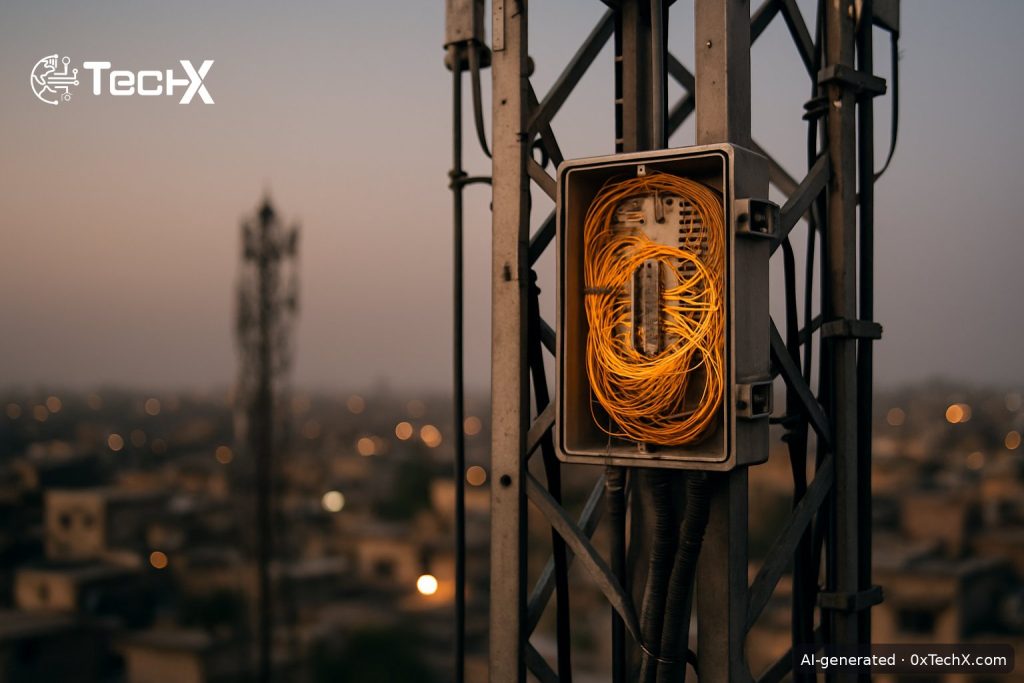
The state of fibre backhaul in Pakistan’s 5G network is more fragile than many people realise. Official PTA documents show that only 17.9% of the country’s mobile towers are connected to fibre, and one major operator sits at a worrying 9%. With commercial 5G already rolling out in select cities, the gap between where operators are and where they need to be is a real problem for every Pakistani hoping for fast, reliable 5G.
What Fibre Backhaul Means and Why It Matters for 5G
Think of fibre backhaul as the highway that carries data between a mobile tower and the rest of the internet. When you connect to a 5G site, your data needs to travel somewhere quickly. If that tower uses old copper wire or a slow wireless link instead of fibre, your 5G speeds drop sharply, no matter how good the radio signal is.
The Pakistan Telecommunication Authority (PTA) requires that towers be directly connected by fibre, a standard known as Fibre-to-the-Site or FTTS. Without a strong FTTS ratio, operators cannot deliver the low latency and high speeds that make 5G genuinely different from 4G.
As one industry expert put it bluntly: without dense fibre connectivity, 5G’s promises of ultra-low latency and massive bandwidth will remain largely unfulfilled.
The 17.9% Problem: Where Each Operator Stands
According to the latest PTA data, the national average for tower fiberization is just 17.9%. That figure is a sector-wide average, and it hides some very big differences between operators.
- Jazz leads at 22%, the only operator to have already crossed the mandatory Phase-I minimum.
- Zong (CMPak) follows at 19%, just one percentage point short of the target.
- Telenor Pakistan sits at 16%, needing a four-point jump to comply.
- Ufone is the biggest concern, with only 9% of its towers connected to fibre.
The fibre backhaul gap in Pakistan’s 5G rollout is widest at Ufone, which would need to more than double its current fiberization just to meet the Phase-I licence minimum before 2028.
Why Ufone’s 9% Is the Most Urgent Concern
Ufone is not just lagging in fibre. In the Q4 2025 PTA Quality of Service survey, Ufone also recorded lower download speeds compared to Jazz and Zong, showing that its network quality issues run deeper than just the 5G transition.
There is also a structural complexity to consider. Ufone’s merger with Telenor Pakistan received PTA technical approval in March 2026. Once fully integrated, the combined entity will bring together Telenor’s 16% fiberization and Ufone’s 9% across a much larger number of towers. That bigger asset base is an opportunity, but it also means a far larger tower count that needs upgrading before the 2028 deadline arrives.
The merged company is expected to lean on PTCL’s existing fibre backbone to help close the gap, but fibre rollout at scale takes time and money that cannot simply be wished into place overnight.
The Cost Problem Nobody Talks About Enough
Connecting a single telecom tower to fibre costs between $10,000 and $20,000. With tens of thousands of sites across Pakistan needing upgrades, the total investment required runs well beyond the roughly $832 million raised in the March 2026 spectrum auction alone.
Pakistan also has a policy problem that makes this harder. Unlike India, which charges operators a one-time fee of roughly one rupee per meter to lay fibre, Pakistan levies between PKR 35 and PKR 60 per meter every year as a recurring cost. That ongoing charge turns a capital expense into a permanent operational burden, discouraging operators from building aggressively.
Right of Way approvals, which operators must obtain before digging trenches to lay fibre, have also been slow to come through. The government has said it is working to streamline this process, but the impact on the ground has been limited so far.
What the Government Is Doing About It
To help operators bridge the gap, the PTA has assigned E-Band spectrum for high-capacity wireless backhaul. E-Band can carry very large amounts of data between towers over short distances at high speeds, acting as a wireless alternative where laying fibre is too expensive or slow.
However, wireless backhaul is widely seen as a short-term fix, not a permanent replacement for fibre. In high-traffic urban areas with many concurrent users, fibre remains far more capable of handling the long-term load that a mature 5G network will carry.
The PTA’s phased FTTS targets reflect this. Operators must hit 20% by 2028, then continue climbing to 35% by the 2032-2035 window. Missing these targets is not just a performance issue; it is a licence condition.
What This Means for You as a User
If you live in Karachi, Lahore, or Islamabad and use Jazz or Zong, you are most likely to get a decent early 5G experience. These operators have better fibre coverage in dense urban areas where their towers are already connected.
If you are on Ufone, or if you are outside a major city, your wait for reliable 5G could be much longer. Operators will naturally focus fibre investment where it is cheapest and most profitable first, which means big cities before smaller towns, and commercial areas before residential ones.
The broader concern is that Pakistan could end up with a two-speed 5G rollout: fast and reliable in a few urban pockets, and barely distinguishable from 4G everywhere else. That outcome would undercut the economic case for 5G in sectors like logistics, health tech, and manufacturing that Pakistan is counting on.
Frequently Asked Questions
What is fibre backhaul and why does 5G need it?
Fibre backhaul is the high-speed fibre-optic connection that links a mobile tower to the core internet network. 5G needs it because the technology generates far more data traffic than 4G. Without fibre, the tower becomes a bottleneck and the user gets slow speeds despite a 5G signal.
Which Pakistani operator has the best fibre-to-site ratio?
Jazz currently leads with 22% of its towers connected to fibre, making it the only operator that already meets the PTA’s Phase-I minimum of 20%. Zong is close behind at 19%, while Telenor sits at 16% and Ufone trails at just 9%.
What is the PTA’s target for tower fiberization?
Under the 5G licence conditions, all operators must achieve at least 20% Fibre-to-the-Site (FTTS) by the end of Phase-I in 2028. The target then rises gradually to 35% by Phase-IV, which runs from 2032 to 2035.
Will the Ufone and Telenor merger help close the fibre gap?
It could help over time. The merged entity will inherit both Telenor’s 16% and Ufone’s 9% fiberization across a combined tower portfolio, and it can draw on PTCL’s existing fibre backbone. But a larger tower base also means more sites to upgrade, so the path to the 20% target is still a significant challenge before 2028.