
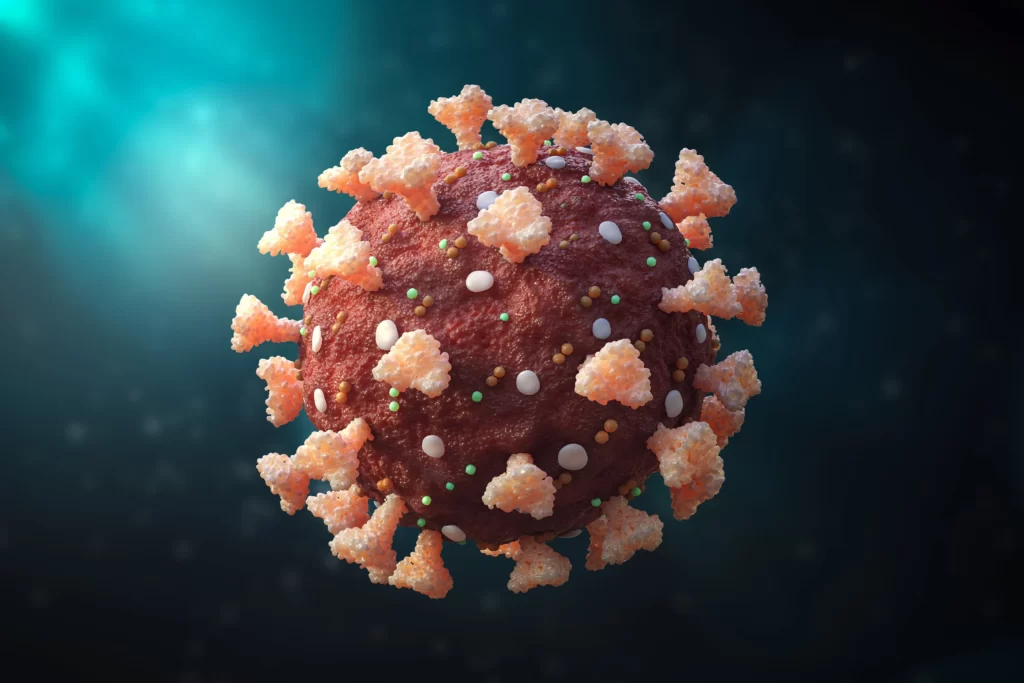
The presence of Omicron’s subvariant XBB and one of the three dominant COVID-19 strains in China has been confirmed by genome sequencing in Pakistan, according to the National Institutes of Health (NIH) and Aga Khan University, a News Agency reported on Tuesday.
The extremely contagious strain, BF.7, is not a threat to the nation, though.
“Genomic surveillance is underway at NIH Islamabad. However, due to low positivity, only a few samples are available for sequencing. Our last batch showed increased cases of Omicron XBB,” an official of the NIH Islamabad said.
A big COVID-19 wave is not now posing a threat to Pakistan, according to NIH authorities.
We do, however, constantly watch the situation and stand ready for anything, they added.
The XBB sub-variant of the Omicron variant was discovered and reported to the local authorities by Aga Khan University researchers, who added that they had not yet seen the other two sub-variants, including BF.7.
Dr. Faisal Sultan, a specialist in infectious diseases, thinks that because there were no travel restrictions in place to stop the spread of the COVID-19 virus, in addition to the XBB variation, the extremely contagious BF.7 would also be present and spreading in the nation.
There is no question about the occurrence of the XBB and BF.7 variations in Pakistan, adds Dr. Faisal Mehmood, another infectious disease expert from Aga Khan University.
However, he asserted that individuals have developed better immunity than the Chinese population as a result of the combination of vaccinations, particularly mRNA vaccines.
The BF.7 form has not yet reached Pakistan, according to Professor Saeed Khan, a senior molecular scientist, and professor of pathology at Dow University of Health Sciences (DUHS) Karachi.
According to him, once BF.7 enters Pakistan, there will be a substantial increase in COVID-19 cases, which would serve as an announcement of its entry.
He claimed that the COVID-19 re-infection-evading properties of the BF.7 variant made it so contagious that just one individual with the virus might infect 18 to 20 more persons.
“Once, we have this variant on our soil, we would see a surge like we saw when the original Omicron variant started infecting people in Pakistan. There was a sharp rise in COVID-19 cases, which is not happening at the moment,” said Prof. Saeed Khan.
To read our blog “Two new Omicron subvariants have been discovered in Pakistan,” click here.