

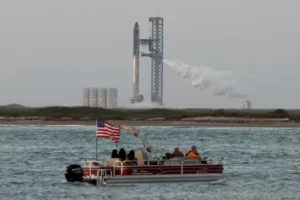
The enormous Starship from SpaceX has launched, but it was unable to enter orbit. The stainless steel spacecraft, which consists of a spacecraft perched on the so-called Super Heavy booster rocket, launched on Thursday morning from Boca Chica, Texas in the United States.
According to Stephen Clark of SpaceflightNow.com, at least five of its 33 Raptor engines did not appear to activate as the rocket lifted off. The rocket climbed past the launch tower and began to ascend.
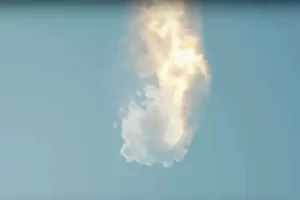
The spacecraft was unable to detach from the Super Heavy launcher, spinning endlessly before disintegrating in what is known as a “rapid unscheduled disassembly” in technical terms.
— Elon Musk (@elonmusk) April 20, 2023
The launch breaks the previous record for the biggest rocket ever fired.
Elon Musk, the CEO of SpaceX, stated in March that there was a 50% probability that the rocket would enter orbit.
On Thursday, he tweeted: “Congrats [SpaceX] team on an exciting launch of Starship!”
“Learned a lot for next test launch in a few months.” After the launch, there was a fire at the launch site.
According to its specifications, the Starship rocket has almost twice the power of NASA’s own Space Launch System (SLS), which launched its first unmanned spacecraft in November.

NASA Wants to Use Starship Rocket for Reviving Its Apollo Program
For the first time since the Apollo program came to an end in 1972, NASA has chosen the Starship spaceship to carry men to the moon in late 2025. This mission is known as Artemis III.
As a result of a pressurization problem in the lower-stage Super Heavy rocket, SpaceX had earlier postponed a launch that was scheduled for Monday. Musk said in a tweet that the abandoned test had taught him “a lot.”
Starship cruise ship prototypes had just completed five subspace trips up to 10 km (6 miles) above Earth.
Although SpaceX completed a test-firing of the booster in February, sparking 31 of its 33 Raptor engines for around 10 seconds while the rocket was strapped in place vertically atop a platform, the Super Heavy booster had never taken off.
“It’s a very risky flight,” Musk said in a Twitter livestream message on Sunday. “It’s the first launch of a very complicated, gigantic rocket.”
In a successful test, all 33 Raptor engines would fire simultaneously to launch the Starship on a journey that would almost take it around the entire planet.
It would then re-enter the atmosphere and plunge at supersonic speeds into the Pacific Ocean, about 60 miles (97 km) off the coast of the northern Hawaiian Islands.
The Super Heavy rocket is designed to start a controlled return flight when it separates from the Starship before crashing into the Gulf of Mexico.
To read our blog on “SpaceX makes 2nd offer to launch starship on test flight,” click here.