
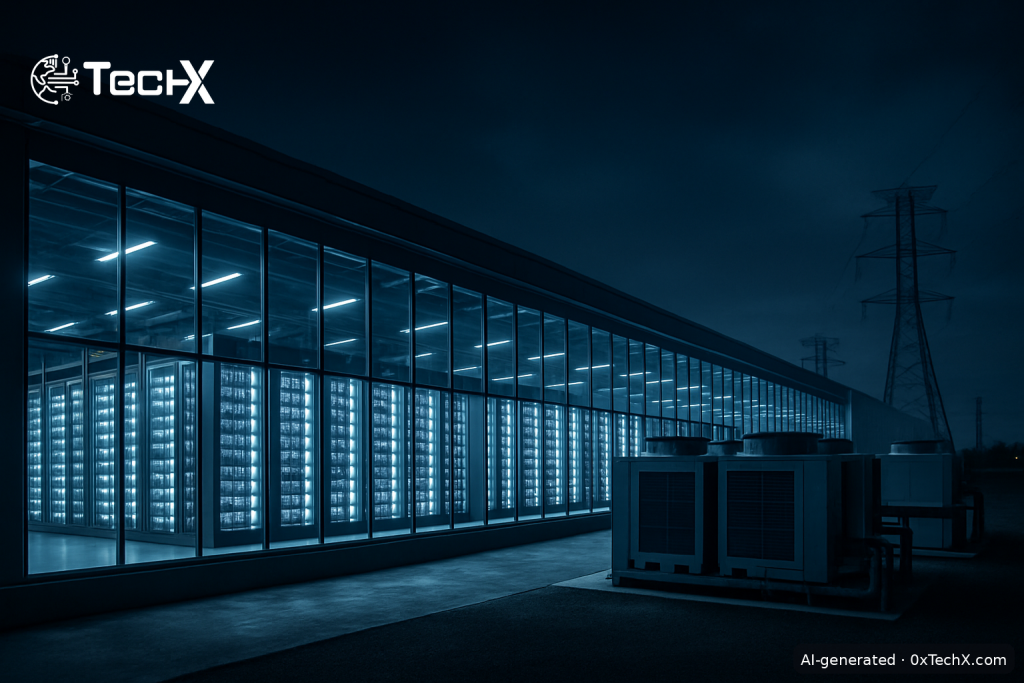
The New York data center moratorium is now official, and it is a first in United States history. On 15 July 2026, Governor Kathy Hochul signed an executive order that stops new hyperscale data centers above 50 megawatts (MW) from getting state permits for up to one year. The reason is simple: artificial intelligence is eating power faster than the grid can handle, and ordinary people are being left to pay for it.
What the New York Data Center Moratorium Actually Does
The order targets the biggest facilities. A conventional data center uses roughly 10 to 25 MW. An AI-focused hyperscale site can use 100 MW or more. By drawing the line at 50 MW, New York is squarely aiming at the AI infrastructure race that has exploded across the country.
The New York Department of Environmental Conservation will stop processing new discretionary state permits for construction or expansion of data centers at or above that 50 MW threshold. Projects that had already been deemed complete before the order are not affected, and local government permits are not touched by it. The pause stays in place until the state finishes a Generic Environmental Impact Statement, or for one year, whichever comes first.
During that time, regulators will study energy demand, water use, air quality, noise, and the effect on lower-income communities. The state will also publish a Community Investment Framework within 60 days to help local governments negotiate benefits from any future data center deals. You can read the full executive order on the official New York Governor’s website.
Why AI Energy Demand Triggered This Move
The numbers behind this decision are striking. According to the International Energy Agency, global data center electricity demand grew 17 percent in 2025. AI-focused data centers grew even faster, with electricity use surging 50 percent in that single year. The IEA now projects that total data center electricity consumption will roughly double from 485 terawatt hours in 2025 to around 950 terawatt hours by 2030, which would equal about three percent of all global electricity demand. You can follow this data on the IEA’s official energy and AI report page.
New York felt this pressure directly. Nearly 12 gigawatts of data center load requests had piled up in the New York grid operator’s interconnection queue as of May 2026. More than 8 GW of those requests arrived in 2025 alone. That is a massive spike in a very short period, and it put the state grid under serious strain.
Governor Hochul put it plainly: AI data centers consume enormous amounts of power, threatening to outpace the grid’s capacity and driving up costs for local ratepayers. Her plan also explores making hyperscale companies contribute to a statewide grid fund, so that their power needs do not quietly get passed to regular households through higher bills.
The New York Data Center Moratorium and the Bigger US Debate
New York is not alone in feeling the pressure. Moratoriums have been proposed in at least a dozen US states. Maine came close but its governor vetoed a similar bill because it would have blocked a data center that a struggling town depended on for jobs. At the federal level, several progressive lawmakers including Senator Bernie Sanders have backed a national halt to new data center construction through a proposed Artificial Intelligence Data Center Moratorium Act.
Tech companies and industry groups strongly oppose such moves. They argue that slowing data center approvals hands a competitive advantage to China and hurts local job creation. President Donald Trump has warned states not to put heavy rules on the AI sector. The Data Center Coalition said New York’s move would send investments and jobs to other states instead. It noted that data centers supported more than 227,000 jobs in New York and generated $5.1 billion in state and local tax revenue in 2024 alone.
This tension, between the economic pull of AI infrastructure and the real-world cost it places on grids and communities, is now a live political fight across the US.
What This Signals for Pakistan’s Data Centre Plans
Here is where this story gets interesting for Pakistani readers. While New York slams the brakes, Pakistan is actively trying to attract the same AI infrastructure investment that is now being turned away.
Pakistan’s government has allocated 2,000 MW of electricity to support bitcoin mining and AI data centers, driven from coal-fired plants running at low capacity. The idea is to turn a power surplus into an asset. Pakistan’s finance ministry has positioned the country as a potential data center hub, sitting between Asia, Europe, and the Middle East, with competitive energy costs and a new submarine cable landing that boosts internet connectivity.
Pakistan’s overall data center market is still small, with an installed IT load of about 23.53 MW in 2025. But it is forecast to reach 53.30 MW by 2030, a growth rate of nearly 18 percent per year. Energy, however, remains the biggest challenge Pakistan faces in building on this. As one analysis put it, energy stands out as Pakistan’s most pressing challenge for data centre growth, and long-term energy planning must become part of national technology policy.
The lesson from New York is clear: building data centers without a proper energy plan creates a crisis. Pakistan has a chance to get the framework right from the start, whether that means pairing new facilities with solar and wind power or setting clear rules about who pays for grid upgrades. The country’s wind potential in the Gharo-Keti Bandar corridor alone is estimated at 50,000 MW, which could power sustainable data infrastructure at scale.
For Pakistani tech businesses and the growing IT export sector, AI infrastructure matters directly. The more local compute capacity exists, the cheaper and faster AI tools become for local developers and companies. You can read more about Pakistan’s growing IT sector in our coverage of Pakistan IT exports crossing $4.5 billion in FY26.
Frequently Asked Questions
What is the New York data center moratorium?
It is a one-year pause on new state environmental permits for hyperscale data centers that use 50 MW or more of power. Governor Kathy Hochul signed it as an executive order on 15 July 2026, making New York the first US state to impose such a statewide freeze.
Why did New York pause new hyperscale data centers?
AI demand has caused a massive surge in power requests on New York’s grid, with nearly 12 GW of data center load requests queued by May 2026. State officials say this threatens to push up electricity bills for ordinary New Yorkers and strain grid infrastructure.
Will this stop all data centers in New York?
No. The moratorium only covers facilities above 50 MW that need new state environmental permits. Smaller facilities, research centers, universities, hospitals, and projects already in the approval process are not affected. Local government permits are also not paused.
Does this affect Pakistan or Asian tech investment?
Indirectly, yes. As the US and other major markets tighten rules on new AI infrastructure, countries like Pakistan that have surplus power and are actively trying to attract data center investment could benefit from the overflow. But to compete, Pakistan will need a clear energy and regulatory plan to avoid the same grid strain problems that triggered New York’s moratorium.