
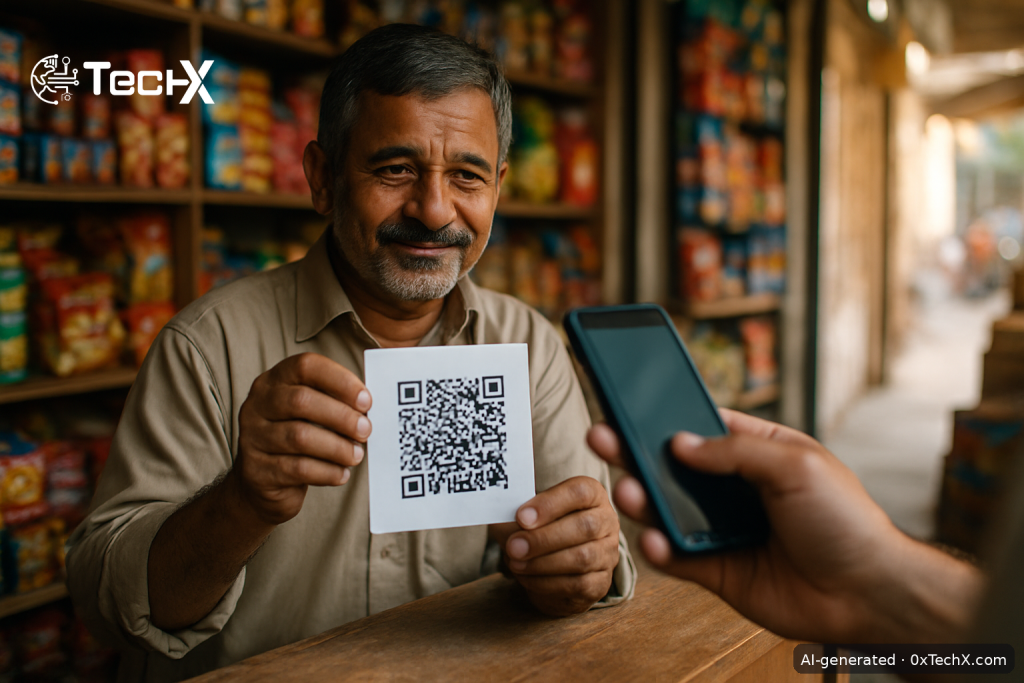
Raast P2M acquiring just took a major step forward in Pakistan. National Bank of Pakistan (NBP), the country’s largest state-owned bank, has received formal regulatory approval from the State Bank of Pakistan (SBP) to commercially launch Raast Person-to-Merchant (P2M) acquiring services. The approval enables NBP to formally roll out Raast P2M acquiring services for merchants, institutions, customers, and government entities across the country. This is not a pilot or a test run. It is a full green light for nationwide commercial operations.
What Is Raast P2M Acquiring and Why Does It Matter?
Before diving into what NBP’s approval means, it helps to understand what Raast actually is. Raast is an instant payment system developed by the State Bank of Pakistan. It operates using the Pakistan Faster Payment System (PFPS), facilitating real-time settlement of small-value retail payments, including peer-to-peer (P2P) and person-to-merchant (P2M) transactions.
The Person-to-Merchant QR code is designed to facilitate established businesses, both retail and corporate, to receive payments through QR codes. Think of it like scanning a code at a shop counter with your banking app and the money lands in the merchant’s account instantly, with no card machine or middleman needed.
This has provided a much-needed facility to small and micro merchants and self-employed individuals to accept payments digitally, who otherwise had no mechanism to receive payments other than cash. That last point is key. Millions of small traders in Pakistan, from general stores to vegetable sellers to tailors, have never had a practical way to accept digital payments. Raast P2M acquiring through a bank as large as NBP could change that.
NBP’s Raast P2M Acquiring Approval: What Happened
The National Bank of Pakistan received regulatory approval to commercially launch Raast P2M acquiring services. The approval allows the bank to facilitate merchant payments through Raast, Pakistan’s instant payment system developed by the State Bank of Pakistan. NBP said the authorisation followed coordination with the SBP’s Digital Innovations and Settlement Department and Raast Payments Pakistan.
The approval not only clears the way for commercial operations but also allows NBP to actively promote Raast P2M acquiring among merchants, customers, institutions, and government entities through structured awareness and media campaigns.
The NBP reiterated its commitment to promoting a cashless economy and announced plans to extend further cooperation to fintech partners and the business community.
One angle that most coverage has missed is NBP’s specific role as an acquirer. In payment system terms, an acquirer is the bank that signs up and supports the merchant side. NBP taking on this acquirer role means it will recruit, onboard, and manage merchants so those businesses can accept Raast payments. With NBP’s massive branch network spread across cities, towns, and rural areas, it has a reach that most private banks simply cannot match.
Who Will Benefit Most From This Launch?
Officials highlighted that the initiative will particularly focus on underserved segments, small merchants, and institutional payment ecosystems where digital acceptance remains relatively limited. There are three clear groups who stand to gain:
- Small and micro traders: Street vendors, kiryana stores, and small shops that currently only take cash can now get a simple QR code and start receiving instant payments.
- Government entities: The State Bank of Pakistan has announced plans to route all government payments through Raast by the end of the current fiscal year 2025-26, marking a major push to digitize financial transactions. NBP, as the government’s primary banker, is central to making that happen.
- Fintech partners: The bank plans to work closely with regulators, fintech companies, business partners, and merchant communities to accelerate adoption of digital transactions.
The Bigger Picture: Pakistan’s Cashless Push Is Gaining Speed
This approval does not exist in isolation. Pakistan’s digital payments market has been growing fast, and the numbers are striking. Pakistan’s digital payments continued to grow strongly during the first quarter of 2026, with 3.7 billion retail transactions worth PKR 168.8 trillion processed through formal banking and payment channels between January and March 2026. Digital channels accounted for 92% of all retail payments during the quarter.
Within that, Raast P2M has been the fastest-growing segment. Person-to-merchant transactions rose to 55.9 million from 36.3 million in the previous quarter. And the merchant side is expanding rapidly too: across the country, 2.5 million QR-enabled merchant locations have now been registered with banks and branchless banking providers.
The government has also put real money behind adoption. A subsidy programme covering a three-year period will provide Rs 3.5 billion in subsidies for September 2025 to June 2026. Under this scheme, merchants will be reimbursed at a rate of 0.5% of the value of each P2M QR code-based transaction or Rs 100, whichever is lower, effectively ensuring minimal to zero cost for digital adoption. This directly tackles the biggest barrier: small traders who resist any transaction fee, however small.
Challenges That Still Need Solving
The road is not completely smooth. Small retailers, often operating with thin profit margins, resist transaction charges even as low as 0.25%. Many merchants prefer encouraging customers to use P2P transfers, which remain free, rather than P2M payments, raising the risk of cannibalisation.
There are also widespread trust deficits, as informal businesses fear visibility to tax authorities, while infrastructure gaps in rural and peri-urban areas limit the reach of digital payments. These are real concerns, and NBP’s outreach campaigns will need to address them directly, especially for merchants who have operated informally for years.
There is also the scale of cash still outside the system. More than Rs 11.2 to 11.3 trillion is currently circulating in cash outside the banking system. If Rs 2.5 to 3 trillion of this is brought back into the financial system, it will benefit banks, fintechs, and all stakeholders, while helping curb the large undocumented and informal economy. NBP’s commercial launch of Raast P2M acquiring is one concrete step toward that goal.
For deeper context on how Pakistan’s state-backed digital infrastructure projects are reshaping the economy, see our earlier coverage of the PM Cloud Programme and Pakistan’s sovereign cloud push, another initiative where government-led digital ambition is meeting real-world rollout.
You can read more about Raast directly on the SBP’s official Raast P2M page or check NBP’s digital banking updates at nbp.com.pk.
Frequently Asked Questions
What is Raast P2M acquiring?
Raast P2M acquiring refers to the service where a bank signs up merchants to accept instant digital payments through Pakistan’s Raast system. Customers can pay by scanning a QR code or using their banking app, and funds reach the merchant instantly. NBP has now received SBP’s permission to commercially offer this service.
How is this different from a normal card payment or bank transfer?
Unlike card payments, Raast P2M requires no physical card machine or card network. Unlike a P2P bank transfer, it is a proper merchant transaction with a structured payment flow. It works through any Raast-enabled banking app, is interoperable across banks, and is designed to keep costs very low for small traders.
Will small shopkeepers in Pakistan actually benefit from this?
Yes, that is one of the stated goals. NBP will focus on underserved and small merchants who currently only accept cash. The government’s Rs 3.5 billion subsidy programme also means merchants pay close to zero in transaction fees during the early adoption phase, making it practical even for a small kiryana store.
Is Raast P2M available through all banks in Pakistan?
Multiple banks already participate in the Raast P2M network. NBP’s commercial launch adds the country’s largest state bank as a full acquirer, significantly expanding merchant coverage. Since its launch, 44 entities including SBP-regulated and government entities have been onboarded on Raast as participants. NBP’s entry broadens that network further, particularly for government-linked and underserved merchant segments.