
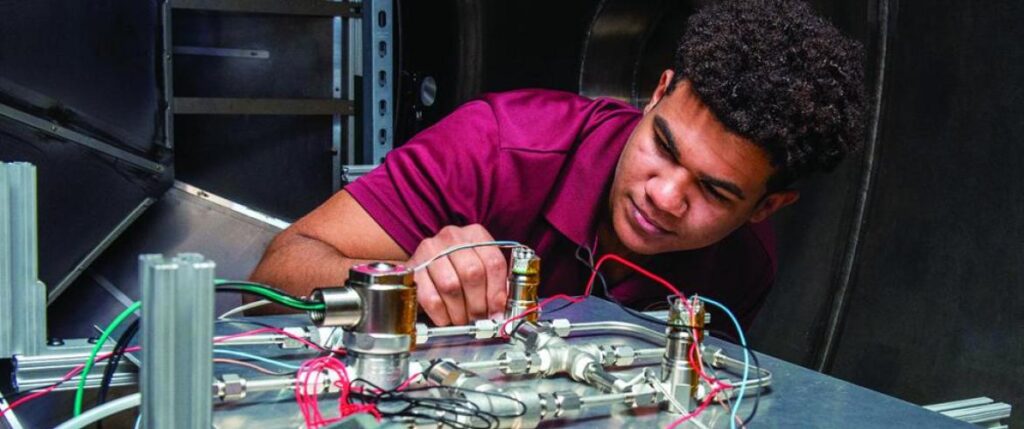
With more than $10.8 million distributed among 15 universities over three years to fund scientific and technological research, NASA has announced the recipients of its annual Established Program to Stimulate Competitive Research (EPSCoR) grants. Understanding our changing environment and promoting long-term exploration on the Moon through Artemis are two of the agency’s top priorities, and the research supports both of those goals.
The agency’s Kennedy Space Center in Florida is the hub for the programme, which serves a total of 25 states and 3 territories (Guam, U.S. Virgin Islands, and Puerto Rico).
The projects were chosen by NASA based on their value and how well they fit in with NASA’s goals. The research priorities of each awardee span from deep space exploration and sustainable space manufacturing to scientific and technological advances that will help people back on Earth.
Here are the lucky recipients and how much money they’ll be getting over the course of three years:
- Brown University $749,662.96
- Ames campus of Iowa State University, the amount was $661.362.
- The University of Nevada System – $747,791
- The University of New Mexico – $749,999.22
- $750,000 to Oklahoma State University.
- $750,000 to the South Dakota School of Mines and Technology
- $750,000 to the University of Alaska, Fairbanks
- $750,000 to the University of Delaware
- $749,995 for the University of Idaho in Moscow
- $750,000 for the University of Kentucky in Lexington.
- Grand Forks Campus of the University of North Dakota $470,368
- The University of Vermont in Burlington was awarded $750,000.
- Wyoming’s University Receives $749,696
- $748,564 for West Virginia University
- $750,000 to Wichita State University
NASA gives grants on the basis of different projects
Among the awardees is Oklahoma State University, which will use the grant to work on creating a straightforward method for constructing solar panels directly on the Moon’s surface. This capacity could help NASA get one step closer to its aim of supporting a lunar base camp and extended excursions to the moon. Because of their low mass, great power-generation potential, and resistance to radiation, vacuum-processed perovskite solar cells are being studied as a viable solar panel technology for use in outer space.
A grant has been awarded to the University of Wyoming to support the growth of research on the effects of global climate change on western United States water availability. This project could have significant effects on agriculture, tourism, and quality of life in areas where water scarcity is becoming a serious problem.
South Dakota School of Mines and Technology plans to develop an improved form of lithium-sulfur battery technology. Powering rockets, spacecraft, and habitats on the Moon and eventually Mars could be aided by advances in battery capacity and life.
Proposals for the EPSCoR funds came in from universities and colleges all around the country, with each authority allowed to submit just one proposal per year. Each project will have a three-year execution duration and a fifty percent cost sharing requirement. These awards not only help fund vital NASA research, but also improve the research infrastructure, science, and technology capabilities of the recipient’s higher education system and local economy.
The NASA EPSCoR initiative is an essential part of NASA’s plan to increase regional collaboration and national R&D growth. NASA is contributing to a stronger and more vibrant scientific community by funding cutting-edge research in these areas, which will drive innovation and push the frontiers of what is possible in space exploration for the benefit of all.
To read our article about “Apple’s Siri may soon use ChatGPT-like technology” click here.