
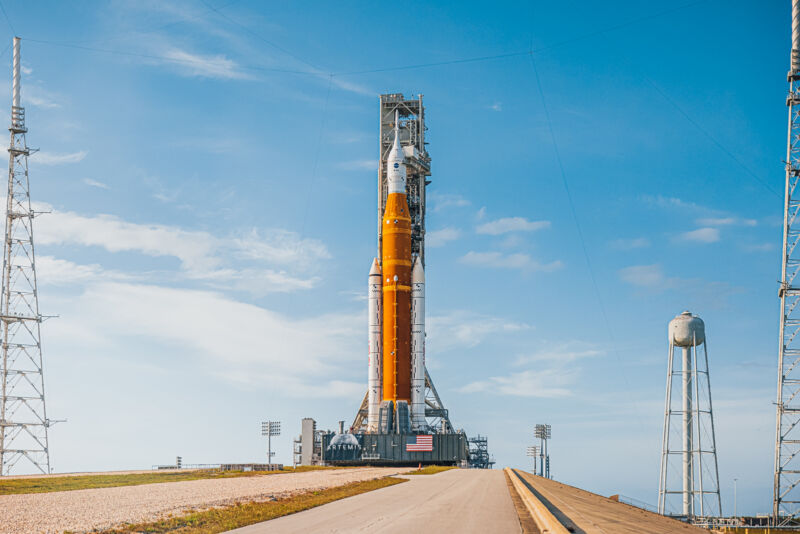
On Monday, NASA’s most potent rocket to date will launch on the first leg of a journey to return people to the Moon and eventually Mars.
After 50 years since the final Apollo mission, the unmanned Space Launch System (SLS) rocket will launch from Florida’s Kennedy Space Center at 8:33 am, (5:33 p.m.) Pakistan’s time to launch the Artemis space program for Mars.
Tens of thousands of spectators are gathered along Florida’s beaches to witness this launch, which has been planned for many years. Vice President Kamala Harris is one of them.
The launch is projected to draw between 100,000 and 200,000 people, and hotels in the area of Cape Canaveral are completely booked.
The SLS and the Orion crew capsule, which are mounted atop the rocket, will be tested during the trip known as Artemis 1.
In order to determine whether the spacecraft is soon safe for habitation, the capsule will orbit the Moon. Artemis will see the first lunar walk by a woman and a person of color at some point.
“This mission goes with a lot of hopes and dreams of a lot of people. And we now are the Artemis generation,” Bill Nelson, the NASA administrator, stated on Saturday.
On the Launch Complex 39B at the space center, the enormous orange and white rocket has been idle for a week.
More than three million liters of liquid hydrogen and oxygen were to be poured into its fuel tanks over the course of Sunday night and Monday.
Pack your bags, we are going to the Moon! 🧳
The Space Launch System and @NASA_Orion are targeting a two-hour launch window starting at 8:33 a.m. on August 29. Check out this handy travel guide to know what to prepare for our #Artemis I mission >> https://t.co/br7XSCuhzD pic.twitter.com/DHe1QfS8K8
— NASA_SLS (@NASA_SLS) August 28, 2022
According to NASA, there is an 80% likelihood of good weather for a timely launch at the start of a two-hour launch window.
Charlie Blackwell-Thompson will give the final OK for takeoff for the first time. There was only one woman working in the control room during Apollo 11, but currently, 30% of the team is female.
Every second of the 42-day journey will be documented by cameras, which will also take a selfie of the spaceship with the Moon and Earth as a backdrop.
The Orion spacecraft will orbit the Moon, approaching within 60 miles (100 kilometers) of it at its closest point before firing its engines to travel 40,000 miles beyond it—a record for a spacecraft designed to transport people.
To read our blog on “Moon mission series of NASA the Artemis will be initiated in August,” click here.