
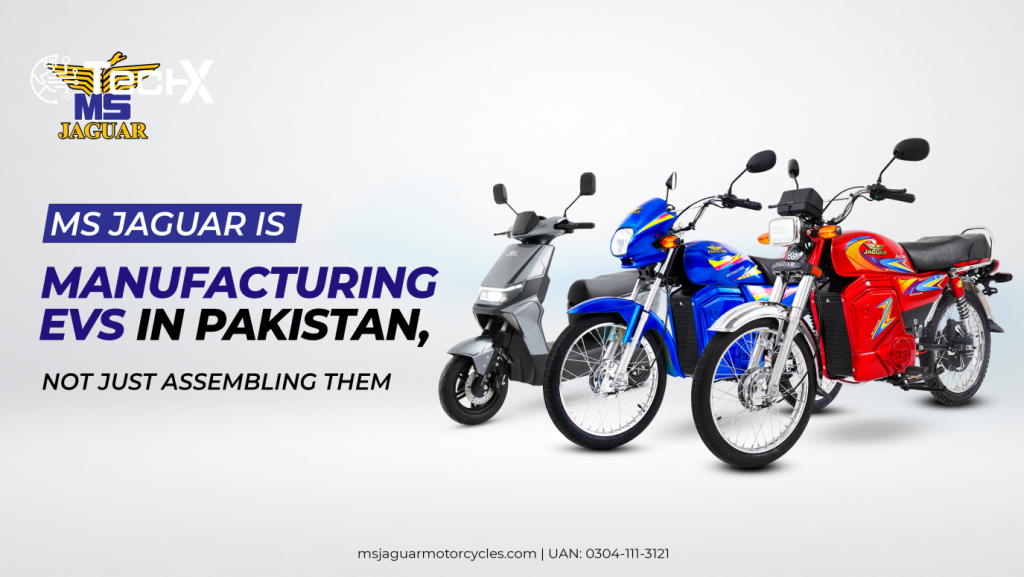
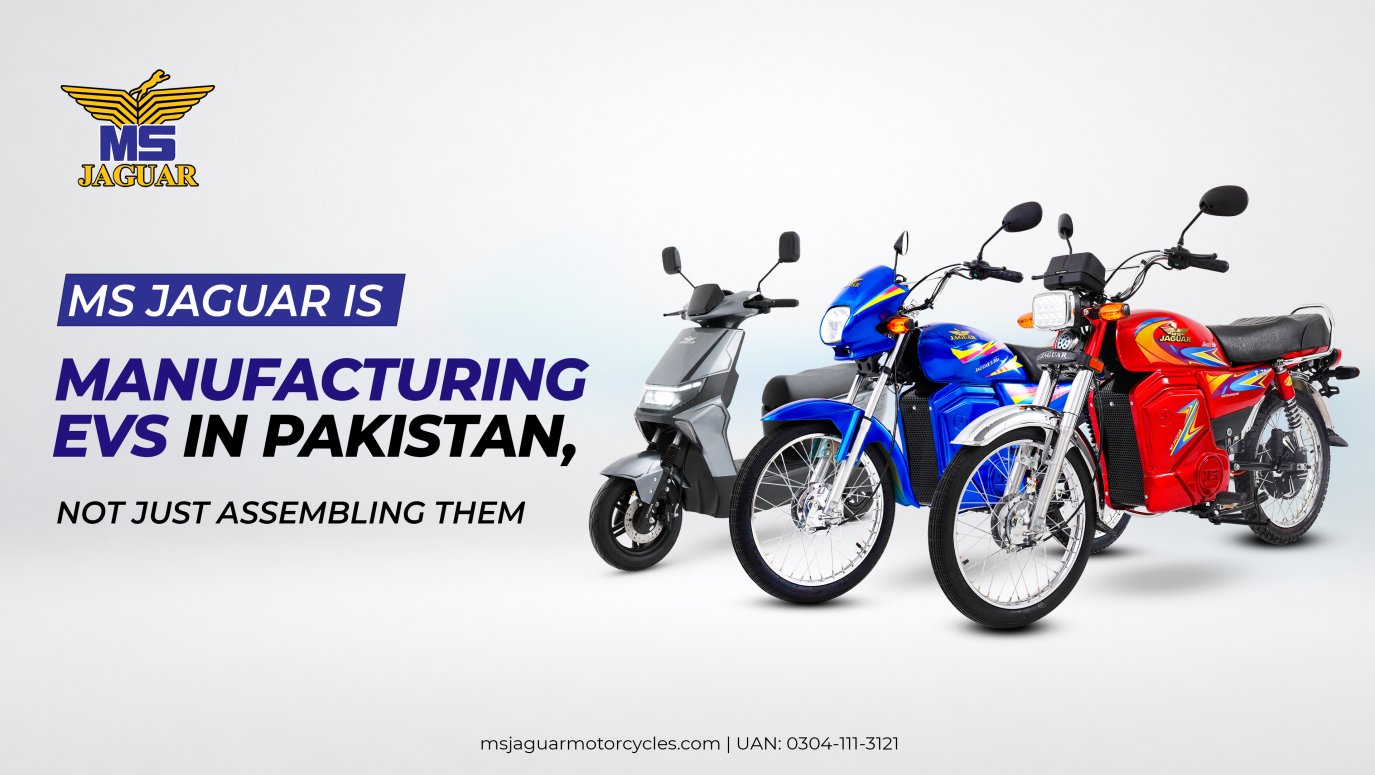

MS Jaguar was among Pakistan’s early adopters of electric mobility, introducing its EV lineup in 2021. The company was also the first in Pakistan to introduce Lithium Iron Phosphate (LFP) battery technology in two-wheelers. Today, MS Jaguar focuses on electric bikes, electric scooters, and electric three-wheelers, combining reliable technology with practical, sustainable mobility solutions.
Today, it manufactures electric bikes and battery packs in Pakistan. MS Jaguar electric scooters, including the Miso, Bolt, M1 and Miso 3-W, are assembled locally from imported CKD components.
Pakistan’s NEV Policy 2025, 30 sets a target for electric vehicles to account for 30% of new vehicle sales by 2030. The industrial opportunity lies in supplying that market with vehicles and components produced in the country. MS Jaguar’s electric bike and battery pack operations put it directly within that effort.
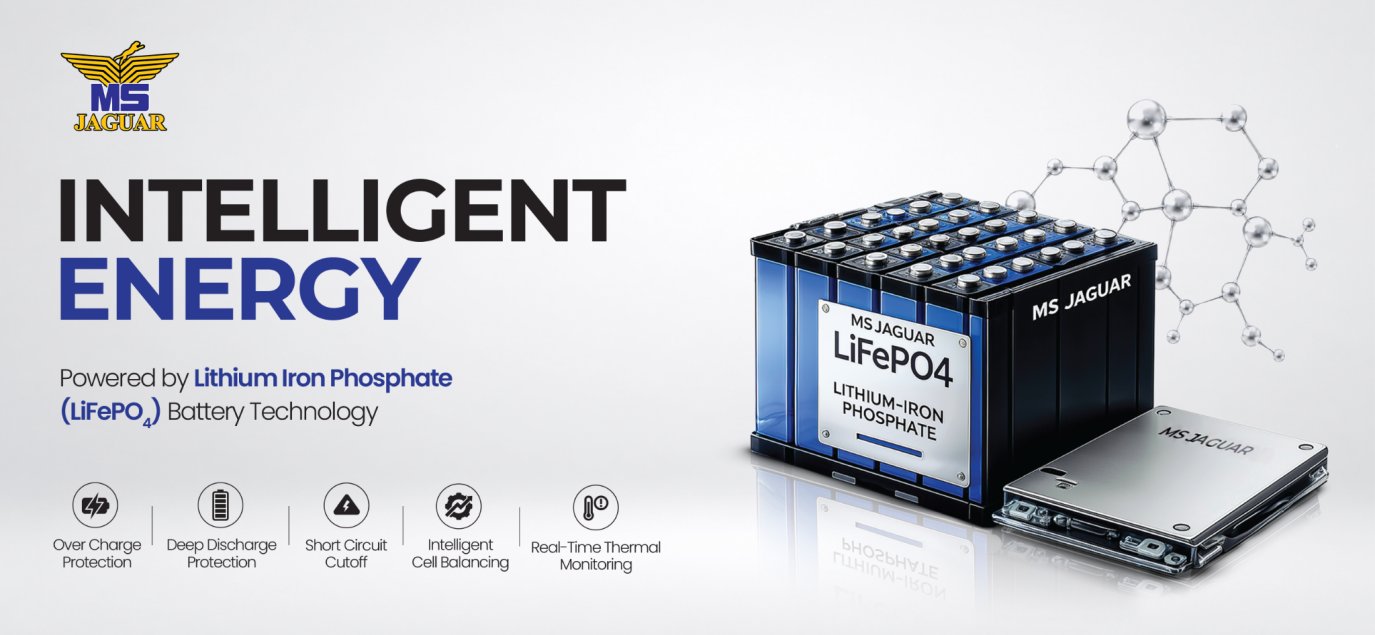
Building a battery pack means far more than fitting cells into a case. It calls for R&D into which cells to use, the right cell chemistry, and the pack’s shape and configuration, decisions that come from experience and testing, not simply buying cells and slotting them into a housing. Individual cells are wired together and paired with a battery management system (BMS) that monitors voltage, temperature and charge state across the pack, alongside proper thermal management to keep the pack safe and durable over time. This is engineering work distinct from vehicle assembly, and distinct too from cell manufacturing itself, which MS Jaguar sources rather than produces.

A 2024 study by LUMS Energy Institute researchers, including Naveed Arshad, identified local battery pack production using imported cells as an opportunity for Pakistan. It also highlighted the need for skills in battery management systems and fault diagnosis.
The work requires investment before sales reach a dependable level. Equipment, tooling and testing have to be paid for, while suppliers need regular orders to justify expanding production. The Competition Commission of Pakistan’s assessment of the automobile industry identifies low production volumes and policy uncertainty as barriers to deeper localization. It also documents how currency movements and difficulties obtaining imported components have disrupted production across the industry.
The LUMS study also identified financing constraints, limited testing facilities and shortages of trained EV personnel. A workforce experienced in petrol bikes needs additional expertise in batteries and electric drivetrains. Service technicians need to diagnose electrical faults as well as mechanical ones.
“The transition from petrol to electric required extensive research into different battery chemistries, from traditional lead-acid and lithium-ion systems to newer technologies,” said Ch. M. Umer Asad, Managing Director, MS Jaguar. “Our R&D team spent significant time studying cell chemistry, battery performance, safety, longevity, and real-world operating conditions. This research ultimately led us to adopt Lithium Iron Phosphate (LFP) technology, making MS Jaguar the first company in Pakistan to introduce LFP batteries in two-wheelers, backed by the longest battery warranty in Pakistan. Alongside this, we invested in specialized manufacturing equipment, including laser welding, and developed extensive battery testing and validation processes. These investments have helped us build the technical expertise and manufacturing capabilities required to deliver reliable electric mobility.”
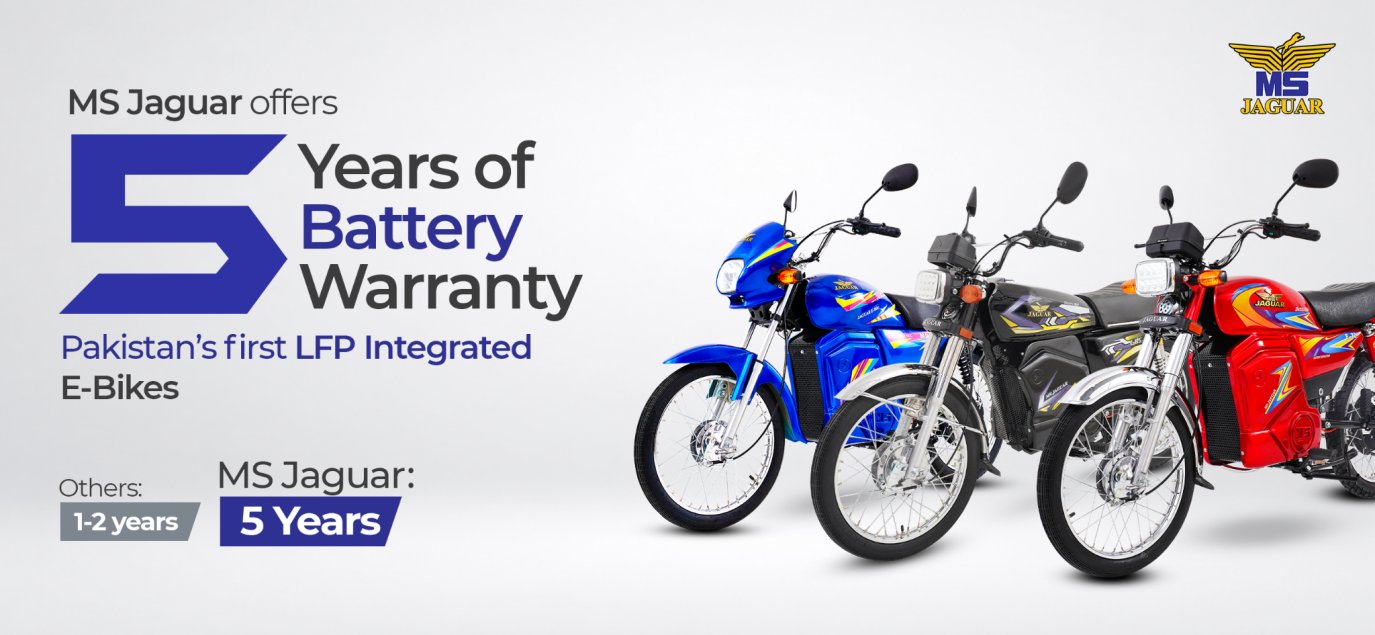
MS Jaguar’s introduction of LFP batteries was an early part of its EV work. Its current range combines LFP electric bikes with scooters offering Graphene or LFP options, allowing the business to serve several price points and consumer needs.
The pressure to offer alternatives to petrol has become more immediate. PSO lists petrol at Rs. 392.05 per litre effective September 23, 2026, compared with Rs. 367.75 on September 10. That difference of Rs. 24.30 means a rider buying 20 litres a month would spend Rs. 486 more for the same amount of fuel. Electric bikes and scooters replace petrol purchases with charging costs, offering an alternative for everyday commuting.
The purchase price still has to fit a household’s budget. MS Jaguar’s range starts with the Miso scooter and extends to the E-125 bike. The E-70 and E-70 Supreme retain the familiar bike format, while the scooters offer a different seating and riding layout. The MS Jaguar electric bike and scooter lineup currently includes the following models.
| Model | Vehicle type | Battery options |
| Miso | Electric scooter | Graphene |
| Bolt | Electric scooter | Graphene / LFP |
| M1 | Electric scooter | Graphene / LFP |
| Miso 3-W | Electric three-wheeler | Graphene |
| E-70 | Electric bike | LFP |
| E-70 Supreme | Electric bike | LFP |
| E-125 | Electric bike | LFP |
Battery choice helps account for the spread. The Miso’s Graphene battery takes approximately five to six hours to charge fully and offers a published range of up to 70 km. The LFP versions of Bolt and M1 support fast charging in approximately 2.5 to three hours, with up to 100 km of published range. These configurations let MS Jaguar offer an accessible entry model alongside options for riders who need shorter charging stops.
The Miso 3-W broadens the audience further. At Rs. 228,000, it brings an affordable electric three-wheeler below the Rs. 230,000 mark. Its intended riders include people with disabilities and older adults who prefer a three-wheel layout. A low seat and step-through frame help with getting on and off, while reverse mode assists with parking. Its Graphene battery provides a published range of up to 80 km.
Wider dealer coverage puts test rides and purchases within reach of more customers, but it also means stocking parts and training workshop staff in cities where MS Jaguar has no prior footprint.
MS Jaguar’s dealership network grew from 70 outlets three months earlier to more than 80 nationwide by mid-September 2026. Its strongest presence remains in Punjab, including Lahore, Multan and D.G Khan.

A dealership without local repair support is only half useful to the commuter who bought from it. That’s what expansion into a new city actually requires: getting replacement components to workshops and making sure technicians know how to service each battery and vehicle configuration, not just opening a storefront, a commitment MS Jaguar has carried into each new market it has entered.
That kind of follow-through is what turns a growing dealership count into a durable business, and it’s the same discipline MS Jaguar has applied to manufacturing itself: build the capability first, then scale it. As Pakistan’s EV market moves toward the government’s 2030 targets, that combination of local production and local support is what MS Jaguar is counting on to lead rather than follow.