
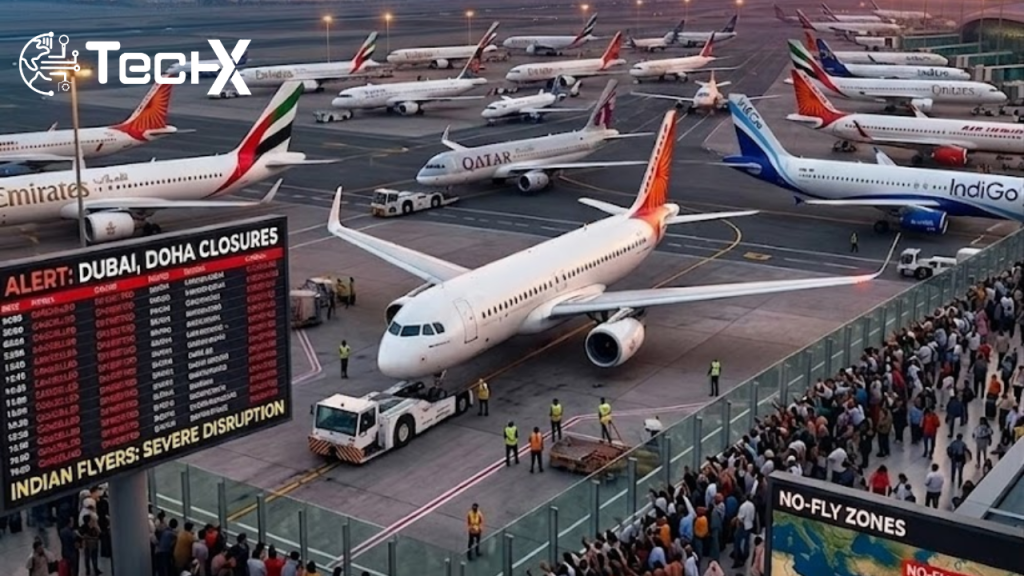
Airspace restrictions in the Middle East amid the ongoing conflict involving Iran have caused major disruptions for Indian carriers. This region is a crucial corridor for flights to Europe and the US, especially since Pakistan banned Indian airlines from its airspace last year.
Flight Cancellations and Rescheduling
Due to the war and resulting airspace closures, Indian airlines have been forced to reschedule or reroute flights. With Pakistan’s airspace unavailable, carriers have very limited options for efficient routes.
Impact on Major Carriers
Data from Cirium shows that India’s largest international airlines, Air India and IndiGo, failed to operate 64% of their 1,230 scheduled flights to the Middle East, Europe, and North America in the past 10 days. Aviation expert Amit Mittal described the situation as a “double whammy” for Indian carriers.
Financial Implications
HSBC has warned that geopolitical tensions in the Middle East will increase costs and reduce profitability for Indian airlines. A week of cancellations could reduce annual pre-tax profits by approximately 1.2%, according to the bank’s estimates.
IndiGo Unique Challenges
IndiGo relies on six long-range Boeing planes leased from Norse Atlantic Airways to fly to Europe. Because these aircraft are registered in Norway, they must follow the EU Aviation Safety Agency advisory to avoid airspaces of Iran, Iraq, Israel, Kuwait, Lebanon, Qatar, UAE, and Saudi Arabia. This has forced longer routes via Africa, adding up to two hours of extra flight time in some cases.
Flight Route Disruptions
Even these alternative routes face hurdles. For example, an IndiGo Delhi-Manchester flight was forced to return to Delhi after air traffic control in Eritrea denied airspace use due to confusion over the Norse-registered aircraft operated by IndiGo. Such incidents highlight the operational challenges Indian airlines are currently facing.