
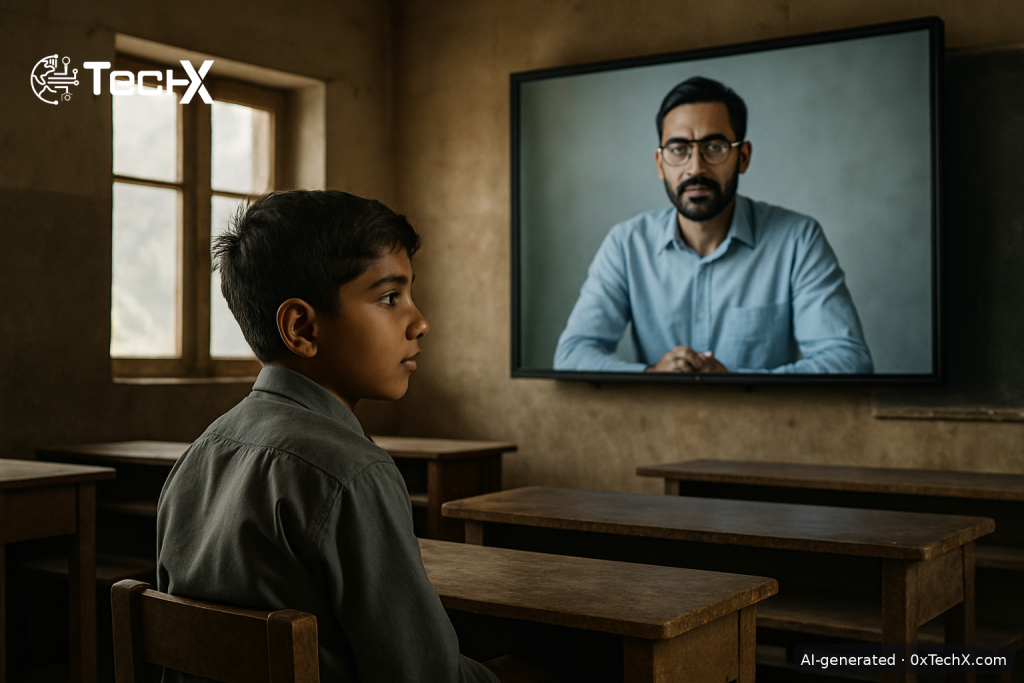
KP AI teachers are now live in government classrooms across Khyber Pakhtunkhwa, with the province deploying AI-generated digital clones of real educators to fill a critical gap in qualified science teachers, especially in remote tribal districts. The move, approved by Chief Minister Muhammad Sohail Afridi, marks Pakistan’s first public-sector virtual school system and could change the way millions of underserved children learn.
Why KP Needs AI Teachers Right Now
The education crisis in KP’s merged and tribal districts is severe. Bajaur district alone has an overall literacy rate of just 26.26 percent, with female literacy dropping to only 12.29 percent. Districts such as Kohistan, North Waziristan, and Bajaur are among the worst affected, facing enduring educational challenges in some of Pakistan’s most conflict-affected regions.
The technology is being introduced mainly to address teacher shortages in remote regions including Bajaur, South Waziristan, North Waziristan, and Bannu, where science teachers are especially scarce. Hiring enough qualified staff for these areas has proved almost impossible for years. KP AI teachers are the government’s direct answer to that problem.
What the Parho KP Virtual School Actually Does
The KP government announced a sweeping digital education plan under which AI-powered human clones of teachers will deliver lessons to students. The Parho Khyber Pakhtunkhwa project aims to digitise the province’s curriculum, put lessons on mobile phones, and introduce virtual classrooms, AI-assisted personalised learning, and virtual science laboratories.
At the core of the system is a digital teaching studio in Gulbahar, Peshawar. The Parho Khyber Pakhtunkhwa initiative will use these AI teacher clones to cover 2,900 curriculum modules for grades six through twelve, including subjects such as physics, maths, and Urdu. A virtual clone of a well-known Peshawar teacher, who has reportedly taught at Cambridge and government institutions, has already been developed and used to deliver classes.
Crucially, this is not just a video library. Students will not simply watch prerecorded videos. Officials say they will be able to ask questions directly to the virtual teachers and receive live responses, transmitted from the virtual school set up in Gulbahar, Peshawar. Selected pilot schools have been fitted with screens, cameras, microphones, internet connections, and sound systems to receive these live sessions.
How Many Schools Are Already Running
In its pilot phase, 46 government schools have already been transitioned into virtual institutions, including 33 schools from settled districts and 13 from merged districts, signalling a broad and inclusive rollout strategy. Another 175 schools are set to join soon.
At the heart of the project is a central digital teaching studio, where an AI-generated teacher is delivering lessons in core subjects such as English, Mathematics, Physics, Chemistry, and Biology. The system also works in Urdu, English, and Pashto, making it accessible to local learners across the province.
Officials said students studying through the virtual school system, including overseas Pakistanis and out-of-school children, will be granted the status of regular students. This is a significant detail that other coverage has largely glossed over: a child in a remote village will have the same formal standing as one sitting in a Peshawar classroom.
The Money Behind the Plan
The government says the initiative requires a one-time investment of Rs5 billion and could generate annual savings of more than Rs100 billion. Chief Minister Sohail Afridi has framed this as a long-term economic decision, not just an education one. He has set a target of raising the province’s literacy rate by 30 to 35 percent within two years.
The government is also tackling the offline access challenge head-on. Under the Parho Khyber Pakhtunkhwa initiative, the government will digitise the provincial curriculum and make all textbooks available through mobile phones. Students will also be able to access classes offline, allowing them to continue learning without an internet connection. Officials said the initiative will capitalise on the widespread availability of smartphones, with approximately 90 per cent of households in the province having access to smart devices.
A new AI Education Authority has also been approved to oversee the rollout. Chief Minister Sohail Afridi has approved the establishment of an AI Education Authority to oversee the initiative, which aims to modernise learning delivery and improve access to quality education across the province.
The Real Concerns on the Ground
Not everyone is convinced. The Young Teachers Association Khyber Pakhtunkhwa has raised concerns over the feasibility of the plan, pointing out that many areas lack reliable basic network connectivity. The association also questioned government claims that the AI system can operate offline, asking how it could work without access to online data.
Teachers’ representatives are questioning whether an AI-driven education system can survive the province’s harshest ground realities, including poor connectivity, vacant teaching posts, and schools lacking basic facilities.
These are fair questions. KP’s merged districts have seen schools bombed and damaged repeatedly in recent years, making even physical infrastructure a challenge. None of this means classrooms will empty out or teachers will disappear. Officials describe the AI teacher system as a support tool for areas where trained staff are hard to find, not a full replacement for human educators.
Pakistan’s broader digital economy push also depends on getting the basics right in provinces like KP. You can read about how Pakistan risks losing $60 billion without faster action on digital inclusion, which underlines why closing the education gap in remote areas matters far beyond just literacy numbers.
Frequently Asked Questions
What are KP AI teachers?
KP AI teachers are AI-generated digital clones of real educators used in Khyber Pakhtunkhwa government schools. They deliver live lessons in subjects like physics, maths, chemistry, and Urdu to students in areas where qualified human teachers are not available.
Which districts are getting AI teachers first?
The technology is being introduced mainly to address teacher shortages in remote regions including Bajaur, South Waziristan, North Waziristan, and Bannu, where science teachers are especially scarce. The pilot includes 13 schools from merged districts.
Can students interact with the AI teacher or just watch videos?
Students can do more than watch. Under the pilot system, selected schools have been equipped with screens, cameras, microphones, internet connections, and sound systems. Students can then attend live classes transmitted from the virtual school in Gulbahar, Peshawar. They can ask questions and get live responses.
What happens if there is no internet in a remote school?
Officials said students will be able to continue learning even without internet connectivity, ensuring uninterrupted access to education, particularly in remote and underserved areas. The government is building an offline-capable learning management system to handle this. However, teachers’ unions have questioned whether true offline AI is practical.