
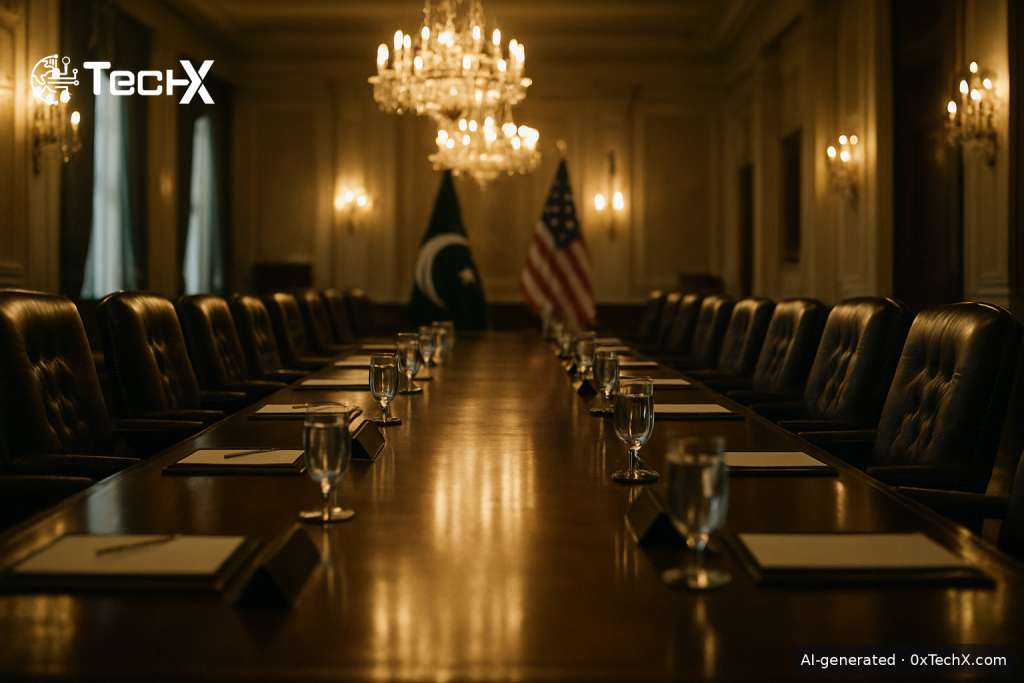
The Israel Iran peace talks that Pakistan hosted in Islamabad have become the centre of a major political storm after US Vice President JD Vance accused Israeli-linked figures of running a secret, heavily funded campaign to wreck the entire peace process. Vance made the remarks on the Joe Rogan Experience, one of the world’s most-listened-to podcasts, in an episode published on 15 July 2026.
What Vance Said on Joe Rogan
Vance did not hold back. He told Rogan there was a campaign he described as very discreet and extremely well-funded aimed at stopping US negotiators from reaching a deal with Tehran. He pointed to a Time magazine article that outlined how former Trump campaign adviser Brad Parscale had allegedly been paid by the Israeli government to push conservative online influencers to attack the peace deal. According to that report, the arrangement was worth around $1.5 million per month and was set up to produce large volumes of pro-war content aimed at younger conservative audiences online.
Vance said he was shocked to see the campaign working through mainstream media. He told those behind the effort to simply go to hell, adding that his job was to serve American interests, not foreign ones. He said some people within the Israeli government wanted the war with Iran to go on indefinitely, with no clear end goal. That position, he argued, was not something Washington could accept.
What makes this significant is who is saying it. A sitting US Vice President publicly blaming a close US ally of funding a sabotage campaign against the Israel Iran peace talks is not normal. It points to deep cracks inside the Trump administration over Middle East policy.
How Pakistan Ended Up in the Middle of All This
To understand why Vance is so frustrated, you need to know what Pakistan actually did here. The Islamabad Talks, held on 11 and 12 April 2026, were the highest-level direct engagement between Washington and Tehran since 1979. The US sent a 300-member team led by Vance himself, alongside special envoys Steve Witkoff and Jared Kushner. Iran sent a 70-member team led by parliamentary speaker Mohammad Bagher Ghalibaf and Foreign Minister Abbas Araghchi. Pakistan’s own team, led by Prime Minister Shehbaz Sharif, Field Marshal Asim Munir, and Deputy PM Ishaq Dar, worked around the clock to keep the two sides talking.
The talks ran for 21 hours across two days and ended without a final agreement, mainly because Iran and the US could not agree on the status of Iran’s nuclear programme and the Strait of Hormuz. But that was not the end. Pakistan kept pushing. Munir reportedly stayed awake through the night making calls and keeping communication lines open whenever the process looked close to collapse.
Eventually, after months of quiet shuttle diplomacy involving Pakistan, Qatar, Saudi Arabia, Turkey and Egypt, a deal took shape. On 12 June 2026, PM Sharif announced that the US and Iran had agreed on a final text. On 17 June, US President Donald Trump and Iranian President Masoud Pezeshkian signed what became known as the Islamabad Memorandum of Understanding. It was a formal framework to end the war, with a 60-day window to negotiate final terms.
The Deal That Fell Apart
What few articles covering the Vance-Rogan interview fully explain is that this Islamabad MoU has since collapsed. On 8 July 2026, after Iran struck multiple commercial ships in the Strait of Hormuz and the US responded with strikes on Iranian territory, Trump declared the MoU was over. Then on 13 July, Iran’s Foreign Ministry said it would no longer comply with the MoU either, accusing the US of violating its terms. By the time Vance sat down with Rogan on 14 July, the deal he had personally led was in ruins, and the Strait of Hormuz was once again a flashpoint.
This context matters a lot. Vance’s anger about the Israel Iran peace talks campaign is not just political noise. He is defending a process he personally invested months into, one that briefly produced a signed agreement, only to unravel under the pressure of continued fighting and, in his view, active sabotage from outside forces.
What This Means for Pakistan
For Pakistan, this is a complicated moment. On one hand, Pakistan’s diplomatic role in the Israel Iran peace talks was recognised globally. The Council on Foreign Relations called Pakistan an unlikely but indispensable mediator. Saudi Arabia’s Foreign Minister specifically acknowledged Pakistan’s sustained efforts throughout the process. That recognition matters for a country that spent years being sidelined on the world stage.
On the other hand, Pakistan is now sitting between two sides that have both walked away from the deal it spent enormous energy putting together. With the Strait of Hormuz tense again and US airstrikes resuming against Iran, the diplomatic window that opened in Islamabad appears to have shut. Pakistan’s mediation role is not formally dead, but it is in a very uncertain place.
For ordinary Pakistanis, the consequences are more immediate. Iran is a neighbour and a critical trade route. Instability in the Strait of Hormuz affects global oil prices, and Pakistan, which imports oil, feels those price swings directly at the pump and in energy bills.
The Bigger Picture at the White House
Vance’s comments also reveal something important about tensions inside the Trump administration. He was tasked by Trump with leading the Iran negotiations. He flew to Islamabad. He signed off on the MoU. And now he is publicly saying that foreign-funded influencers, linked to a US ally, worked to destroy that process by attacking him personally on social media and through press leaks.
He told Rogan that critics were accusing him of being influenced by Qatar, by Tucker Carlson, and by foreign governments. He pushed back hard on all of it, saying he was simply trying to finish the job Trump gave him. His language was blunt: American interests come first, and anyone, including allies, who undermines that should expect no goodwill from him.
Whether or not the influence campaign allegations are fully proven, the fact that a sitting US Vice President is making them publicly tells you how raw the tensions are.
Frequently Asked Questions
What exactly did JD Vance say about Israel on Joe Rogan?
Vance said there was a very discreet and extremely well-funded campaign, allegedly linked to the Israeli government, aimed at stopping US-Iran peace negotiations. He pointed to a Time magazine report about a $1.5 million per month influencer operation and told those behind it to ‘go to hell’.
What role did Pakistan play in the Israel Iran peace talks?
Pakistan was the main mediator. It hosted the historic Islamabad Talks in April 2026, the highest-level direct US-Iran engagement since 1979, and later helped broker the Islamabad Memorandum of Understanding signed in June 2026 by both Trump and Iranian President Pezeshkian.
Is the US-Iran peace deal still active?
No. Trump declared the Islamabad MoU ‘over’ on 8 July 2026 after renewed fighting around the Strait of Hormuz. Iran then also formally said it would no longer comply with the agreement. As of mid-July 2026, US airstrikes against Iran had resumed.
Why does this matter for people in Pakistan?
Pakistan’s role as peace mediator gave it rare international prestige. But the collapse of the deal leaves Pakistan in a difficult position as a neighbour of Iran. Renewed instability in the Strait of Hormuz also pushes up global oil prices, which directly affects fuel and energy costs inside Pakistan.