
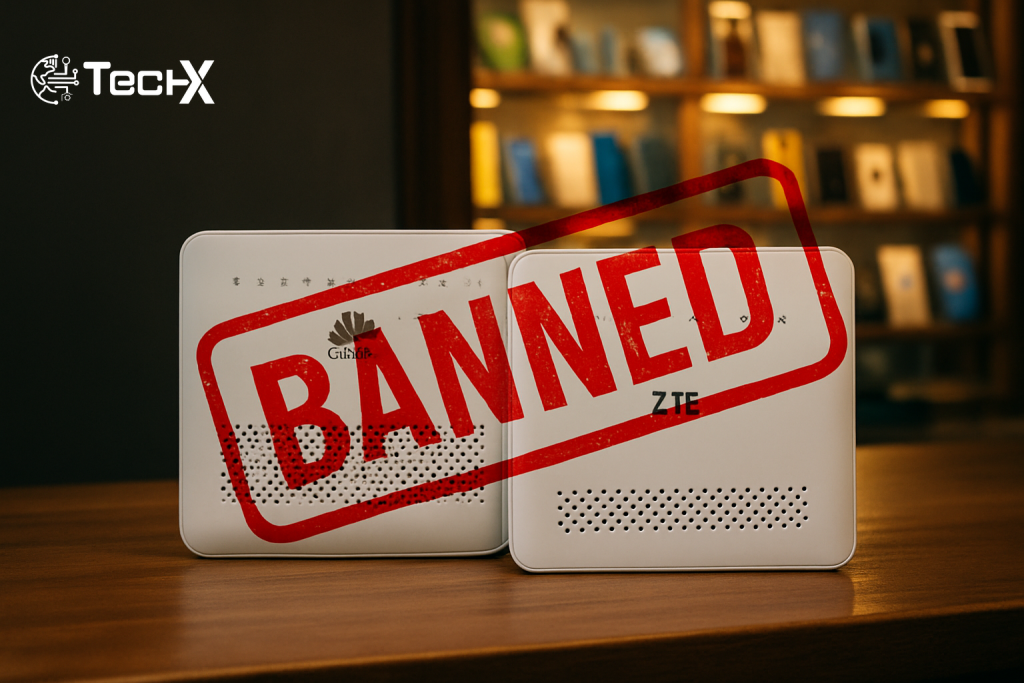
The Huawei ZTE hardware ban just got a lot bigger. On June 26, 2026, the US Federal Communications Commission (FCC) voted to close a major loophole that had quietly allowed older, pre-approved Chinese devices to keep flowing into the American market even after the original 2022 restrictions. The move affects five companies: Huawei, ZTE, Hytera, Hikvision, and Dahua, and it takes effect in early July 2026.
For most Pakistani consumers and importers, the ban does not apply directly. Pakistan is not the US. But the ripple effects on global Chinese hardware supply chains, grey-market phone routes, and future local regulation are very real and worth understanding.
What the FCC’s Huawei ZTE Hardware Ban Actually Did
The story starts in November 2022. That is when the FCC first banned new device models from the five Chinese companies on its ‘Covered List’. The logic was national security: US officials feared that telecom and surveillance equipment from these firms could be used for espionage or disabled in a conflict. Chinese manufacturers and Beijing denied this.
But the 2022 ban had a gap. It only blocked new models. Older devices that had already been approved before late 2022 could still be imported and sold in the US. In practice, this meant government agencies and critical infrastructure operators kept buying legacy Huawei routers, ZTE base-station parts, and Hikvision cameras, just using the older, pre-approved versions.
The June 26, 2026 action closes that gap permanently. The FCC ruled that the age of a device’s certification is not a meaningful security distinction. If the hardware is from a banned company, it is banned, full stop. The rule now covers previously approved older models from all five manufacturers.
This latest action follows a clear pattern. In December 2025, the FCC banned Chinese drone imports. In March 2026, it banned Chinese consumer internet routers. The expanded Huawei ZTE hardware ban is the next layer in what experts describe as a comprehensive hardware exclusion strategy. You can read the FCC’s official Covered List and rules at the FCC Supply Chain Security page.
Why Huawei and ZTE Matter Globally
Huawei and ZTE are not small players. They are telecom infrastructure giants whose equipment forms the backbone of wireless networks in dozens of countries. Hikvision and Dahua are the world’s two largest makers of video surveillance equipment. Hytera makes radio systems used by emergency services worldwide.
Restricting their legacy product lines does not just affect the US. It squeezes global supply chains and pushes resellers, distributors, and grey-market traders to adapt, reprice, or find alternative sources. That matters a great deal for markets like Pakistan.
It is also worth noting the political timing. The FCC vote came roughly six weeks after President Trump met President Xi in Beijing for trade talks. The move stands in contrast to earlier signals from the Trump administration, which had briefly softened some tech restrictions ahead of that summit. The ban going ahead anyway shows that hardware security policy now moves somewhat independently of broader trade diplomacy.
Beijing’s response followed a familiar pattern: Chinese foreign ministry officials described the FCC decisions as protectionist measures that violate World Trade Organization rules and harm global supply chain stability.
The Huawei ZTE Hardware Ban and Pakistan’s Grey Market
Here is where this story touches Pakistan directly. Pakistan is not a formal market for Huawei smartphones. Devices enter the country through grey-market channels, meaning unofficial imports via Dubai, UAE, or Chinese resellers rather than through authorised distributors.
Grey-market phones can be cheaper by PKR 12,000 to PKR 35,000 compared to officially registered models. That price gap is a big draw for Pakistani buyers. But grey imports lack PTA approval, may ship with non-Pakistani firmware, and carry no manufacturer warranty. Pakistan’s PTA requires all mobile devices to be registered to work on local networks. Devices that are not registered can have their SIMs blocked.
Pakistan imported over 10.88 million mobile units in April 2026 alone, with ZTE among the brands maintaining notable volumes in the low-cost segment. That gives some sense of the scale of Chinese hardware flowing through Pakistan’s supply chains.
The US ban does not stop Pakistani importers from buying Huawei or ZTE devices. These companies still sell freely across the Middle East, Africa, and Asia. But here is the indirect risk:
- Supply chain pressure: As the US, EU, and other Western markets shrink for these brands, manufacturers may shift production priorities. This can affect availability of certain models globally.
- Regulatory signal: The US-China tech war is pushing other countries to make choices. The PTA already has its own device registration and security frameworks. If pressure builds on Pakistan to align with Western hardware policies, grey-market import routes could face tighter scrutiny.
- Grey-market risks grow: Unofficial imports already come with hidden costs. Prices can rise after PTA registration, brokerage, and customs duties. Warranties are shop promises, not manufacturer guarantees. Repairs take longer because spare parts for region-specific variants are not stocked locally.
For anyone relying on grey-market Huawei or ZTE devices in Pakistan, these structural risks are not new. But the global policy direction adds another layer of uncertainty for the long term.
You can check PTA’s official device registration system and rules at the PTA DIRBS portal. Registering your device is the first step to avoiding a SIM block.
For a broader look at how US export controls are reshaping the tech landscape for Pakistani users, see our piece on how US AI export controls are pushing Chinese AI firms into the global gap.
What Happens Next
The FCC is also reportedly weighing a ban on US carriers connecting with Chinese telecom firms, which would effectively bar those companies from running data centres on US soil. That would be an even bigger escalation.
For now, the Huawei ZTE hardware ban expansion is a US domestic rule. But it is part of a wider decoupling between Western and Chinese technology ecosystems that is reshaping global hardware markets. Pakistani businesses and consumers who depend on Chinese tech supply chains should watch this space closely.
Frequently Asked Questions
Does the FCC’s Huawei ZTE hardware ban affect Pakistan directly?
No, the ban is a US rule and applies to imports into the United States. Pakistani importers can still legally buy Huawei and ZTE devices from China or other markets. However, the ban tightens global supply chains and signals a wider tech-decoupling trend that could indirectly affect availability and pricing over time.
What was the loophole that the new ban closes?
When the FCC first banned these companies in 2022, it only blocked new device models approved after that date. Older, pre-approved hardware could still enter the US. The June 26, 2026 expansion removes this exception and bans all legacy models too, effective early July 2026.
Which companies are covered by the expanded ban?
The five companies on the FCC’s Covered List are Huawei, ZTE, Hytera Communications, Hangzhou Hikvision Digital Technology, and Zhejiang Dahua Technology. All are state-linked Chinese hardware makers in telecom and surveillance sectors.
What should Pakistani buyers of grey-market Chinese phones know?
Grey-market phones lack official PTA registration, which means your SIM can be blocked if the device is not registered. Prices can also be higher than they appear once customs duties and PTA fees are added. Unofficial devices may arrive with Chinese firmware and no local warranty. Always check PTA registration status before buying.