
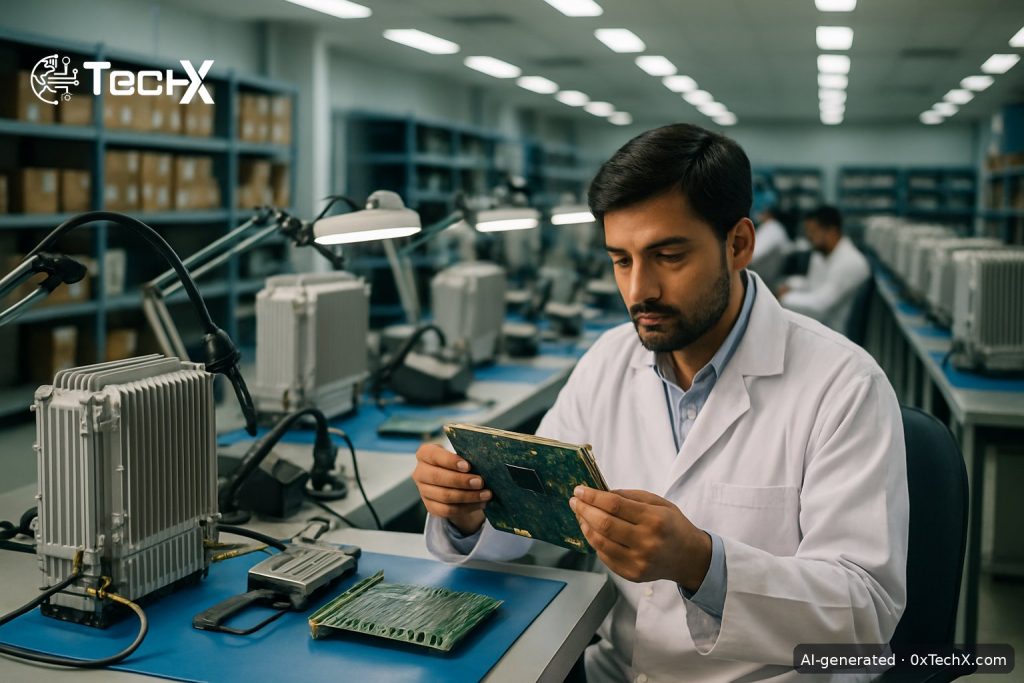
Pakistan’s Huawei national telecom repair centre is now open in Islamabad, and it is the first facility of its kind in the country. Federal Minister for IT and Telecommunication Shaza Fatima Khawaja cut the ribbon on Thursday, 24 September 2026, with Huawei Pakistan CEO Ethan Sun also on stage. The centre means Pakistan can now fix its own critical telecom gear locally, instead of shipping it abroad and waiting weeks for it to come back.
What the Huawei National Telecom Repair Centre Actually Does
Before this centre existed, faulty telecom equipment used across Pakistan’s mobile and broadband networks had to be sent overseas for diagnosis and repair. That cost money, cost time, and left networks more fragile whenever something broke down. The new facility provides local repair, testing, troubleshooting, and maintenance for Huawei telecommunications equipment deployed across the country, with the aim of reducing dependence on overseas operations, improving turnaround times, and cutting operational costs.
Spread across approximately 250 square metres, the centre can handle more than 10,000 modules each year, with over 6,000 repaired components expected to return to service annually. The average repair success rate is approximately 60 percent, which reduces both replacement needs and the dependency on overseas repair.
16 Desks, 180-Plus Equipment Types
The centre features 16 specialized repair desks and covers more than 180 equipment item codes across major technology areas, including wireless, microwave, digital power, and access network technologies. In plain language, this means engineers here can work on the base station units that power your 4G signal, the microwave links that carry data between towers, and the power systems that keep those towers running, all without leaving Pakistan.
The facility’s local capability also allows Huawei to respond swiftly during national disasters or emergencies, when network continuity is most critical. That is a point that often gets missed in coverage of such events: when a flood or earthquake hits, the speed at which broken network equipment can be fixed directly affects rescue and recovery operations.
A Million Dollars Already Saved
The forex angle is one of the clearest wins here. The minister said domestic repair of telecom equipment has already contributed to savings of one million dollars in foreign exchange. For a country that carefully watches its hard-currency reserves, keeping repair work inside Pakistan instead of paying foreign service centres is a direct financial benefit.
Minister Shaza Fatima said the facility would create high-skilled employment, reduce foreign exchange outflows, and help Pakistan transition from a technology consumer to a technology builder. She also pointed to the bigger picture: the repair centre could serve not only Pakistan but the entire region. If that vision is realised, Islamabad could become a regional hub for telecom equipment maintenance, sending repaired hardware to neighbouring countries rather than relying on distant service centres in China or the Gulf.
Why This Matters Beyond the Ceremony
Events like this are often treated as ribbon-cutting photo opportunities. But the practical impact on Pakistan’s telecom networks is real. When a tower’s base-band unit fails today, an engineer in Islamabad can now diagnose and fix it locally. That cuts weeks off the repair cycle and keeps mobile service more stable for everyday users.
The minister credited government policy certainty and the support of Prime Minister Shehbaz Sharif and the federal cabinet for creating an environment that encourages international technology companies to expand their presence in Pakistan. Huawei’s investment fits a broader pattern of Chinese tech firms deepening roots in Pakistan, a trend also visible at large-scale events such as ITCN Asia 2026, which closed with $550 million in business deals between Pakistani and international tech companies.
The 5G Connection
One line from the event that received little attention elsewhere: the minister asked Huawei to extend the centre’s capabilities to 5G equipment. Huawei said it welcomed the minister’s direction to extend the capability to 5G, seeing it growing alongside the country’s digital ambitions. As Pakistan moves toward a wider 5G rollout, having local repair capacity for next-generation network equipment will become even more important. Sending 5G hardware abroad for fixes would add huge delays and costs at exactly the time when fast, reliable connectivity matters most.
For Pakistani engineers, the centre also signals a skills opportunity. The facility is expected to create high-skilled employment, and hands-on experience with Huawei‘s advanced telecom hardware, from wireless BBU modules to digital power systems, is the kind of training that builds careers and raises the country’s overall technical talent pool.
Frequently Asked Questions
What is the Huawei national telecom repair centre in Islamabad?
It is Pakistan’s first national-level facility for repairing, testing, and maintaining Huawei telecom equipment used across the country’s mobile and broadband networks. It opened on 24 September 2026 and is run by Huawei Pakistan under its Global Service Centre (GSC) programme.
What types of equipment does the centre repair?
The centre covers more than 180 equipment item codes across wireless, microwave, digital power, and access network technologies, with 16 specialized repair desks on site. This includes components used in 4G base stations and microwave backhaul links.
How does this benefit ordinary mobile users in Pakistan?
When network equipment breaks, local repair means faster fixes. Shorter repair times reduce the chance of extended outages in your area. The centre also builds a local pool of skilled engineers who can keep networks running more reliably over time.
Will the centre handle 5G equipment in the future?
Yes, that is the plan. Huawei said it welcomes the minister’s direction to extend the capability to 5G, seeing the centre grow alongside Pakistan’s digital ambitions. No firm timeline has been announced yet, but the commitment is on record.