

According to data, Hex’s market cap fell to $2.41 billion on May 25 from a high of $6.62 billion.
Hex’s market cap
According to source, the market cap of blockchain network Hex (HEX) has dropped by around $4 billion in the last week. According to it, Hex’s market cap fell to $2.41 billion on May 25 from a high of $6.62 billion on May 20.
During this time, the network token led by Richard Heart fell more than 47% to a low of $0.01474 after a heavy sell-off that saw it lead to top 5 losers list for two consecutive days on May 24 and 25.
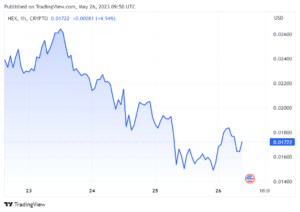

However, it appears that the token has found some relief in the last 24 hours, rising 3.08% to $0.01690 and increasing its market cap to $2.93 billion.
According to TVL, Hex Pulsechain is a top ten blockchain network
While HEX experienced a significant sell-off, its sister layer-1 network Pulsechain saw the total value of assets locked on its network increase 155% in less than a week to $425 million.
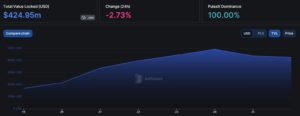

This places the newly launched network ninth in TVL, ahead of more seasoned competitors such as Cardano (ADA), Solana (SOL), and Fantom (FTM).
Pulsechain, a hard fork of the Ethereum network, went live on May 14. According to its website, its “main differences are speed, cost, deflation, and network efficiency.” Capable of hundreds of transactions per second, it far outperforms Ethereum’s 13.
Users complain about Pulsechain’s high gas fees
However, users of Pulsechain have complained about the network speed and the high gas fees on social media platforms.
Taproot Wizard Eric Wall posted several screenshots of Pulsechain users complaining about the gas fees on May 14. A user paid nearly 1 million PLS tokens in gas fees for a transaction, according to one of the screenshots.
According to the community, “if PLS value rises, network gas fees will outperform Ether and other networks.”
Meanwhile, Heart sees no problem with the high fees, stating, “If someone else wants to pay more than you to get into a block, they get in, and you do not.”
Following the initial complaints, Pulsechain users have increasingly emphasized the network’s low transaction fees.
Despite these issues, Pulsechain has maintained its transaction volume and social media buzz. According to DeFillama data, the network’s dominant protocol is the decentralized exchange PulseX, which has a higher TVL than SushiSwap.
Additionally, on May 23, the crypto exchange OKX listed the network’s PLS token. According to CoinMarketCap data, PLS has increased by 6% in the last 24 hours to $0.0001985.
To read our blog on “EU support stricter tax laws for crypto transactions in 2023,” click here