
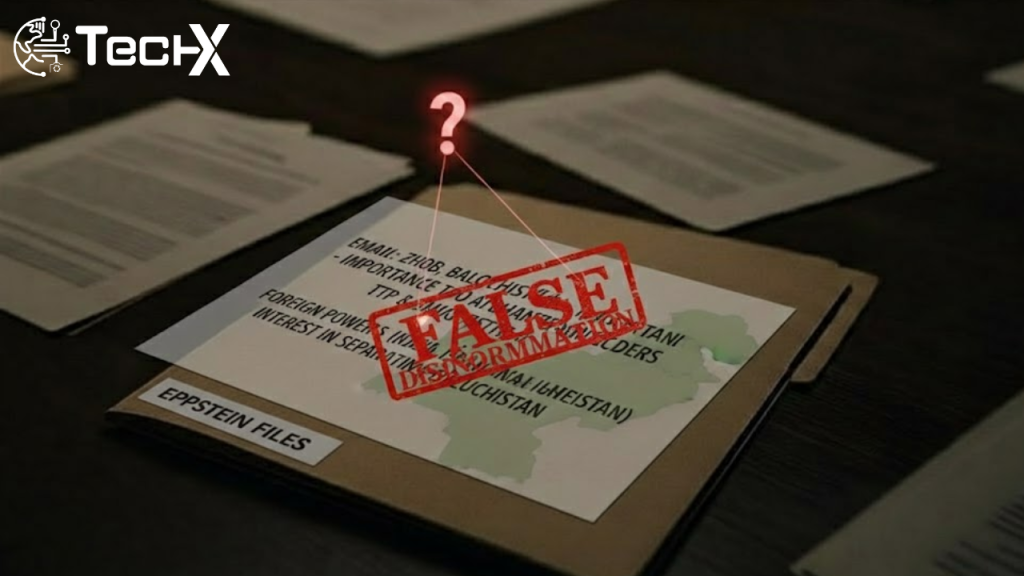
Some internet users make a claim that a leaked email from the so called “Epstein Files” contains information on why Zhob and Baluchistan are significant to the Afghan Taliban, Tehreek-e-Taliban Pakistan (TTP), and smugglers, and how it is connected to the foreign interest of Israel, Afghanistan, and India to separate Balochistan from Pakistan.
But there is no authentic information from official channels or any serious investigative journalism that the confirmed releases of the Epstein Files include an email about South Asian geopolitics. Thus, we will consider the email in your question to be a fictional story being circulated by some people, and we will describe the actual confirmed strategic significance of these groups and regions according to publicly available information. The following information provides confirmed facts about the Balochistan conflict, Taliban and TTP activities, and foreign involvement, so you can compare it with the story in the claim.
Strategic Significance of Balochistan and Zhob
Balochistan is the largest province of Pakistan, with access to the borders of Afghanistan and Iran. The province has been plagued by insurgency due to its topography, lack of development, and neglect of the indigenous Baloch people. The Balochistan Liberation Army (BLA) has been fighting for greater autonomy or independence. Zhob, a Pashtun-majority district, is near the Afghan border and has been used as a route by militants for the past several decades. TTP militants and other terrorists have tried to use Zhob and other adjacent districts along the border to cross into Afghanistan.
Baloch Separatist Insurgency
The Baloch separatist insurgency is essentially the result of ethnic nationalist grievances, such as resentment against political alienation, economic neglect, and resource nationalism, particularly in the wake of large-scale investments in infrastructure projects such as the China-Pakistan Economic Corridor (CPEC). The Baloch insurgents, including the BLA and other associated groups, have often attacked security forces, infrastructure, and development initiatives.
Although the BLA and other such groups purport to represent the interests of the local population, it has been observed that they do not necessarily represent the will of the majority of the Baloch, who are often more interested in economic development and political integration than in waging an insurgency.
Taliban and TTP Links in the Region
The Tehreek-e-Taliban Pakistan (TTP) is a militant Islamist group, which is distinct from the ethnic Baloch insurgents. The TTP has its roots in the anti-government insurgency in northwestern Pakistan but has since then extended its reach and influence and has set up its organizational structure (called wilayahs) in different regions, including parts of Balochistan, especially among the Pashtun population.
A report by the United Nations confirms that the Afghan Taliban continue to offer logistical and financial assistance to the TTP, which helps it to carry out its activities and maintain its bases and training camps in Afghanistan. This has led to an increase in attacks on Pakistani targets.
While the Afghan Taliban government has denied that it is sheltering militants to carry out cross-border attacks, Pakistan has repeatedly accused the Afghan government of not doing enough to prevent TTP militants from using Afghan territory to carry out attacks. This close nexus explains why Taliban-affiliated militants target areas close to the Afghan border, including Zhob
Smuggling and illicit Economies in Balochistan
Apart from the presence of armed groups, the Balochistan border region is known for smuggling activities such as the smuggling of fuel, goods, drugs, and contraband. This is attributed to the porous nature of the borders and the lack of state control. The smuggling activities are conducted by criminal groups and, at times, by armed groups as a means of financing their activities and maintaining their mobility in Afghanistan, Iran, and Pakistan.
How This Differs From the Leaked Email Narrative
The narrative you cited, about an Epstein File email breaking down the importance of Zhob/Balochistan to the Taliban, TTP, smugglers, and international actors, has not been supported by any publicly known releases of information from the Epstein File. There have been no announcements from mainstream international news sources or official releases that the information contained in the Epstein File has made such geopolitical observations. Rather, these points about the region’s security access, tactics, and international accusations have been made in public international analysis by experts, not in leaked information related to other investigations.
What is clear from credible open‑source and UN reporting is that:
- Balochistan is a disputed security zone with ethnic insurgency, Taliban-related militant activity, and smuggling economies.
- TTP has enjoyed Afghan Taliban logistical assistance, which has been documented by UN monitoring teams.
- Militant activities impact large infrastructure and investment schemes, and cross-border sanctuaries are mentioned by authorities as part of the security dilemma.
- Allegations of Indian involvement are commonly leveled by Pakistani authorities but cannot be independently confirmed, and allegations about other foreign powers do not have any evidence in mainstream sources.
Summary
In conclusion, although the email story you cited may be trending on the internet as an interesting case, there is no confirmed evidence that such a document exists in the public domain of the Epstein-related archives. What can be confirmed through independent reporting and analysis is that
- Balochistan is a strategically important and conflict-scarred area that has a separatist insurgency based on local, ethnic, economic, and political grievances.
- The TTP/Afghan Taliban link is a cross-border militant threat that adds to Pakistan’s complex security environment.
- Smuggling and illicit economies are part of the conflict dynamics in the border areas.
Email Content
Source: Esptein

