
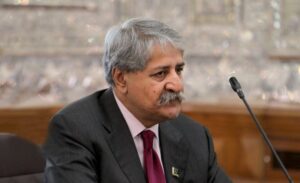
According to knowledgeable sources who spoke a finance magazine, Commerce Minister Syed Naveed Qamar reportedly prevented Cabinet from giving final permission to Pakistan Land Port Authority (PLPA), claiming that Revenue Division had not consulted the Commerce Ministry on the plan.

According to sources, the Revenue Division informed the Cabinet at its most recent meeting that the Pakistan Land Port Authority was envisioned in the Strategic Trade Policy Framework (STPF) 2012-2015, presented by the Ministry of Commerce and approved by the Government of Pakistan.
The purpose of the Policy was to establish the PLPA as a legislative body in charge of inter-agency cooperation to ease the movement of persons and commodities across Border Crossing Points (BCPs), increase trade, and lower transaction costs.
The Central Asia Regional Economic Cooperation – Regional Improving Border Services (CAREC-RIBS) Project, according to the Federal Board of Revenue (FBR), Revenue Division, developed an Integrated Transit Trade Management System (ITTMS) after the STPF 2012-2015 by the Government of Pakistan was approved in order to position Pakistan as a regional transit hub for international trade.
Asian Development Bank agreed to provide funding for the creation of PLPA and the development of important border stations.
As a result, a team of professionals created the overall structure of PLPA in conjunction with the relevant Divisions and in accordance with international best practices.
The subject was then sent to the Prime Minister’s Office and examined by the PLPA Steering Committee as per the PMO’s instructions.
The establishment of the PLPA using current public sector employees in Phase-I for the first two years while staying within the present government budget was unanimously approved by the Committee.
The Revenue Division had been asked to present the case to the Cabinet for its in-principle approval in accordance with Rule 16 (1) (a) of the Rules of Business 1973 in light of the Steering Committee’s endorsement.
The proposed Legal Act, which had also been prepared by FBR in accordance with Rule 27 (2) of the Rules of Business 1973, was also summarized by Revenue Division, outlining its scope, jurisdiction, mandate, legal structure, composition, governance model, and administrative control to provide the legislative protection for PLPA.
In order to facilitate easy cross-border movement of people, vehicles, and goods within an integrated complex, the land port entry points would be converted into Integrated Check Points with the establishment of Pakistan Land Port Authority.
The procedures for immigration, customs, cargo security, quarantine, Sanitary & Phytosanitary (SPS) Measures, etc. would be made easier as a result.
The current infrastructure facilities would be upgraded as necessary to make this possible. A “Set up Committee” led by the Secretary of the Ministry of Commerce will work closely with other Ministries to complete the groundwork for the establishment of PLPA.
The PLPA would initially concentrate on the three crucial border crossings at Wagah, Chaman, and Torkham before progressively expanding to additional border points and assessing the effectiveness of doing so to other interior ports.
The Cabinet’s preliminary permission for the drafting of the PLPA’s proposed legislation was requested due to the urgency of the situation.
Naveed Qamar, the minister of commerce, brought out during debate that his Division was a significant stakeholder but was not contacted. The members proposed granting the necessary consent in principle, subject to the Commerce Division’s approval.
The summary of the proposal provided by the Revenue Division headed “in-Principle Cabinet Approval for Drafting Proposed Legislation of Pakistan Land Port Authority (PLPA)” dated June 13, 2023 was taken into consideration by the Cabinet, which approved it subject to the consent of the Commerce Division.
Commerce Ministry Reservations
When approached, the minister of commerce declined to comment on the ideas he presented to the Federal Cabinet.
“Cannot comment on proceedings of a cabinet meeting, which we are under oath not to disclose. Kindly file your story using whatever other source you have,” he said.
To read our blog on “FBR did comprehensive changes in export facilitation scheme,” click here.