
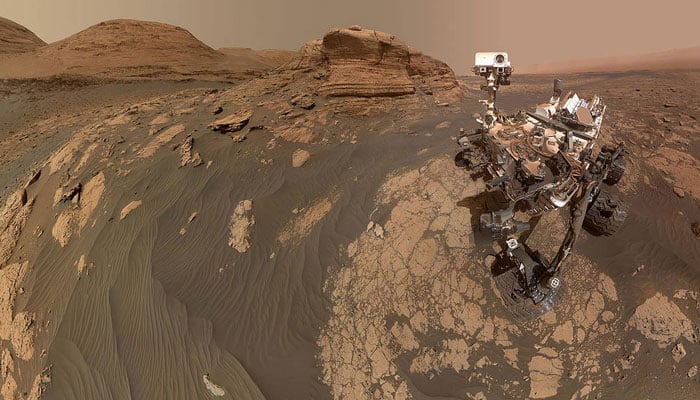
After analyzing data from China’s Zhurong rover, researchers found indications that water may have once existed on Mars. The results suggest that water may have been present widely and just recently.
The data also contribute to the conclusion that Mars’ hot regions may have fruitful zones. The data also hints that there may have been favorable circumstances for life on Mars, but more research is necessary.
The Zhurong rover went into slumber a year ago for the Martian winter, according to the mission leaders, and hasn’t emerged yet.
Mars Mission’s Chief Designer Statement
Zhang Rongqiao, the mission’s chief designer, said “Its solar panels are likely covered with dust, choking off its power source and possibly preventing the rover from operating again.”


Zhurong gathered knowledge on salt-rich dunes with fractures and crusts while it was hibernating. It may have been combined with melting morning frost or snow as recently as a few hundred thousand years ago, according to researchers.
Cracks and other dune features of Mars’ Utopia Planitia, a large plain in the northern hemisphere, are thought to have developed as recently as 1.4 million to 400,000 years ago.
They speculated that Mars may have seen conditions akin to what we are experiencing right now, with rivers and lakes dried up and no longer flowing as they did billions of years ago.
In a paper that was published in Science Advances, the Beijing-based team claimed that understanding the structure and chemical composition of these dunes can give light on the potential for water activity at this time.
The Chinese rover did not immediately notice the water as ice or frost. However, computer simulations and observations by other spacecraft on Mars suggest that certain conditions may still exist today, at specific times of the year, for the water to appear, according to Qin.
The Chinese scientists said, “Small pockets of water from thawing frost or snow, mixed with salt, likely resulted in the small cracks, hard crusty surfaces, loose particles and other dune features like depressions and ridges.”
They contend that neither the wind nor the fact that frost is primarily composed of carbon dioxide, which makes up the majority of Mars’ atmosphere, are the explanation.
2020 saw the introduction of China’s Zhurong, a six-wheeled rover named after a fire god from Chinese mythology. After arriving on Mars in 2021, it spent a year exploring the planet before entering hibernation in May of last year.
The rover had performed better than anticipated and had travelled more than one mile (1,921 meters).
To read our blog on “Study reveals that Mars used to be blue,” click here.