
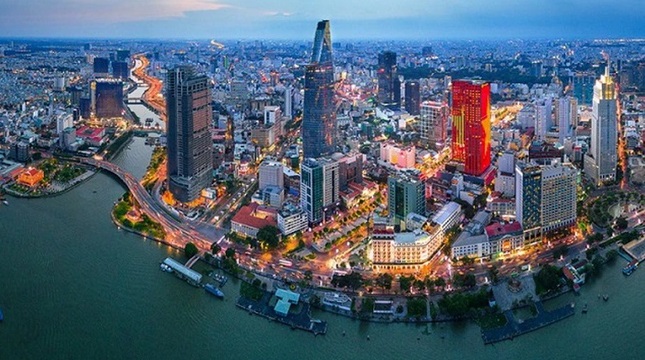
According to the World Bank, Vietnam is expected to become Asia’s fastest growing economy this year, despite a regional downturn dominated by China’s sharp economic slowdown.
The World Bank forecasted 3.2 percent growth in East Asia and the Pacific in 2022, down from 7.2 percent in 2021, before accelerating to 4.6 percent in 2023 in its most recent economic outlook report for the region, which was released yesterday.
The projected growth rate for this year is significantly lower than the 5% predicted by the World Bank in its most recent outlook report in April.
Much of this can be attributed to China’s economic slowdown, which previously led the region’s recovery from the COVID-19 pandemic before its self-defeating strict “zero COVID” policy slowed its economy.
The World Bank forecasted that China’s economy would grow by 2.8 percent this year and 4.5 percent in 2023, a “sharp deceleration” from the 8.1 percent recorded in 2021. In its most recent outlook, published in April, the Bank predicted that China would grow by 5% in 2022.
When China is removed from the equation, forecast growth for East Asia and the Pacific rises to 5.3 percent, up from 4.8 percent in April.
This is more than a doubling of the region’s growth rate of 2.6 percent for 2021, and it indicates that, while the COVID-19 pandemic has not yet ended, its economic consequences have been greatly mitigated.
The emergence of Vietnam as the fastest growing economy in East or Southeast Asia was perhaps the most significant story.
Given the country’s combination of relatively effective COVID-19 containment measures, demographic advantages, and a privileged position in the regional and global economic structures, the World Bank forecasted that Vietnam’s economy would grow by 7.2 percent in 2022, up from 5.3 percent in April.
It is then expected to grow by another 6.7 percent in 2023. Only the Philippines (6.5 percent), Malaysia (6.4 percent), and Indonesia (5.1 percent) were expected to exceed 5 percent this year.
Elsewhere in the region, the outlook was cautiously optimistic. Malaysia’s economic forecast was raised from 5.5 to 6.4 percent by the World Bank, and similar revisions were made for the Philippines (5.7 to 6.5 percent), Thailand (2.9 to 3.1 percent), and Cambodia (4.5 to 4.8 percent).
The World Bank attributed this relatively strong growth to three factors: the recovery of private consumption in the first half of 2022, “enabled by a relaxation of COVID-related restrictions”; the sustained global demand for exports of manufactured goods and commodities from East Asia and the Pacific; and the limited tightening of fiscal and monetary policy so far, though it noted that “pressures to tighten may increase.”
To read our blog on “For first time in 30 years, unfold Asia is growing faster than China,” click here