
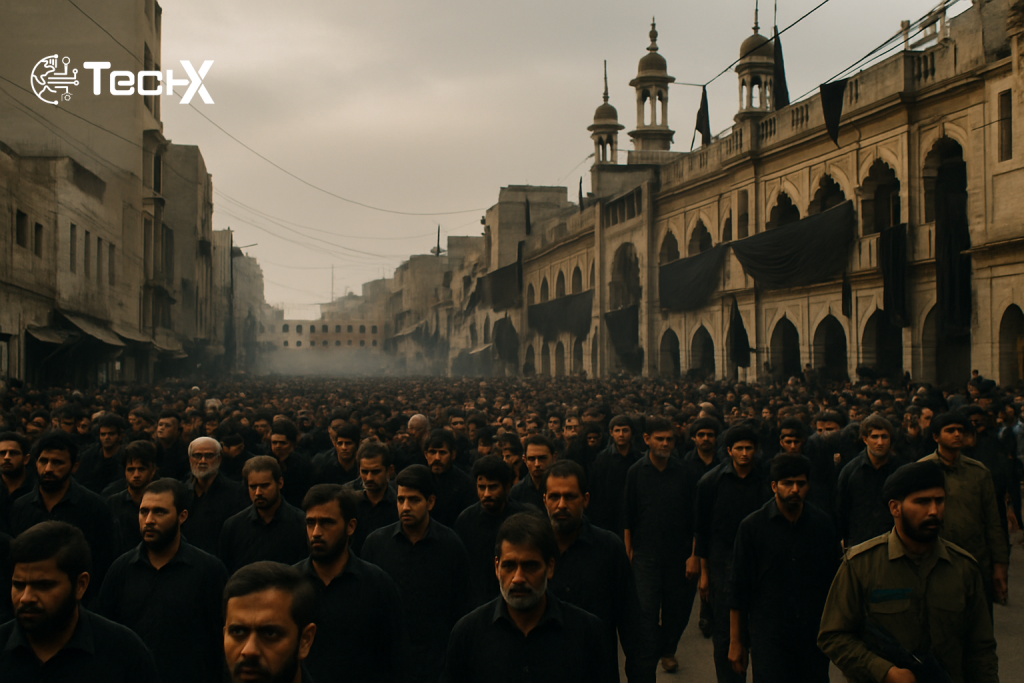
Ashura 2026 security arrangements across Pakistan reached an unprecedented scale on Friday, 26 June, as millions of mourners took to the streets for Youm-e-Ashura processions. Snipers on rooftops, surveillance drones, a custom CNIC scanning app, and mobile service shutdowns were among the tools used by authorities to keep the day peaceful. The processions concluded without any major incident.
What Is Youm-e-Ashura?
Ashura falls on the 10th day of Muharram, the first month of the Islamic calendar. The day is marked nationwide, including in Azad Jammu and Kashmir and Gilgit-Baltistan, to honour the sacrifice of Hazrat Imam Hussain (R.A), who, along with 72 family members and companions, was martyred at Karbala for the principles of truth, justice, and righteousness. It is observed as a nationwide public holiday, with schools, colleges, government offices, banks, and many public institutions remaining closed.
Ashura 2026 Security: A Multi-Layer Operation
More than 12,000 police officers and personnel were deployed across Rawalpindi and Islamabad, with extensive security measures including snipers on high-rise buildings, drones, a custom CNIC scanning app, and a complete suspension of mobile and internet services in Rawalpindi.
Rawalpindi Police developed a special identification and scanning app that can scan any person’s CNIC instantly. Security personnel used the app at entry pickets and bus terminals, verifying processioners’ identities. Procession participants were only allowed entry after body searches, with lady police personnel conducting checks on women. Metal detectors and walk-through gates were also in place.
A massive deployment of 16,000 personnel from the Islamabad Police, Rangers, Frontier Constabulary, and Special Branch effectively blanketed the capital. Heavy shipping containers were strategically placed at entry and exit points, while Armored Personnel Carriers (APCs) were stationed at critical junctions.
Authorities requisitioned 61 companies of the Pakistan Army and 76 companies of Rangers to support security arrangements, while more than 30,000 trained volunteers assisted law-enforcement agencies.
Technology Used in Ashura 2026 Security
This year, technology played a bigger role than ever before. Modern surveillance tools including AI-based monitoring systems, CCTV cameras, body-worn cameras, and geo-tagged video monitoring were deployed. The Provincial Intelligence Centre conducted round-the-clock monitoring through a digital surveillance wall, with more than 5,600 CCTV cameras operational and over 1,000 4G event cameras installed at sensitive locations.
Bomb disposal units and sniffer dogs were used to sweep imambargahs, majalis venues, and procession routes, while personnel in plain clothes were also deployed at sensitive locations and places of worship.
The Pakistan Telecommunication Authority (PTA) was directed by the Ministry of Interior to suspend mobile services at specified locations. This decision is a standard security protocol for large religious gatherings, intended to reduce the risk of remote-triggered incidents. Readers who want to understand how Pakistan’s telecom regulations work in practice can also read about the Punjab mobile service suspension during Ashura 2026 in our earlier coverage.
Mobile Services Suspended in 24 Punjab Districts
Security measures were tightened across Punjab, with authorities announcing partial suspension of mobile phone services in 24 districts to ensure law and order. The suspension was enforced only in sensitive areas hosting Ashura processions and majalis, while mobile services remained fully operational in all other locations.
The affected districts included Rawalpindi, Attock, Chakwal, Sargodha, Khushab, Bhakkar, Hafizabad, Gujrat, Narowal, Faisalabad, Toba Tek Singh, Jhang, Chiniot, Multan, Sahiwal, Okara, Pakpattan, Dera Ghazi Khan, Rajanpur, Muzaffargarh, Layyah, Kot Addu, Bahawalnagar, and Rahim Yar Khan. Lahore and all remaining districts of Punjab continued to have uninterrupted mobile services throughout the day. The partial suspension remained in effect until 10:00 PM at procession routes and majalis venues.
Processions Across Major Cities
Mourning processions began in major cities and towns across the country, including Karachi, Lahore, Rawalpindi, Multan, Sukkur, Hyderabad, Muzaffarabad, Peshawar, and Quetta.
In Karachi, the central procession departed from Nishtar Park at around 9:30am and concluded at Imambargah Hussainia Iranian in Kharadar after passing through its traditional routes. Sindh Chief Minister Murad Ali Shah joined a mourning procession and said that 60,000 police and Rangers personnel had been deployed for the security of processions across Sindh, where more than 1,600 processions are taken out during Muharram.
In Peshawar, more than 10,000 security personnel were deployed as 12 Ashura processions got underway, with the inner city completely sealed and monitoring carried out through drones, Safe City cameras, and 171 CCTV cameras. Across Khyber Pakhtunkhwa, 43,317 police personnel were deployed for Muharram security, while Section 144 was enforced in various districts.
In Rawalpindi, the Punjab government suspended the Metro Bus Service between Rawalpindi and Islamabad for the day. The decision was taken on the recommendation of intelligence agencies because the main procession passes along Murree Road beneath the Metro Bus track.
Rescue and Emergency Services
Emergency services were placed on full alert for the day. Rescue 1122 deployed 57 ambulances across Rawalpindi district, while public hospitals reserved 537 beds to deal with any emergency. Across Punjab as a whole, the scale was even larger, with hundreds of ambulances, rescue motorbikes, and fire and rescue vehicles positioned along procession routes, and thousands of rescuers on standby.
The Rescue 1122 Punjab service was placed on high alert province-wide under directions from the Punjab Chief Minister.
Frequently Asked Questions
What is Youm-e-Ashura and why is it observed?
Youm-e-Ashura is the 10th day of Muharram in the Islamic calendar. It marks the martyrdom of Hazrat Imam Hussain (R.A) and his companions at the Battle of Karbala in 680 AD. Muslims across Pakistan and the world commemorate this day with processions, prayers, and mourning gatherings called majalis.
Why were mobile services suspended during Ashura 2026?
Authorities said the partial suspension remained in effect until 10:00 PM at procession routes and majalis venues, describing the measure as part of a broader security plan. Officials said the temporary restrictions were limited to designated sensitive locations and were implemented as a precautionary step to strengthen security arrangements. The Ministry of Interior directed the PTA to enforce the suspension at specified coordinates provided by provincial police.
What was the CNIC scanning app used for?
Rawalpindi Police developed a special identification and scanning app that can scan any person’s CNIC instantly. Security personnel used the app at entry pickets and bus terminals to verify the identities of processioners. This allowed police to quickly check anyone entering a procession route against security watchlists.
Did Ashura 2026 processions pass peacefully?
The stringent security measures ensured that the sacred event passed peacefully and reached its conclusion without any untoward incidents, despite persistent threats from banned militant groups and a nationwide wave of security challenges targeting religious gatherings. Authorities reiterated that foolproof security arrangements were in place to ensure peaceful observance of Youm-e-Ashura across the country.