
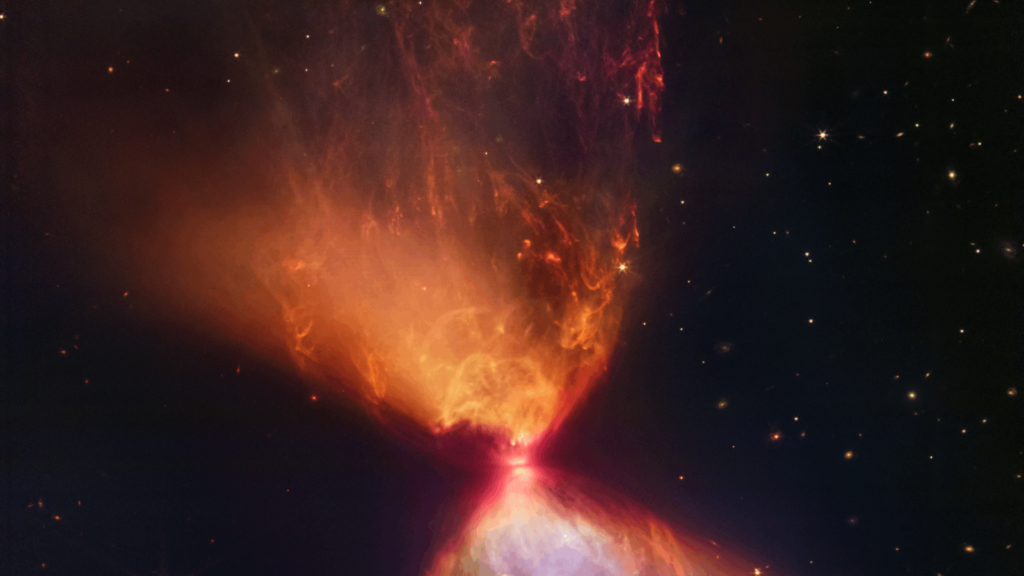
The protostar within the shadowy cloud L1527 has had previously unseen features exposed by NASA’s James Webb Space Telescope, offering fresh information about the formation of a star.
The Taurus star-forming region is a prime target for Webb’s Near-Infrared Camera since these blazing clouds are only discernible in infrared light (NIRCam).
The “neck” of this hourglass-shaped object conceals the protostar itself. The center of the neck is darkened by an edge-on protoplanetary disc.
This disk’s cavities in the surrounding gas and dust are illuminated by light leaking from the protostar above and below.
In this representative-color infrared image, the region’s dominant characteristics, the blue and orange clouds, outline voids formed when material shoots away from the protostar and collides with surrounding matter.
Layers of dust between Webb and the clouds are what give the colors themselves their hue. The dust is thinnest in the blue regions.
A layer of dust that is too thick prevents blue light from escaping, resulting in pockets of orange light.
Molecular hydrogen filaments that have been shocked by the protostar’s material ejections are also seen by Webb.
New stars can’t form in the cloud because of shocks and turbulence; otherwise, they would.
As a result, the protostar rules the area and hoards most of the resources for itself.
The disc is roughly the size of our solar system and can be seen in the photograph as a dark band in front of the dazzling core.
Given the density, clumping of most of this material, the precursors of planets, is not rare.
In the end, this image of L1527 offers a window into the early state of our Sun and the solar system.
To read our blog on “James Webb Telescope photographed Tarantula Nebula,” click here.