
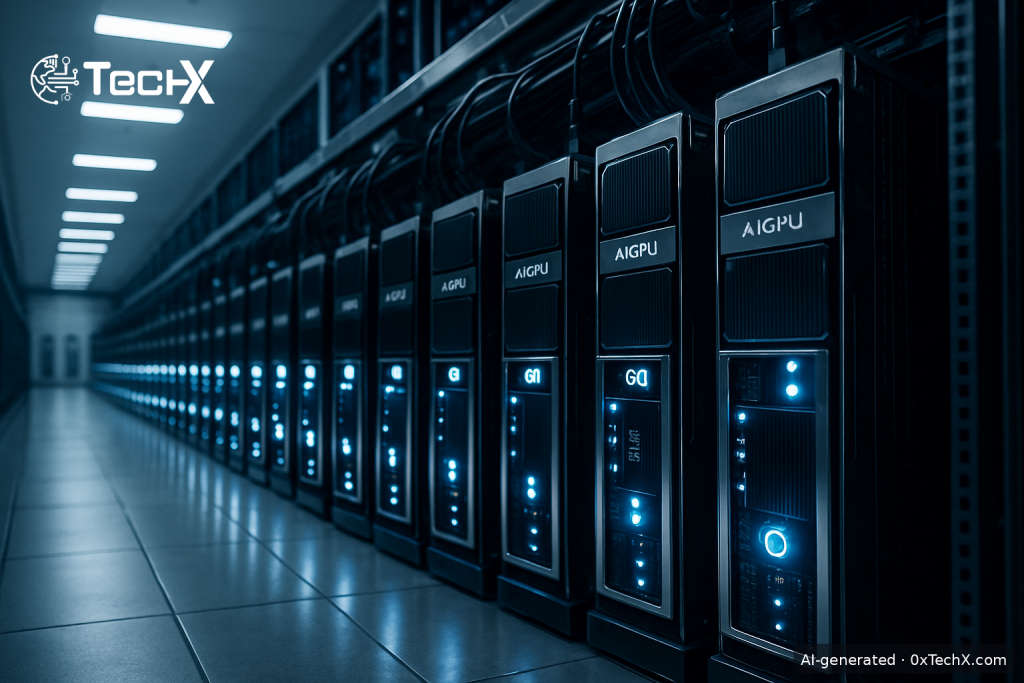
The Anthropic AMD MI450 deal, announced on July 22, 2026, is one of the biggest chip procurement agreements in tech history. Anthropic will deploy up to 2 gigawatts of AMD’s next-generation Instinct MI450 GPUs starting in the first half of 2027, while AMD commits up to $5 billion as a strategic investment in the maker of Claude. For AI developers, cloud buyers, and anyone watching the global chip race, including those in Pakistan, this deal changes the picture in a meaningful way.
What the Anthropic AMD MI450 Deal Actually Covers
The agreement has three main parts. First, there is the hardware side: Anthropic will use AMD Helios rack-scale systems packed with Instinct MI455X GPUs, AMD EPYC ‘Venice’ CPUs, and AMD Pensando networking, all running AMD’s ROCm software stack. The first gigawatt of capacity is due to come online in H1 2027, with a second gigawatt to follow.
Second, AMD is putting up to $5 billion of its own money into Anthropic as a strategic equity stake. This flips the usual script: instead of giving the customer stock warrants (as AMD did with OpenAI), AMD is here becoming a shareholder in the company buying its chips.
Third, and easy to overlook, the two companies will work together to use Claude itself to improve AMD’s ROCm software and optimize AI workloads for AMD hardware. This matters because ROCm’s relative weakness compared to Nvidia’s CUDA has long been seen as AMD’s biggest barrier in AI compute.
Why the MI450 Chip Is a Big Deal on Its Own
The AMD Instinct MI450 is not a minor upgrade. Built on TSMC’s 2nm process and the CDNA 5 architecture, each MI450 GPU is projected to deliver 40 PFLOPS of FP4 compute, which is double the performance of the previous MI350 series. It upgrades memory from 288GB of HBM3e to 432GB of HBM4, with memory bandwidth leaping to 19.6 TB per second. Scale-out bandwidth per GPU reaches 300 GB per second, making large clusters far more practical to build and run.
AMD positions the MI450 series directly against Nvidia’s Vera Rubin platform. On paper, the specs are competitive. The real test will be in the software layer, which is exactly why the ROCm collaboration with Anthropic is so important to AMD’s long-term ambitions.
How Large Is 2 Gigawatts of AI Compute?
Gigawatts are now the unit of measure for serious AI infrastructure. AMD executives have said 1 gigawatt of computing power is enough to supply roughly 750,000 average American homes. At costs that run into double-digit billions per gigawatt, the full 2-gigawatt Anthropic commitment implies a hardware deal potentially worth over $30 billion, making it one of the largest single chip procurement commitments ever made public.
To put the scale in context, AMD already had a 6-gigawatt agreement with OpenAI (beginning with a 1GW MI450 phase in H2 2026) and a separate 6-gigawatt deal with Meta. Adding Anthropic’s 2 gigawatts pushes AMD’s confirmed large-scale AI commitments well past 14 gigawatts across just three customers. Oracle has also separately confirmed deployment of 50,000 MI450 GPUs, and Microsoft announced it would add Helios racks to Azure data centers just two days before the Anthropic news broke.
Is This the End of Nvidia’s Monopoly on AI Compute?
Not quite yet, but the direction is clear. Nvidia still dominates, with its Blackwell and upcoming Rubin platforms holding the largest share of AI training infrastructure worldwide. However, the Anthropic deal is the strongest signal yet that the biggest AI labs are actively building a second supply chain that does not depend entirely on Nvidia chips.
There is a real supply-side risk to watch. Delivering 2 gigawatts of MI450 capacity by H1 2027 will depend heavily on TSMC’s advanced packaging throughput and on HBM4 memory supply, both of which remain tight. AMD has tried to reduce this risk by committing more than $10 billion in Taiwan ecosystem investments, naming ODM partners like Sanmina, Wiwynn, Wistron, and Inventec to build Helios systems at scale.
The ‘up to’ language in the deal is also worth noting. Both the 2-gigawatt hardware commitment and the $5 billion investment are framed as upper limits, not guaranteed figures. Actual delivery and investment will depend on milestones being hit.
What This Means for Pakistani AI Developers and Cloud Buyers
Pakistan’s AI sector is growing, with the government backing initiatives like 7 national AI innovation hubs to support hundreds of startups. For developers and businesses in Pakistan that rely on Anthropic’s Claude API for AI features, this deal is a quiet but important piece of news. When Anthropic secures more compute, it can serve more users, run more inference, and, over time, bring down the cost of API access. Greater competition between AMD and Nvidia in the data center also puts long-term downward pressure on cloud GPU pricing globally, which flows through to the cost of hosted AI services that Pakistani developers buy.
Pakistani cloud buyers and software houses that are evaluating AI infrastructure should also note that AMD’s ROCm software stack is open source. If AMD’s collaboration with Anthropic makes ROCm significantly more capable, it opens up a wider range of hardware options beyond Nvidia for teams building or fine-tuning their own models, and that matters for anyone thinking about local AI development capacity.
Frequently Asked Questions
What is the Anthropic AMD MI450 deal?
On July 22, 2026, AMD and Anthropic announced that Anthropic will deploy up to 2 gigawatts of AMD Instinct MI450 Series GPUs in AMD Helios rack-scale systems, with the first gigawatt coming online in H1 2027. AMD also committed to investing up to $5 billion in Anthropic as a strategic equity stake.
What makes the AMD Instinct MI450 chip special?
The MI450 is built on TSMC’s 2nm process using CDNA 5 architecture. It delivers up to 40 PFLOPS of FP4 performance, carries 432GB of HBM4 memory with 19.6 TB/s bandwidth, and is AMD’s direct answer to Nvidia’s Vera Rubin platform. It doubles the compute of the previous MI350 series.
Does this deal mean AMD is beating Nvidia in AI chips?
Not yet. Nvidia still leads the AI chip market. But the scale of the Anthropic deal, combined with similar agreements with OpenAI, Meta, Oracle, and Microsoft, shows AMD is becoming a genuine alternative. Whether AMD can match Nvidia in software support, particularly through ROCm improvements, will decide how far this goes.
How does this affect Claude API users in Pakistan?
When Anthropic secures more compute supply through deals like this, it can expand capacity for its Claude API. Over time, more competition between chip makers also tends to push down cloud AI costs. Pakistani developers and businesses using Claude for AI applications could benefit from more stable access and potentially lower API costs as this infrastructure comes online in 2027.