
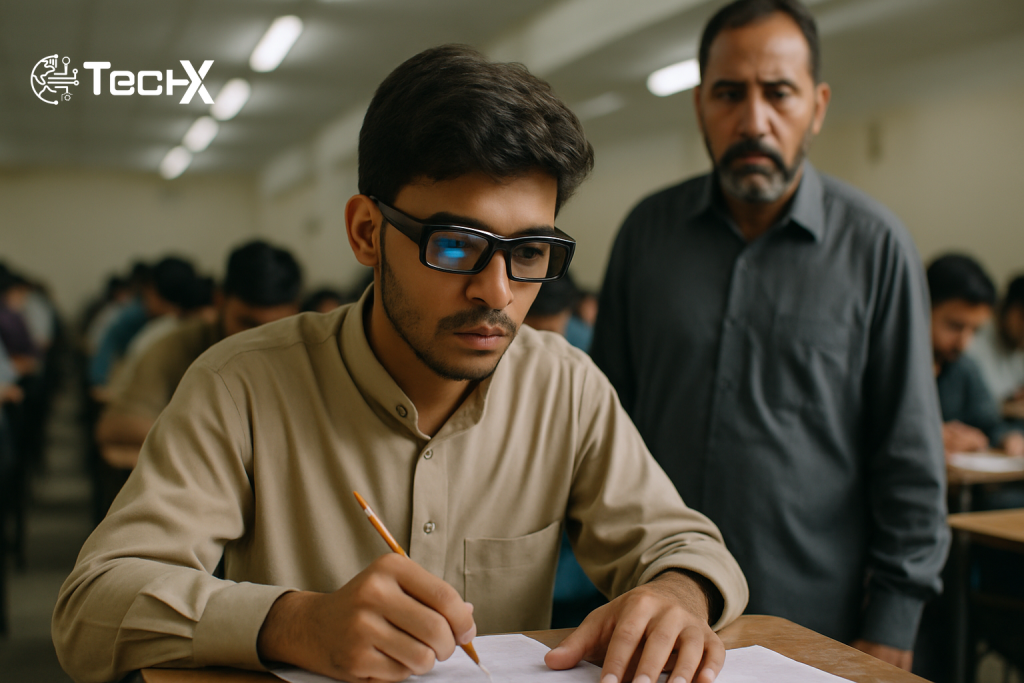
AI smart glasses cheating has moved from a distant tech fear to a real-world crisis in Asia, and it is coming for Pakistan’s own exam season faster than regulators may realise. In late June 2026, confirmed cheating incidents in South Korea, Taiwan, and China put the world on notice that wearable AI is now a serious threat to exam fairness. Here is what happened, how the technology works, and what Pakistan should do about it before it is too late.
What Happened in Asia
Twice last month, people in South Korea taking an English language skills exam, the results of which are often used in hiring decisions, were caught using smart glasses. The Korea TOEIC Committee confirmed that two test-takers had their scores cancelled after allegedly using AI smart glasses in separate exams held on May 10 and May 31.
In Taiwan, a student sitting for an entrance exam for a top medical school was discovered wearing smart glasses after proctors noticed the student staring oddly at the test, leading to an inspection that revealed the frame was emitting heat. The university where the student was caught is now reviewing its rules and procedures for AI eyewear during examinations.
Meanwhile, an AI-powered pair of smart glasses solved all 30 questions on a practice math test for the Korean College Scholastic Ability Test (known as the suneung) in 18 minutes, scoring 96 out of 100, and a viral video of the feat put schools across the country on edge.
How Do AI Smart Glasses Actually Work in Exams
Smart glasses are wearable devices that look similar to normal eyeglasses but have a tiny camera, a processor, and a small screen built into the frame. When used to cheat, the process is simple and fast.
By simply looking at an exam paper, the glasses can transmit questions to a connected AI large language model, which generates answers and displays them on the lenses. Within 30 seconds of scanning a question, an answer appears on the lens display.
Some models closely resemble ordinary eyeglasses and can analyse objects or text captured by built-in cameras, delivering information through displays or speakers, raising serious concerns about misuse during exams.
Smart glasses are becoming slimmer and less noticeable, while integrating AI models that can operate independently with connectivity, raising concerns not only about exam integrity but also about broader privacy risks. This makes them much harder to spot than a phone or a cheat sheet hidden in a pocket.
AI Smart Glasses Cheating Triggers Government Crackdowns
For China’s annual college entrance exam this month, which more than 10 million students take each year, authorities required screening of all glasses. That is a massive logistical step, but it shows how seriously the government is taking the threat.
South Korea’s Ministry of Education sent a circular to regional offices nationwide on June 16 urging tighter exam management, and for the annual national suneung in November, the ministry said it plans to explicitly list AI glasses as a prohibited item.
The Seoul Metropolitan Office of Education issued its own guidance on June 11, telling supervisors to watch for candidates whose glasses have unusually thick temples or who repeatedly touch the temple area during an exam, and to inspect glasses after any test if behaviour appears suspicious.
In the United Kingdom, the head of England’s exam watchdog warned that AI glasses and smart devices like earpieces could worsen cheating in exams. The College Board in the United States has banned smart glasses for SAT testing.
The scale of the problem is likely bigger than the headlines suggest. “If we’re seeing a few cases being reported, we’re seeing a lot more cases not being reported,” said Thomas Corbin, a lecturer at Deakin University in Australia who has researched AI-powered glasses in academic assessment.
Why Pakistan Cannot Ignore This
Pakistan’s exam culture shares many features with the Asian countries most affected. A single test can decide a student’s career. Seats in medical and engineering colleges are fiercely competitive. The pressure to score high is enormous, and that pressure fuels demand for shortcuts.
Pakistan already has a history of technology-assisted cheating in high-stakes tests. In Khyber Pakhtunkhwa, reports highlighted the alarming use of covert Bluetooth devices by dozens of students during the MDCAT, with miniature earpieces reportedly sold for approximately $10,000 to help students achieve scores above 90.
Now the threat has evolved. AI smart glasses cheating is cheaper, harder to detect, and more powerful than a Bluetooth earpiece. Students in China have reportedly rented AI smart glasses for as little as $12 per day to use in exams. As these devices become more widely available in Pakistan’s growing tech retail market, the risk is real.
The stakes are very high right now. MDCAT 2026 is officially confirmed for Sunday, August 16, 2026. Regulated by the Pakistan Medical and Dental Council (PMDC), it is the single most important exam for any student wanting to study medicine in Pakistan. ECAT and NTS tests follow close behind. These exams need updated rules on wearable technology before test day arrives.
PMDC has already put biometric attendance and ID verification in place at exam venues, and digital encryption and secure paper distribution have been introduced to prevent leaks. These are good steps, but they do not address wearable AI devices at all.
Exam bodies like PMDC and the National Testing Service (NTS) need to do what South Korea and China have already done: explicitly ban AI glasses and similar wearables in their test rules, train invigilators to identify them, and allow physical inspection of any eyewear before and during tests.
What Experts Say About the Bigger Picture
“Wearable AI is as much of a challenge to exams as ChatGPT was to essays in 2022, and I just don’t think there is any real way that we can reliably have exam practices moving forward,” said Thomas Corbin.
That is a bold statement, but it points to a deeper question. Should Pakistan’s exam bodies keep relying only on the traditional written MCQ paper format, or is it time to think about how assessments are designed? Open-book elements, oral vivas, and practical assessments are harder to cheat with a pair of glasses. A short-answer format, where students must show their working, is also harder to game with a one-line AI answer on a lens.
In East Asia’s test-obsessed societies, where a single exam could impact the trajectory of a student’s future career and social status, educators are scrambling to get ahead of the problem. Pakistan is in a very similar position, and the time to act is before exam day, not after.
Frequently Asked Questions
What are AI smart glasses and how do they help students cheat?
AI smart glasses are wearable eyeglasses with a built-in camera and a tiny screen in the lens. They can scan an exam paper, send the questions to an AI model over a wireless connection, and show the answers directly on the lens in seconds. This makes AI smart glasses cheating nearly invisible to invigilators who are not trained to look for them.
Which countries have caught students using smart glasses in exams?
South Korea, Taiwan, and China have all had confirmed cases in 2026. South Korea saw its first cases during TOEIC exams. Taiwan caught a medical school entrance exam candidate. China now screens all glasses at its national college entrance exam. The UK and the US have also issued warnings and bans.
Is this a risk for Pakistani students sitting MDCAT, ECAT, or NTS exams?
Yes, it is a real and growing risk. Pakistan already has a history of tech-based cheating in competitive exams, and AI smart glasses are becoming cheaper and more widely available. With MDCAT 2026 scheduled for August 16, exam bodies need to update their banned-items lists and train invigilators now.
What can exam regulators do to stop AI smart glasses cheating?
Several steps are already being used in other countries: explicitly listing AI glasses as banned items, training invigilators to spot unusual frames or student behaviour, allowing physical inspection of any eyewear, and using detection tools that pick up Bluetooth signals from smart glasses. Longer-term, rethinking exam formats to include open-book or practical elements can reduce the reward for cheating altogether.