
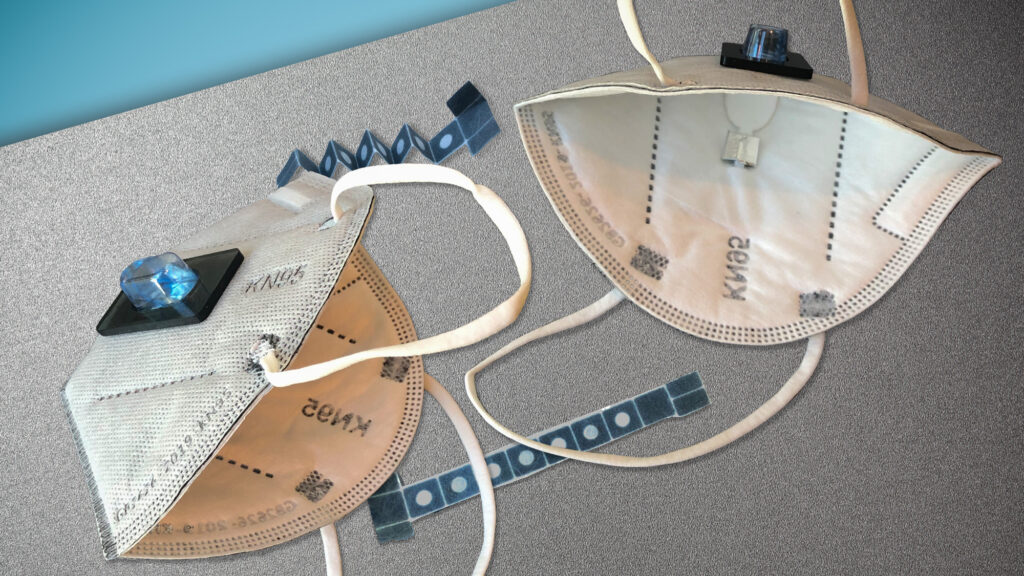
After a 10-minute conversation with an infected person, a face mask with an integrated virus sensor could detect trace amounts of the coronavirus.
The mask would then send a signal to the person wearing the face covering’s smartphone, allowing them to decide whether to leave an area where coronavirus is present – or to remove their mask if they felt safe when no virus was detected.
However, the results thus far are based on preliminary research. According to Yin Fang of Tongji University in China, the mask has not yet been tested against whole viruses, only the coronavirus’s surface proteins, and the technology is still in development.
Fang’s team created a face mask that detects outer proteins from three viruses: two flu strains, H5N1 and H1N1, and SARS-CoV-2, the virus that causes covid-19.
Aptamers, short strands of DNA or RNA that can be designed to bind to specific proteins, are used in the sensor within the mask’s breath valve. Aptamers are smaller and more stable than antibodies, which are used to detect the coronavirus spike protein in lateral flow tests.
When the aptamers bind to their target proteins, the electrical charge of the aptamer’s changes, and an integrated chip in the mask sends a signal to a designated smartphone.
The mask was tested by placing it in a closed chamber and spraying it with tiny drops of liquid containing the coronavirus spike protein or surface proteins from the two flu viruses, similar to those produced when an infected person coughs or talks.
The system could detect as little as 0.1 femtograms (0.0000000000000001 grammes) of protein per milliliter of fluid after 10 minutes.
The mask could be useful for people who need to be in indoor spaces with poor ventilation, says Fang. “It’s a new technique we can use to protect people.” The system could also be updated with aptamers that recognize different pathogens, he says.
The researchers have not yet determined how frequently the mask incorrectly emits an alert signal when it comes into contact with surface proteins from other viruses.
Al Edwards at the University of Reading, UK, says the idea has potential, but needs further testing. “It’s really hard to make things work in the real world,” he says.
The principle of using highly sensitive aptamer-based tests could also be exploited in other settings, such as placing the sensors within ventilation units or in hospital wards, he says.
To read our blog on “Uber and Lyft are no longer requiring drivers to wear masks in US,” click here